

Learning prefixes in English grammar is a direct way to understand how words change their meaning. A prefix is placed at the beginning of a root word and gives it a new sense or direction. They are often short but powerful parts that appear in everyday words and help form different meanings in academic and daily language.
In this post you’ll learn the most common prefixes, see their meanings, and check plenty of example words with their uses in sentences. By studying prefixes in English grammar, you’ll be able to talk about language in school subjects, exams, and study discussions with more accuracy.
In This Page
What Is a Prefix in English?
A prefix in English is a small group of letters placed at the beginning of a word that changes its meaning. It does not stand alone but works with a base word to give a new idea or direction. For example, adding un- to happy makes unhappy, and adding re- to write makes rewrite. Prefixes are used in grammar, vocabulary, science, and everyday speech.
Why Are Prefixes Important in Grammar?
Prefixes are important in grammar because they give new meanings to words without changing their core structure. By adding them, learners can quickly understand opposites, degrees, or time relationships in language. For example, dis- in disagree makes it the opposite of agree, and pre- in preview shows something before it happens.
They also make it easier to build vocabulary. When students know common prefixes, they can guess meanings of new words in reading, science, and academic subjects. This skill improves comprehension and makes learning smoother in schoolwork and study.
Types of Prefixes in English
Types of prefixes in English are grouped by the way they change the meaning of a base word. Each type has a special role, such as making a word negative, showing number, pointing to time, or giving degree. When you understand the types, you can see patterns in word formation and quickly recognize how words are built in grammar and study.
Negative Prefixes (un-, in-, dis-, etc.)
These prefixes give words the opposite or negative sense. They are common in everyday English.
- un-: not or opposite → unhappy, unclear, unfinished, unfair, untidy
- in-: not → incorrect, incomplete, invisible, indirect, inactive
- im-: not (before p, m, b) → impossible, immature, impolite, immobile
- ir-: not (before r) → irregular, irrelevant, irresponsible, irreplaceable
- il-: not (before l) → illegal, illogical, illegible, illicit
- dis-: opposite of → disagree, dislike, disconnect, disappear, dishonest
- non-: not → nonsense, nonstop, nonfiction, nonliving, nonprofit
Number Prefixes (mono-, bi-, tri-, etc.)
These prefixes show quantity or number. Many appear in math, science, and daily terms.
- mono-: one → monotone, monorail, monologue, monopoly
- uni-: one → unicorn, uniform, unicycle, universe
- bi-: two → bicycle, biweekly, bisect, bilateral
- di-: two, double → dioxide, dialogue, diploma
- tri-: three → triangle, triple, tripod, trilingual
- quadri- / tetra-: four → quadrant, quadruped, tetrahedron
- penta-: five → pentagon, pentathlon, pentameter
- hexa-: six → hexagon, hexapod, hexameter
- deca-: ten → decade, decagon, decathlon
- cent-: hundred → century, centimeter, centipede
- milli-: thousand → millimeter, millisecond, millipede
Size and Degree Prefixes (super-, over-, mini-, etc.)
These prefixes express how large, small, high, or low something is.
- super-: above, more → superman, supernatural, superstar
- over-: too much → overcook, overreact, overwork
- under-: too little, below → underpay, underweight, underestimate
- sub-: beneath, lower → submarine, subway, subzero
- mini-: small → minibus, miniature, miniskirt
- micro-: very small → microscope, microphone, microorganism
- macro-: large → macrocosm, macroeconomics, macrophage
- mega-: great, large → megabyte, megaphone, megastar
Time and Order Prefixes (pre-, post-, re-, etc.)
These prefixes show order, time, or repetition of an action.
- pre-: before → preview, prehistoric, prepay
- post-: after → postwar, postgraduate, postpone
- re-: again → rewrite, redo, rebuild
- ex-: former, out of → ex-president, exhale, export
- fore-: before, in front → forecast, foresee, forehead
Miscellaneous Common Prefixes
These prefixes have special uses that do not fit into the other groups.
- auto-: self → autograph, automatic, autopilot
- inter-: between → international, interact, interconnect
- trans-: across, change → transport, transform, translate
- mis-: wrong, badly → misunderstand, misplace, mislead
- co- / com- / con-: together → cooperate, combine, connect
- pro-: forward, in favor → promote, proactive, progress
- anti-: against → antibiotic, antifreeze, antisocial
- sub-: under → submerge, subdivide
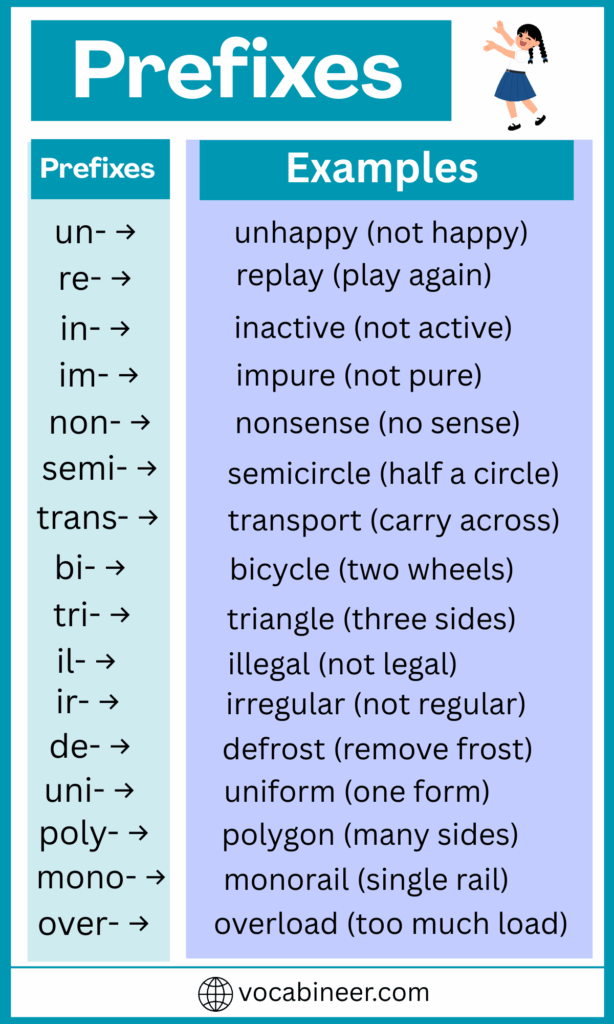
Easy Prefixes List with Meanings
Prefixes help you understand new words without always checking a dictionary. When you see a prefix at the beginning of a word, it gives you a clue about the meaning. This makes reading and study easier because many words can be understood just by breaking them down.
Below is a chart of some of the most common prefixes in English grammar, with their meanings and example words.
| Prefix | Meaning | Examples |
|---|---|---|
| un- | not, opposite | unhappy, unfair, unclear, untidy |
| dis- | not, opposite | disagree, dislike, dishonest, disconnect |
| pre- | before | preview, prepay, prehistoric, prefix |
| re- | again | redo, rebuild, rewrite, replay |
| over- | too much | overcook, overreact, overwork, overestimate |
| under- | too little, below | underpay, underground, underestimate, underweight |
| sub- | beneath, under | subway, submarine, subzero, subdivide |
| mis- | wrong, badly | mislead, misplace, misunderstand, misbehave |
| inter- | between | international, interconnect, interview, interact |
| auto- | self | autograph, automatic, autopilot, autonomous |
| trans- | across, change | transport, transform, translate, transaction |
| anti- | against | antibiotic, antifreeze, antisocial, antivirus |
| pro- | forward, in favor | promote, proactive, proclaim, progress |
| co- / com- / con- | together | cooperate, combine, connect, companion |
100 Examples of Prefixes Every Learner Should Know
Prefixes come before a root word and change its meaning. They can show number, time, place, direction, or even create opposites. By knowing common prefixes, learners can quickly understand and build many English words. Below is a large list of 100 prefixes with simple examples.
- un- → unhappy, unfair, unknown
- in- / im- / il- / ir- → incorrect, impossible, illegal, irregular
- non- → nonstop, nonsense, nonliving
- dis- → dislike, dishonest, disconnect
- mis- → misunderstand, misplace, misbehave
- mal- → malfunction, malnourished, malpractice
- anti- → antiwar, antibiotic, antifreeze
- contra- / counter- → contradict, counterattack, counterbalance
- mono- → monorail, monologue, monocycle
- uni- → uniform, unicorn, unicycle
- bi- / di- → bicycle, bilingual, dioxide
- tri- → triangle, tricycle, tripod
- quadri- / tetra- → quadrilateral, quadruple, tetragon
- penta- → pentagon, pentathlon, pentagram
- hexa- → hexagon, hexadecimal, hexapod
- hepta- → heptagon, heptathlon, heptameter
- octa- → octagon, octopus, octave
- nona- / ennea- → nonagon, ennead, nonagenarian
- deca- → decade, decagon, decimal
- cent- / centi- → century, centimeter, centipede
- milli- → millisecond, millimeter, millipede
- pre- → preview, prehistoric, preheat
- post- → postwar, postgraduate, postpone
- fore- → forecast, forewarn, forehead
- mid- → midnight, midterm, midway
- inter- → international, interconnect, interrupt
- intra- → intranet, intramural, intravenous
- extra- → extracurricular, extraordinary, extraterrestrial
- retro- → retroactive, retrospect, retrofit
- sub- → subway, submarine, substandard
- super- / supra- → supermarket, superhuman, supranational
- trans- → transport, translate, transact
- tele- → telephone, television, telepathy
- circum- → circumference, circumnavigate, circumvent
- peri- → perimeter, periscope, periphery
- epi- → epicenter, epidermis, epilogue
- ex- / e- → export, exhale, eject
- pro- → progress, promote, proceed
- over- → overcook, overestimate, overload
- under- → underpay, underground, underestimate
- hyper- → hyperactive, hypersensitive, hypertension
- hypo- → hypodermic, hypothermia, hypothesis
- mega- → megabyte, megastar, megaphone
- micro- → microscope, microorganism, microchip
- macro- → macroeconomics, macroscopic, macrostructure
- mini- → minibus, miniskirt, minimize
- maxi- → maximize, maxi-dress, maxilla
- poly- → polygon, polyglot, polyester
- multi- → multicolored, multimedia, multicultural
- omni- → omnivore, omnipresent, omniscient
- pan- → pandemic, panorama, panacea
- co- / com- / con- → cooperate, companion, connect
- syn- / sym- → synonym, symmetry, symphony
- with- → withstand, withdraw, withhold
- en- / em- → enable, empower, embrace
- up- → upward, uplift, upgrade
- down- → downhill, download, downsize
- out- → outrun, outgrow, outbreak
- auto- → autobiography, autograph, automatic
- bio- → biology, biography, biodegradable
- geo- → geography, geology, geothermal
- hydro- → hydroelectric, hydrogen, hydrate
- aero- → aeroplane, aerospace, aerodynamic
- thermo- → thermometer, thermostat, thermodynamic
- photo- → photograph, photosynthesis, photocopy
- chrono- → chronology, chronometer, synchronize
- astro- → astronaut, astronomy, astrophysics
- electro- → electricity, electromagnetic, electrode
- psycho- → psychology, psychiatrist, psychotic
- socio- → society, sociology, sociocultural
- techno- → technology, technocrat, technophile
Prefix Examples in Sentences
Understanding prefixes becomes easier when you see them used in full sentences.
- The soup was overcooked, so it tasted bitter.
- She felt unhappy after missing the event.
- The car became immobile after the accident.
- We must redo the project to fix the errors.
- His style was very unusual compared to others.
- The teacher gave a preview of the new lesson.
- The story was incomplete without the last chapter.
- They had to postpone the concert due to rain.
- The house was submerged after heavy rainfall.
- He signed his name as an autograph on the paper.
Difference Between Prefixes and Suffixes
Prefixes come before a base word, while suffixes are added at the end. The table below shows the contrast.
| Word | With Prefix | With Suffix |
|---|---|---|
| happy | unhappy | happiness |
| act | react | action |
| legal | illegal | legality |
| kind | unkind | kindness |
How to Learn Prefixes Easily
The best way to learn prefixes is to start with the most common ones like un-, dis-, pre-, and re-. Practice them in short word groups and use them in simple sentences.
Another quick method is to take a root word such as play or happy and add different prefixes to form new words like replay, unhappy, or misplay. By repeating this activity, prefixes become easier to remember and use.
Conclusion
Prefixes in English grammar are small word parts with big impact. They change meanings, form opposites, and create new ideas from simple roots. By learning common prefixes and practicing them in words and sentences, you gain confidence in reading and writing.
FAQs on Prefixes in English
A prefix is a part added to the beginning of a base word to change its meaning, while a suffix is added to the end to adjust its form or function.
No. Some words cannot accept certain prefixes because the prefix and root would not make sense together or may break normal word-building rules.
In most cases, the root word keeps its spelling when a prefix is added. For example, un + happy becomes unhappy without changing the spelling of happy.
When you know common prefixes, you can figure out the meaning of many new words by breaking them into prefix and root.
Yes, in English the prefix re- meaning “again” is usually used with verbs such as rewrite, rebuild, and replay.
Read More
