

Learning A to Z things name helps students recognize everyday objects and connect their English names with what they already see around them. This builds both vocabulary and understanding of common things used in daily life.
In this post, you’ll learn the names of familiar items arranged alphabetically. Knowing these names helps in classroom learning, speaking activities, and everyday communication.
In This Page
100 Common A to Z Things Name in English
Learning common A to Z things name in English helps learners talk about familiar objects they use or see every day. These words build practical English knowledge and improve confidence in describing daily life items at home, school, and outside.
Below is a list of 100 common things with their simple meanings:
Household Items
Household items are things we use every day at home for comfort, work, and cleaning. They make our daily lives easier and more organized.
- Chair: A piece of furniture with legs and a back used for sitting.
- Table: A flat surface with legs, often used for meals, study, or writing.
- Bed: A furniture piece made for resting or sleeping comfortably.
- Sofa: A soft seat designed for two or more people to sit together.
- Lamp: A device that provides light when switched on.
- Fan: A machine that moves air to make the room cooler.
- Clock: A device that shows time with moving hands or a digital display.
- Mirror: A smooth surface that reflects your face or image.
- Door: A wooden or metal structure used to open or close an entry.
- Window: An opening in a wall that lets air and sunlight into a room.
- Curtain: A cloth hanging used to cover windows for privacy or decoration.
- Cupboard: A piece of furniture used for storing dishes, clothes, or other items.
- Shelf: A flat board fixed to a wall or furniture for keeping things.
- Television: An electronic screen used for watching programs or news.
- Fridge: A machine that keeps food and drinks cold and fresh.
- Washing Machine: A household appliance used to clean clothes automatically.
- Oven: A heated box used for baking or roasting food.
- Microwave: A small electric oven that quickly heats or cooks food.
- Iron: A device used to remove wrinkles from clothes using heat.
Kitchen Items
Kitchen items are used to prepare, cook, and serve food. These are among the most common English words for daily home activities.
- Plate: A flat dish used to serve or eat food.
- Bowl: A deep round dish used for holding soup, fruit, or snacks.
- Cup: A small open container used to drink tea, milk, or coffee.
- Spoon: A small utensil used for eating or stirring liquids.
- Fork: A tool with pointed ends used for picking up or eating food.
- Knife: A sharp-edged tool used to cut food or vegetables.
- Glass: A clear cup used for drinking water or juice.
- Bottle: A container made of glass or plastic used to hold liquids.
- Mug: A cup with a handle used for hot drinks.
- Kettle: A metal pot used to boil water.
- Tray: A flat object used to carry dishes or cups.
- Pan: A flat cooking container used to fry or heat food.
- Pot: A deep round container used for boiling or cooking food.
- Oven Mitt: A padded glove used for handling hot cookware safely.
- Spatula: A flat tool used for flipping or spreading food.
- Ladle: A long-handled spoon used for serving soups or sauces.
- Chopping Board: A flat board used for cutting fruits and vegetables.
- Fridge: A machine that keeps food items cool and fresh.
- Stove: A kitchen appliance used for cooking food with gas or electricity.
School and Study Items
These are things students use in schools or at home for learning and writing. They help in studying, organizing, and improving English vocabulary.
- Book: Pages bound together containing text or pictures for reading.
- Pen: A writing tool that uses ink to write on paper.
- Pencil: A thin stick made of graphite used for writing or drawing.
- Notebook: A set of pages bound together for writing notes.
- Eraser: A soft object used to remove pencil marks.
- Ruler: A measuring tool used for drawing straight lines or measuring lengths.
- Bag: A container used by students to carry books and stationery.
- Desk: A flat surface used for studying or doing homework.
- Chair: A seat used by students while studying.
- Sharpener: A tool used to make a pencil tip pointed.
- Crayon: A stick of colored wax used for drawing.
- Highlighter: A colored pen used to mark important text.
- Glue: A sticky substance used to join paper or materials.
- Marker: A thick pen used for writing on boards or posters.
- Compass: A tool used for drawing circles or measuring angles.
- File: A folder used for keeping documents safe and organized.
- Folder: A thin cover used for holding papers together.
- Scale: A straight tool used to measure small lengths.
- Paper: A thin flat sheet used for writing, drawing, or printing.
Electronic Devices
Electronic devices are machines that use electricity to perform different tasks. They make communication, entertainment, and study easier.
- Phone: A device used to talk, text, or browse the internet.
- Computer: A machine used for typing, studying, and working.
- Laptop: A small, portable version of a computer.
- Tablet: A flat touch-screen device used for reading or watching videos.
- Keyboard: A panel with keys used to type letters or numbers.
- Mouse: A small hand-held device used to control a computer pointer.
- Printer: A device that prints words and pictures on paper.
- Television: An electronic device that displays pictures and sound.
- Camera: A device used to take photographs or record videos.
- Headphones: Devices worn on the ears to listen to sound privately.
- Speaker: A device that produces loud sound or music.
- Remote: A small device used to control electronics from a distance.
- Charger: A device used to power up electronic gadgets.
- Light Bulb: A small glass bulb that glows when electricity passes through.
- Fan: A device that moves air for cooling.
- Radio: A machine that plays sound and music through airwaves.
- Router: A device that provides internet connection to other devices.
- Projector: A device that displays images or videos on a wall or screen.
- Monitor: A screen that shows visuals from a computer.
- Microphone: A device that captures sound for speaking or recording.
Personal and Clothing Items
These are the things people wear or use for grooming and comfort. Learning their English names improves daily conversation about clothing and appearance.
- Watch: A small timepiece worn on the wrist.
- Wallet: A small case used to carry money and cards.
- Ring: A circular piece of jewelry worn on the finger.
- Key: A small metal tool used for locking and unlocking.
- Shoe: A covering worn on the foot while walking.
- Socks: Soft coverings worn on the feet inside shoes.
- Dress: A single piece of clothing worn by women and girls.
- Shirt: A garment worn on the upper body, usually with buttons.
- Pants: Clothing worn from the waist to the ankles.
- Hat: A head covering worn for warmth or protection.
- Jacket: A short coat worn for warmth or style.
- Belt: A strap worn around the waist to hold clothing.
- Scarf: A long piece of cloth worn around the neck or head.
- Gloves: Coverings for hands worn in cold weather.
- Comb: A small tool used for arranging hair.
- Soap: A substance used to wash the body or hands.
- Towel: A piece of cloth used for drying after bathing.
- Toothbrush: A small brush used to clean teeth.
- Toothpaste: A soft substance used with a toothbrush to clean teeth.
Travel and Transport Items
These are things that help people travel from one place to another safely and comfortably.
- Car: A four-wheeled vehicle used for personal transport.
- Bus: A large vehicle used to carry many passengers.
- Train: A connected set of vehicles that runs on tracks.
- Bicycle: A two-wheeled vehicle moved by pedaling.
- Motorbike: A fast two-wheeled vehicle powered by an engine.
- Truck: A large vehicle used for carrying heavy goods.
- Plane: A flying vehicle that carries people and cargo through the air.
- Boat: A small watercraft used on rivers and lakes.
- Ship: A large vessel used for sea travel and transport.
- Helicopter: A flying vehicle that lifts vertically using rotating blades.
- Bridge: A structure built to cross rivers, roads, or valleys.
- Road: A smooth surface built for vehicles and walking.
- Ticket: A printed paper used for entry or travel permission.
- Helmet: A hard protective covering worn on the head for safety.
- Map: A drawing that shows roads, cities, or areas.
- Fuel: A substance that powers vehicles like cars or bikes.
- Key: A tool used to start or unlock vehicles.
- Wallet: A small pouch for holding travel money.
- Backpack: A bag carried on the back for travel or school.
Nature and Outdoor Things
These names describe natural objects and outdoor elements found in our environment.
- Tree: A tall plant with a wooden trunk and branches.
- Flower: The colorful part of a plant that blooms beautifully.
- Grass: Small green plants that cover the ground.
- Leaf: A flat green part of a plant that makes food.
- Fruit: The sweet edible part of a plant containing seeds.
- Vegetable: A plant part eaten as food.
- Sun: The bright star that gives light and warmth to Earth.
- Cloud: A white or gray mass of tiny water droplets in the sky.
- Rain: Water that falls from clouds to the ground.
- Mountain: A tall, raised piece of land with a peak.
- River: A long stream of flowing water.
- Sand: Tiny grains found on beaches and deserts.
- Stone: A small hard piece of natural rock.
- Plant: A living thing that grows in soil and makes its food.
- Soil: The upper layer of earth that supports plant growth.
- Wind: Moving air that can be felt outdoors.
- Sky: The space above the Earth seen from the ground.
- Field: An open area of land used for farming or sports.
- Seed: The small part of a plant that grows into a new one.

A to Z Things Name List
Each letter introduces common objects that people use or see every day. These words help build practical vocabulary for home, school, and nature.
Things Starting with A
Objects beginning with A are common in homes, schools, and outdoor spaces. They are easy to recognize and fun to learn.
- Apple
- Ant
- Axe
- Apron
- Airplane
- Arrow
- Anchor
- Alarm
- Avocado
- Almond
- Apricot
- Aquarium
- Album
- Armchair
- Alley
- Arch
- Ashtray
- Artboard
- Arrowhead
- Address
Things Starting with B
B words include many objects found indoors and outdoors, useful for describing common daily items.
- Ball
- Bag
- Bat
- Box
- Brush
- Bed
- Book
- Bottle
- Bell
- Banana
- Basket
- Button
- Blanket
- Bench
- Broom
- Bread
- Bowl
- Bridge
- Brush
- Bucket
Things Starting with C
C words include furniture, foods, and useful home and classroom items.
- Car
- Cup
- Cat
- Chair
- Clock
- Candle
- Camera
- Carpet
- Cap
- Chain
- Cake
- Coin
- Cupboard
- Cage
- Comb
- Curtain
- Calendar
- Cart
- Cushion
- Clip
Things Starting with D
These D words cover animals, objects, and things used daily at home and school.
- Dog
- Door
- Drum
- Desk
- Duck
- Dress
- Dish
- Doll
- Dice
- Donkey
- Drawer
- Diamond
- Diary
- Dustbin
- Doormat
- Dolphin
- Document
- Duster
- Doorbell
- Drumstick
Things Starting with E
E objects include animals, tools, and common household items.
- Egg
- Envelope
- Ear
- Engine
- Elephant
- Eraser
- Eye
- Elevator
- Earth
- Easel
- Earring
- Edge
- Envelope
- Elbow
- Extension
- Envelope
- Exit
- Equipment
- Envelope
Things Starting with F
F items include nature, tools, and furniture.
- Fan
- Fish
- Fork
- Flower
- Flag
- Frame
- Fence
- Finger
- Fruit
- Feather
- Floor
- Fire
- Frog
- Flashlight
- Fridge
- File
- Funnel
- Flute
- Forest
- Fence
Things Starting with G
G items are a mix of household and natural things.
- Goat
- Glass
- Gate
- Gift
- Grapes
- Guitar
- Globe
- Grass
- Gloves
- Garlic
- Garden
- Game
- Garage
- Gold
- Gas stove
- Grain
- Glasses
- Gum
- Ground
- Gear
Things Starting with H
H items include things from home, clothing, and outdoor life.
- Hat
- Hammer
- Hand
- House
- Horse
- Heart
- Hose
- Helicopter
- Hill
- Honey
- Hanger
- Handle
- Headphone
- Heater
- Helmet
- Honeycomb
- Hook
- Hospital
- Hurdle
- Hinge
Things Starting with I
I objects include things related to science, home, and imagination.
- Ink
- Ice
- Iron
- Island
- Igloo
- Insect
- Ice cream
- Invitation
- Instrument
- Inkpot
- Idea
- Item
- Iron box
- Ice cube
- Idol
- Inkwell
- Internet
- Invoice
- Ivory
- Inkpen
Things Starting with J
J items are easy to learn and common in school or home.
- Jar
- Jug
- Jacket
- Jam
- Jeans
- Juice
- Jet
- Jungle
- Jewel
- Joker
- Jump rope
- Jeep
- Jewelry
- Juice box
- Jackfruit
- Jigsaw
- Journal
- Joystick
- Jar lid
- Junction
Things Starting with K
K words often describe kitchen tools, clothing, or animals.
- Key
- Knife
- Kite
- King
- Kettle
- Kitten
- Keyboard
- Knot
- Kiwi
- Kitchen
- Kangaroo
- Knee
- Ketchup
- Keychain
- Kid
- Knob
- Kettle drum
- Kit
- Kickstand
- Kernel
Things Starting with L
L objects are common around the house, outdoors, and in school.
- Lamp
- Leaf
- Lion
- Ladder
- Lock
- Lemon
- Laptop
- Leg
- Letter
- Lollipop
- Log
- Light
- Lamp post
- Lake
- Lid
- Lunchbox
- Locket
- Lipstick
- Lizard
- Luggage
Things Starting with M
M covers many words about nature, home, and everyday use.
- Map
- Mug
- Mirror
- Mouse
- Magnet
- Mango
- Mask
- Mat
- Moon
- Milk
- Marker
- Machine
- Mushroom
- Mattress
- Microphone
- Motor
- Magazine
- Mug
- Matchbox
- Mailbox
Things Starting with N
N objects include items from home, school, and nature.
- Net
- Nail
- Necklace
- Needle
- Notebook
- Nose
- Napkin
- Newspaper
- Nest
- Nail cutter
- Nut
- Nightstand
- Note
- Name tag
- Necklace chain
- Noodles
- Nib
- Nest box
- Night lamp
- Notebook cover
Things Starting with O
O includes many words used for food, home, and travel.
- Orange
- Onion
- Oven
- Owl
- Oil
- Octopus
- Ocean
- Ornament
- Office
- Omelet
- Oar
- Olive
- Outlet
- Object
- Organ
- Oxygen
- Operator
- Ointment
- Orchard
- Overcoat
Things Starting with P
P includes daily use objects, tools, and foods.
- Pen
- Pencil
- Paper
- Plate
- Pillow
- Plant
- Phone
- Pan
- Pear
- Pot
- Paintbrush
- Purse
- Plug
- Pipe
- Paperclip
- Pillowcase
- Pineapple
- Piano
- Packet
- Poster
Things Starting with Q
Q words are fewer but still useful to learn.
- Queen
- Quilt
- Quill
- Quarter
- Question
- Quiver
- Quinoa
- Quartz
- Queue
- Quotation
- Quadcopter
- Quaker
- Quarantine tent
- Quarry
- Quilt cover
- Quota
- Quokka
- Quencher
- Quiz paper
- Quiver bag
Things Starting with R
R objects include tools, gadgets, and natural items.
- Ring
- Radio
- Rabbit
- Rope
- Road
- Ruler
- Rose
- Raincoat
- Refrigerator
- Rock
- Rubber
- Rack
- Razor
- Robot
- Rag
- Remote
- Railing
- River
- Room
- Rucksack
Things Starting with S
S items are common in homes, schools, and nature.
- Sun
- Shoe
- Spoon
- Sock
- Scarf
- Ship
- Sand
- Soap
- Star
- Stone
- Scissors
- Snake
- Shelf
- Sandwich
- Switch
- Stick
- Seed
- Stove
- Shirt
- Sofa
Things Starting with T
T words include furniture, tools, and everyday things.
- Table
- Tiger
- Tap
- Truck
- Toy
- Tree
- Towel
- Tomato
- Train
- Telephone
- Tent
- Television
- Tray
- Torch
- Tire
- Ticket
- Tie
- Tank
- Tunnel
- Thread
Things Starting with U
U includes unique and uncommon words that expand your vocabulary.
- Umbrella
- Uniform
- Urn
- Unicorn
- Utensil
- University
- USB
- Unicycle
- Unit
- Utensil holder
- Upholstery
- Urchin
- U-turn sign
- Utility knife
- Urgent light
- User card
- Undershirt
- Uniform cap
- Upper shelf
- Ultrabook
Things Starting with V
V words describe items, instruments, and objects.
- Van
- Vase
- Violin
- Vegetable
- Volcano
- Vest
- Village
- Vehicle
- Vacuum
- Velvet
- Valve
- Vine
- Video
- Viewfinder
- Visa
- Vitamin
- Vent
- Velvet cloth
- Volume button
- Vial
Things Starting with W
W words include nature, home, and clothing items.
- Water
- Watch
- Wall
- Window
- Wheel
- Wire
- Worm
- Whale
- Wallet
- Whistle
- Wagon
- Wing
- Wheat
- Wardrobe
- Washer
- Wrap
- Weather vane
- Wheelchair
- Wool
- Workshop
Things Starting with X
Words starting with X are rare but important for vocabulary.
- Xylophone
- Xerox
- X-ray
- X-axis
- Xylem
- Xylograph
- Xiphosuran
- Xenon lamp
- Xylitol
- Xyloid
- Xylose
- Xyst
- X-chromosome
- Xylography tool
- Xiphias
- Xerophyte
- Xystarch
- Xylograph board
- Xebec
- Xylan
Things Starting with Y
Y words describe living things and useful objects.
- Yarn
- Yacht
- Yak
- Yolk
- Yard
- Yo-yo
- Yogurt
- Yawn
- Yearbook
- Yellow flower
- Yardstick
- Yoke
- Yurt
- Yarrow
- Young plant
- Year calendar
- Yellow cap
- Yule log
- Yard gate
- Youth cap
Things Starting with Z
Z words are short and interesting English object names.
- Zoo
- Zebra
- Zip
- Zero
- Zigzag
- Zinc
- Zipper
- Zone
- Zucchini
- Zeppelin
- Zoom lens
- Zinnia
- Zodiac chart
- Zinc plate
- Zipper bag
- Zipline
- Zigzag road
- Zither
- Zinc pot
- Zodiac sign
FAQs about A to Z Things Name
They are everyday objects whose English names start from each letter of the alphabet, helping learners practice and remember common vocabulary in order.
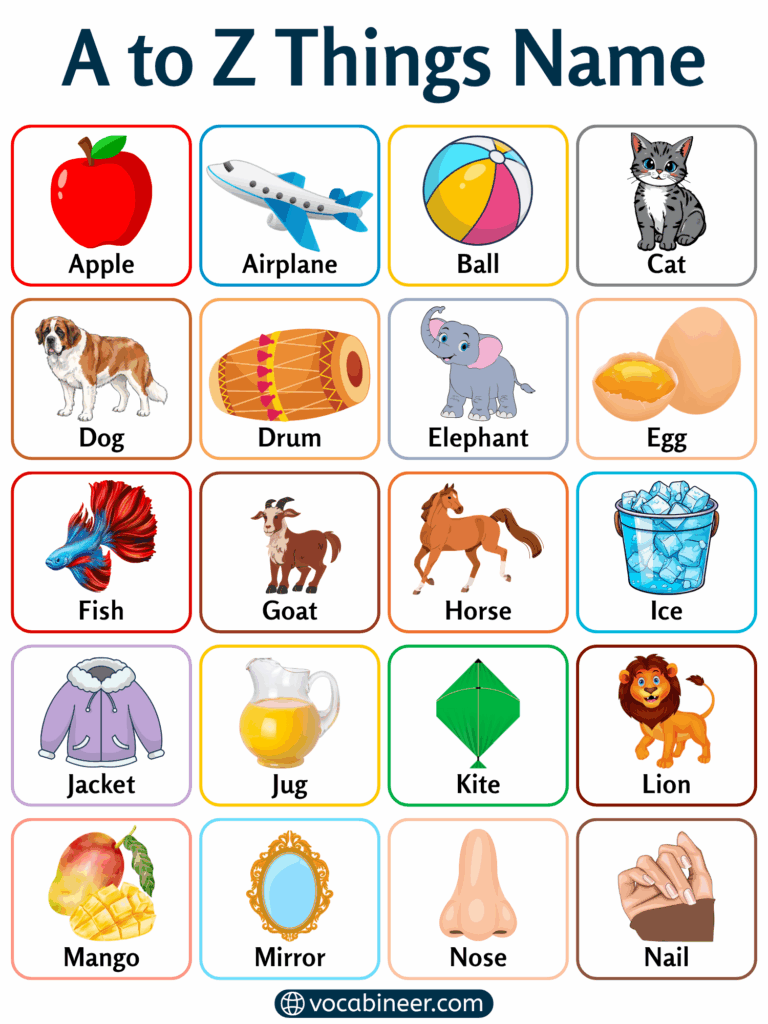
Pictures create a visual link between the word and the object. Seeing the image helps learners remember meanings faster and use the words correctly.
No. These words are useful for learners of all ages who want to improve basic English vocabulary and daily speaking skills.
Read, write, and say each word aloud. Try labeling household items or matching names with pictures to strengthen memory.
Knowing these names helps describe everyday situations easily, talk about surroundings, and build strong English communication skills for real-life use.
Conclusion
Learning A to Z things name makes understanding daily life vocabulary much easier. When learners connect words with objects they see every day, it strengthens memory and helps them describe things naturally in English. From common household items to objects in school, kitchen, and nature, these names build a strong base for communication and confidence in learning English.
Read More
