

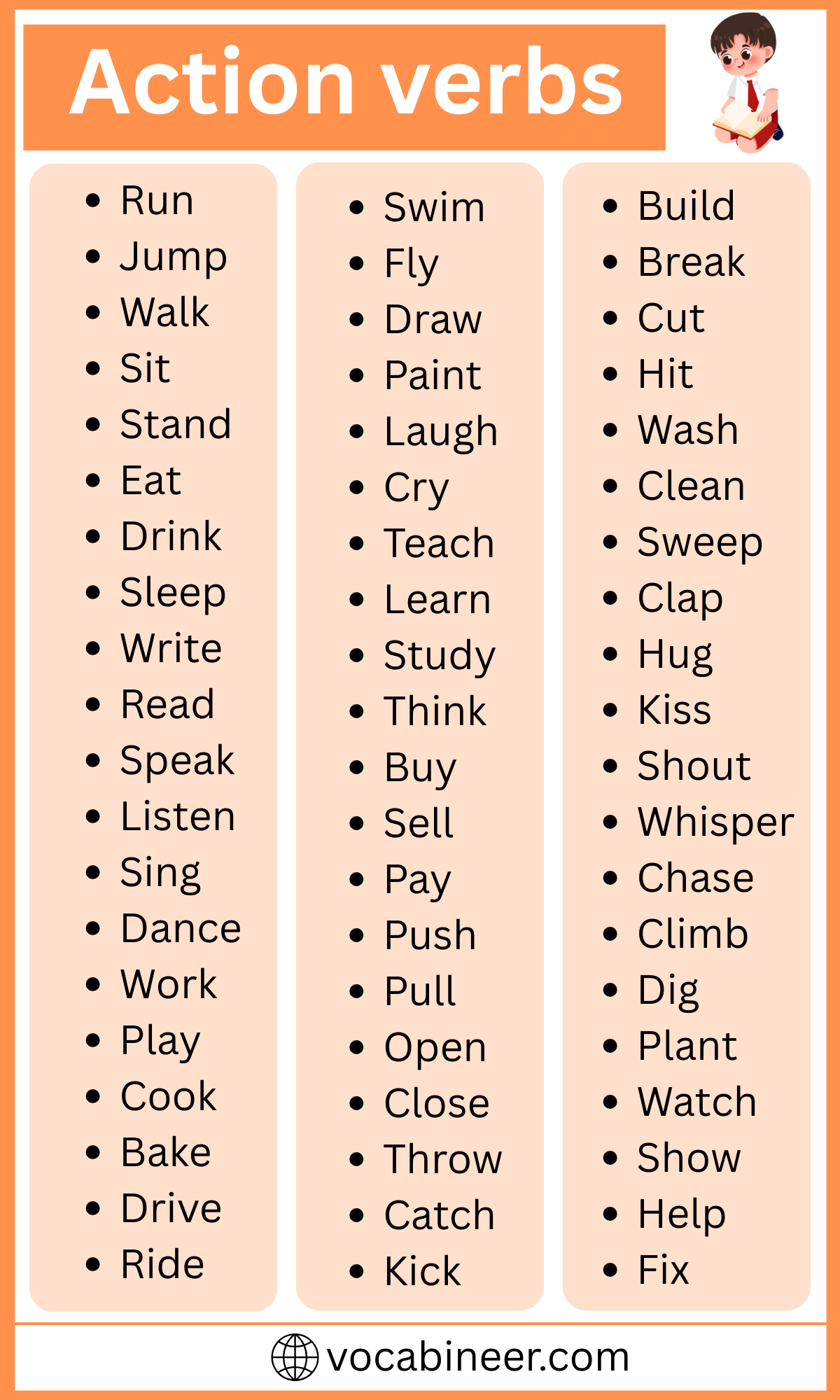
Action words are verbs that show what someone or something does in a sentence. They are also called action verbs or doing words. Words like run, eat, write, jump, speak, and play are common action words used in daily English. These words help us describe actions clearly, whether someone is moving, speaking, learning, working, or doing something in everyday life.
Learning action words helps kids, students, and English learners build vocabulary, write clearer sentences, and speak with more confidence. When students understand words like read, draw, listen, cook, clean, and help, they can make simple sentences more easily. The examples below show how action words are used in everyday sentences, school activities, daily routines, and basic grammar practice.
In This Page
What Are Action Verbs?
Action verbs are words that show what someone is doing. They tell us about movements or everyday activities. These verbs are used when we talk about what people, animals, or things do.
Examples:
- The boy runs.
- She writes a story.
- The dog jumps.
- We eat lunch.
- The baby sleeps.
In each sentence, the bold word shows an action.
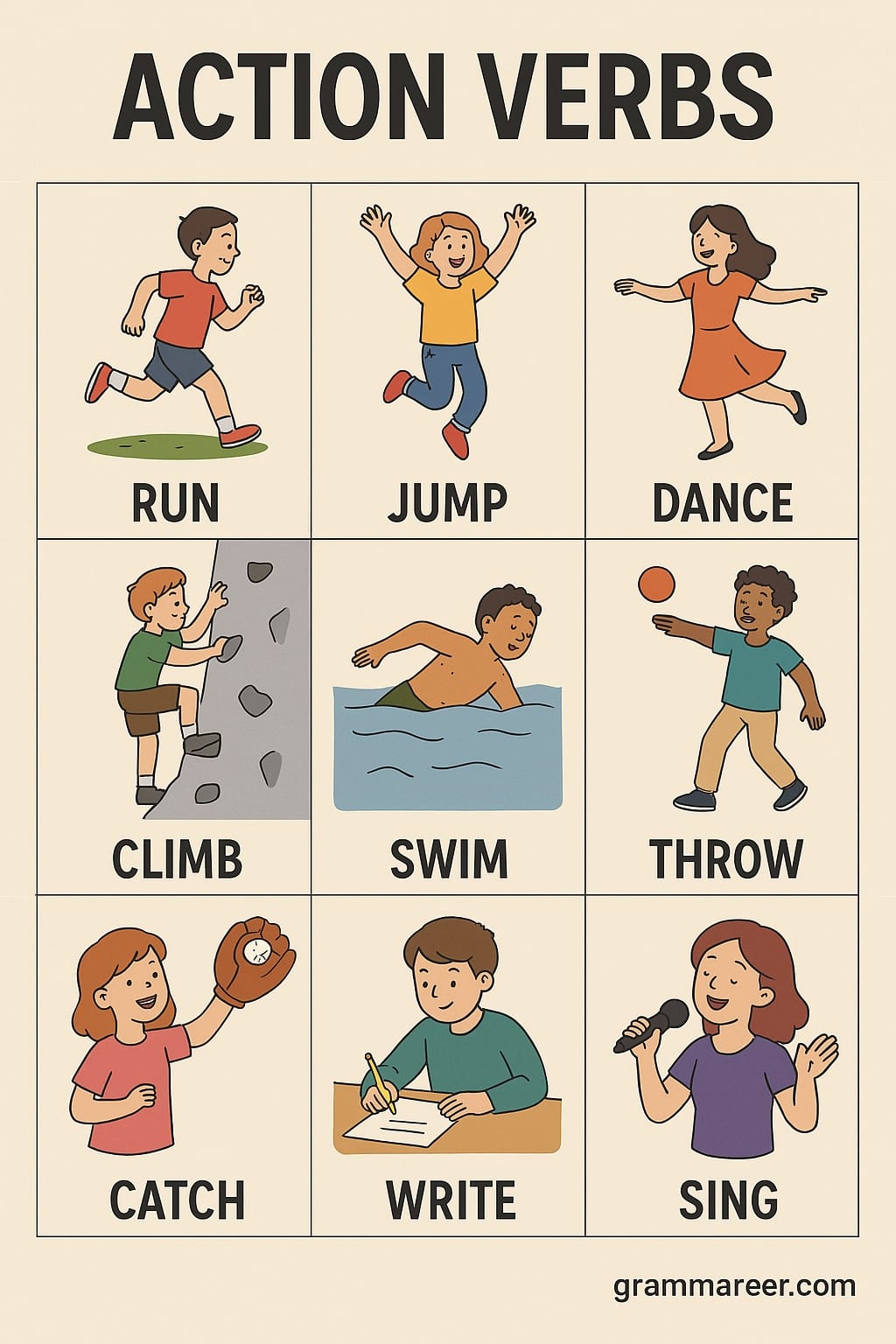
Action Words Are Also Called Doing Words
Action words are often called doing words because they tell what someone or something does. This name is common in beginner grammar lessons.
Examples:
- The teacher teaches.
- The child draws.
- The bird flies.
- The baby crawls.
- The girl reads.
Doing words make sentences complete and easier to understand.
100 Action Words in English with Sentences
Here is a numbered list of 100 action words with simple meanings and example sentences.
Basic Action Words
- Run – To move quickly using your legs.
She runs in the park. - Walk – To move on foot.
We walk to school. - Jump – To push yourself into the air.
The child jumps high. - Eat – To take food into your mouth.
I eat breakfast every morning. - Drink – To take liquid into your mouth.
He drinks water after running. - Sleep – To rest your body and mind.
The baby sleeps peacefully. - Sit – To rest on a chair or surface.
Please sit on the chair. - Stand – To be upright on your feet.
He stands near the door. - Read – To look at and understand words.
She reads a storybook. - Write – To form letters or words.
I write in my notebook. - Speak – To say words using your voice.
He speaks clearly. - Listen – To pay attention to sound.
We listen to the teacher. - Sing – To make music with your voice.
She sings a sweet song. - Dance – To move your body to music.
They dance at the party. - Cook – To prepare food.
My mother cooks dinner. - Clean – To remove dirt or mess.
I clean my room every Sunday. - Wash – To clean with water.
He washes his hands. - Drive – To control a vehicle.
She drives to work. - Swim – To move through water.
They swim in the pool. - Climb – To go upward using hands or feet.
We climb the hill.
Daily Routine Action Words
- Brush – To clean with a brush.
I brush my teeth twice a day. - Comb – To arrange hair with a comb.
She combs her hair carefully. - Open – To make something not closed.
He opens the door. - Close – To shut something.
Please close the window. - Wear – To have clothes on your body.
She wears a blue dress. - Buy – To get something by paying money.
We buy fruit from the market. - Sell – To give something for money.
The farmers sell fresh vegetables. - Pay – To give money for something.
My father pays the bill. - Bring – To carry something to a place.
Please bring your book. - Take – To get or carry something.
I take my bag to school. - Catch – To stop and hold something moving.
She catches the ball. - Throw – To send something through the air.
He throws the ball. - Draw – To make a picture.
She draws a flower. - Cut – To divide with a sharp tool.
He cuts the paper. - Fold – To bend something neatly.
He folds his clothes.
Speaking and Emotion Action Words
- Call – To speak by phone or shout a name.
I call my friend. - Text – To send a written message.
He texts his brother. - Ask – To say something to get information.
She asks a question. - Answer – To reply to a question.
He answers correctly. - Tell – To give information in words.
Please tell me the truth. - Say – To speak words.
They say hello. - Shout – To speak very loudly.
He shouts for help. - Whisper – To speak very softly.
She whispers a secret. - Laugh – To show happiness with sound.
We laugh at the joke. - Cry – To shed tears.
The baby cries loudly. - Smile – To show happiness on your face.
He smiles at the camera. - Frown – To show sadness or anger on your face.
She frowns at the mess. - Complain – To say you are unhappy about something.
They complain about the noise. - Apologize – To say sorry.
He apologizes for being late. - Thank – To show gratitude.
I thank her for the gift.
Thinking, Learning, and Study Action Words
- Think – To use your mind.
I think about the answer. - Check – To look carefully at something.
He checks his answer. - Learn – To get knowledge or skill.
We learn English at school. - Teach – To help someone learn.
She teaches math. - Remember – To keep something in your mind.
I remember his name. - Forget – To not remember.
Do not forget your keys. - Decide – To choose something.
We decide to stay home. - Guess – To give an answer without being sure.
Can you guess the number? - Plan – To think about what to do.
I plan my day. - Imagine – To picture something in your mind.
Imagine a big castle. - Study – To learn by reading or practicing.
They study for the test. - Solve – To find the answer to a problem.
We solve the puzzle. - Practice – To do something again to improve.
I practice English every day. - Review – To study something again.
We review the lesson before the test. - Notice – To see or become aware of something.
She notices a small mistake.
Some thinking verbs can also describe a state, depending on how they are used. For beginners, words like think, remember, decide, learn, and solve are useful mental action examples.
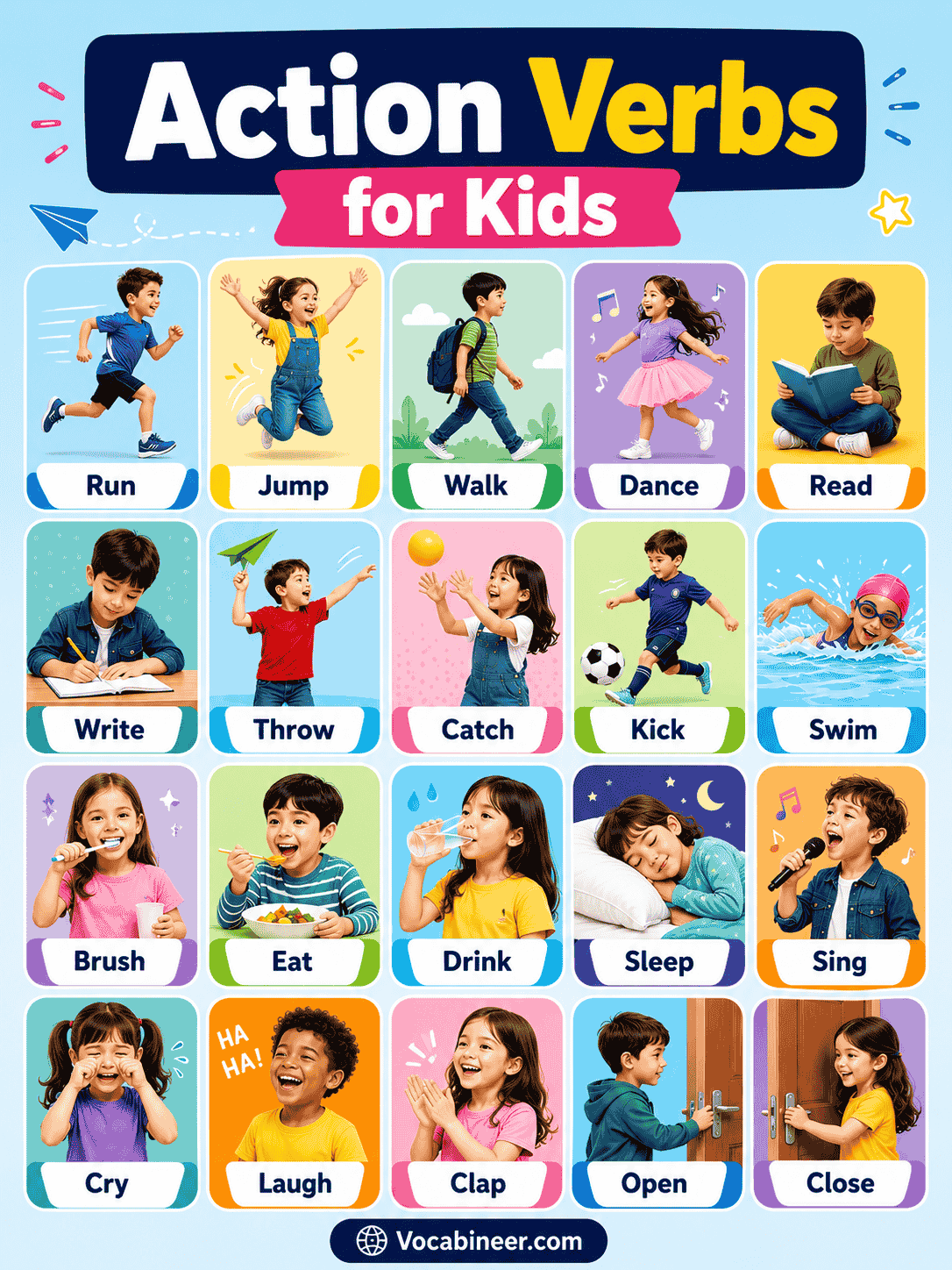
Movement and Travel Action Words
- Move – To change place or position.
We move the table. - Travel – To go from one place to another.
They travel by train. - Arrive – To reach a place.
She arrives on time. - Leave – To go away from a place.
He leaves early. - Enter – To go inside.
We enter the room quietly. - Exit – To go out.
Please exit through the gate. - Push – To move something away with force.
He pushes the door open. - Pull – To bring something closer with force.
She pulls the rope. - Pick – To choose or take something.
He picks a flower. - Drop – To let something fall.
She drops her keys. - Shake – To move quickly back and forth.
They shake hands. - Carry – To hold and move something.
He carries the box. - Lift – To raise something up.
She lifts the bag. - Kick – To hit with the foot.
He kicks the ball. - Fly – To move through the air.
Birds fly in the sky.
Work and Everyday Action Words
- Work – To do a job or task.
He works in an office. - Earn – To get money for work.
She earns money from her online class. - Spend – To use money or time.
We spend the weekend at home. - Save – To keep money or something useful.
I save money for a bike. - Send – To make something go to someone.
He sends an email. - Receive – To get something.
I receive a letter. - Help – To make something easier for someone.
Can you help me? - Build – To make something by putting parts together.
They build a small house. - Break – To damage something.
He breaks the glass by mistake. - Fix – To repair something.
I fix my bicycle. - Paint – To add color to something.
We paint the wall. - Tie – To fasten with a knot.
She ties her shoes. - Plant – To put seeds or plants in the ground.
We plant flowers. - Grow – To become bigger.
The tree grows fast. - Choose – To pick one thing.
She chooses a red pen. - Share – To give part of something to others.
They share their toys. - Count – To say numbers in order.
He counts the apples. - Spell – To say or write letters in order.
I spell my name. - Start – To begin something.
We start the game. - Finish – To end or complete something.
She finishes the race.
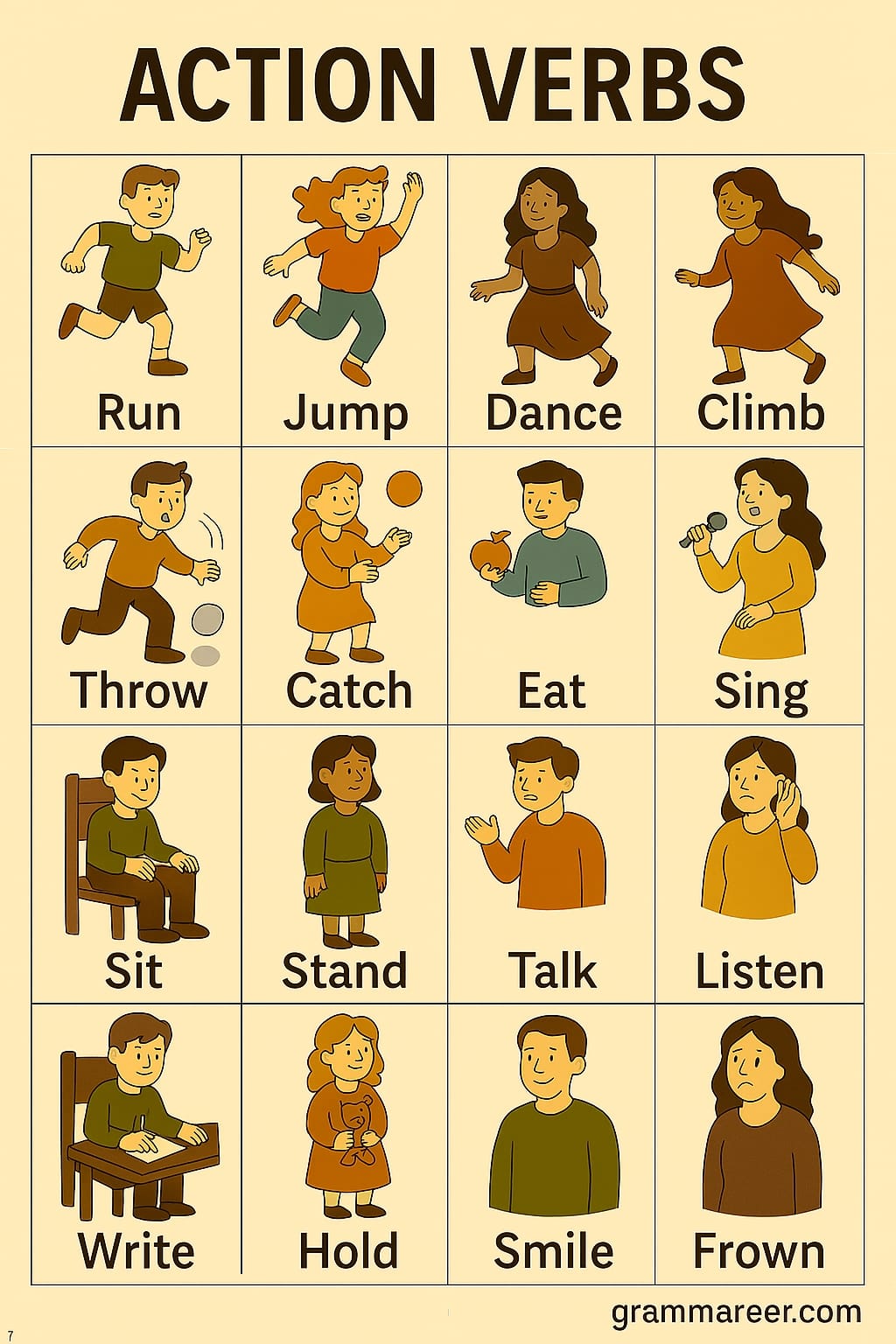
How to Use Action Words in Sentences
You can use action words to make simple sentences. Start with a subject, add an action word, and then add more information.
Examples:
- Subject + action word: Birds fly.
- Subject + action word + object: She reads a book.
- Subject + action word + place: They play in the park.
- Subject + action word + time: We eat dinner at night.
Action words make sentences clear because they show what is happening.
Easy Action Words for Kids
Kids can start with simple doing words that are easy to act out, say, and use in short sentences.
- Run – The boy runs fast.
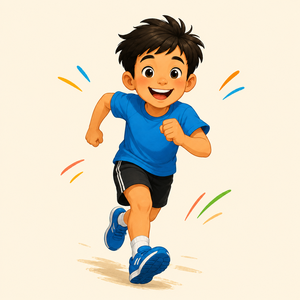
- Walk – We walk to school.

- Jump – The rabbit jumps high.

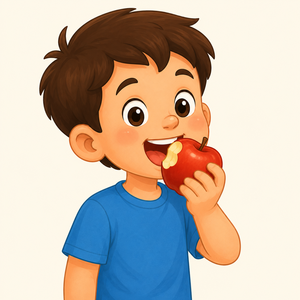
- Eat – I eat an apple.
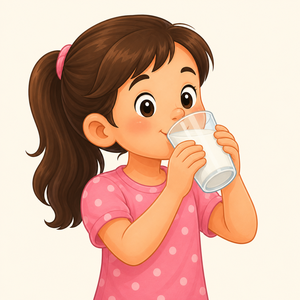
- Drink – She drinks milk.
- Sleep – The baby sleeps.

- Read – He reads a book.

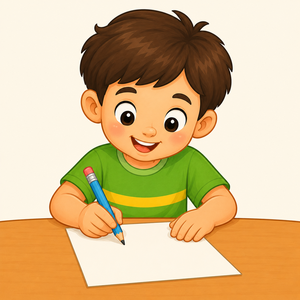
- Write – I write my name.
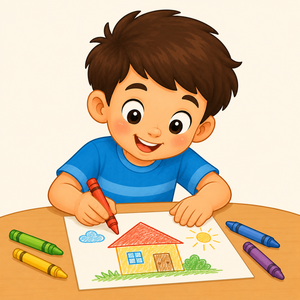
- Draw – They draw a house.
- Clap – We clap our hands.

- Sing – She sings a song.
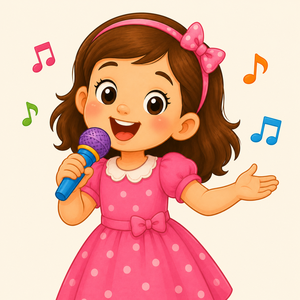
- Dance – The children dance.
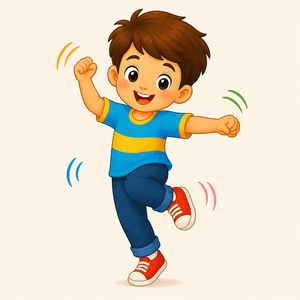
- Smile – He smiles at his friend.

- Cry – The baby cries loudly.

- Kick – She kicks the ball.
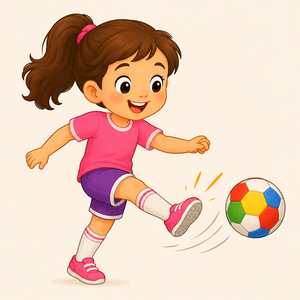
- Throw – He throws the ball.

- Catch – I catch the ball.
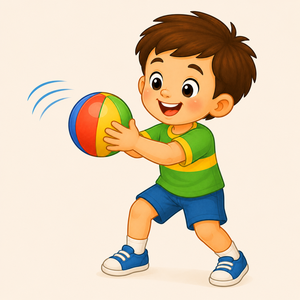
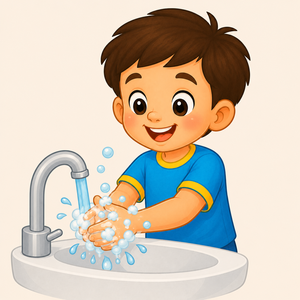
- Wash – We wash our hands.
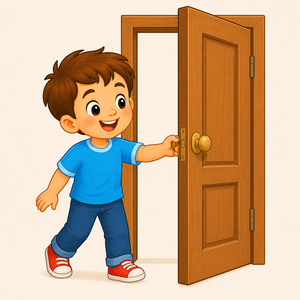
- Open – Please open the door.
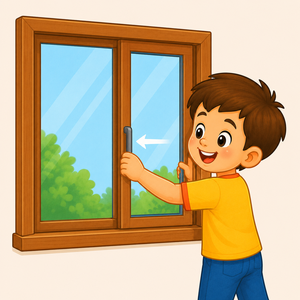
- Close – Please close the window.
These words are useful for early vocabulary lessons, speaking practice, and simple sentence writing.
School Action Words
School action words help students talk about classroom activities, lessons, homework, and learning.
- Read – We read a story in class.
- Write – She writes the answer.
- Listen – The students listen carefully.
- Speak – He speaks in English.
- Learn – We learn new words.
- Teach – The teacher teaches math.
- Ask – I ask a question.
- Answer – He answers the question.
- Count – They count numbers.
- Spell – I spell my name.
- Study – He studies for the test.
- Solve – We solve the math problem.
- Draw – She draws a flower.
- Color – The children color the picture.
- Copy – I copy the sentence.
- Check – She checks her answer.
- Practice – We practice reading.
- Review – They review the lesson.
- Complete – He completes his homework.
- Present – She presents her project.
Teachers can use these words for vocabulary lessons, sentence writing, classroom activities, and speaking practice.
Daily Use Action Words
Daily use action words describe common activities people do at home, school, work, and outside.
- Wake – I wake up early.
- Brush – I brush my teeth.
- Wash – He washes his hands.
- Comb – She combs her hair.
- Wear – He wears a jacket.
- Cook – My mother cooks dinner.
- Eat – We eat lunch together.
- Drink – She drinks water.
- Clean – We clean the room.
- Open – Please open the door.
- Close – Please close the window.
- Buy – They buy fruit.
- Pay – He pays the shopkeeper.
- Carry – She carries her bag.
- Help – I help my mother.
- Call – He calls his friend.
- Text – She texts her sister.
- Drive – My father drives to work.
- Walk – We walk in the park.
- Sleep – The baby sleeps at night.
These examples help learners connect action words with real daily activities.
Types of Action Verbs
Action verbs can be grouped in different ways. Some show physical actions, some show mental actions, and some need objects to complete their meaning.
Physical Action Verbs
Physical action verbs show actions we can see or do with the body.
Examples:
- Run
- Walk
- Jump
- Sit
- Stand
- Eat
- Drink
- Swim
- Dance
- Clap
- Kick
- Throw
- Catch
- Push
- Pull
- Carry
Example sentences:
- The children jump on the grass.
- She swims in the pool.
- We walk to school.
- He throws the ball.
- They carry the box.
Mental Action Verbs
Mental action verbs show actions of the mind.
Examples:
- Think
- Decide
- Imagine
- Remember
- Forget
- Learn
- Study
- Solve
- Guess
- Plan
- Notice
- Review
Example sentences:
- I think about the answer.
- She decides to read a book.
- We learn new words.
- He solves the puzzle.
- They review the lesson.
Some verbs, such as know, love, want, need, and seem, usually describe states, not actions. These are often called non-action verbs or stative verbs.
Transitive Action Verbs
Transitive action verbs need an object to complete their meaning. The object receives the action.
Examples:
- She reads a book.
- He eats an apple.
- They play football.
- I write a letter.
- We clean the room.
- She opens the door.
- He carries the bag.
Intransitive Action Verbs
Intransitive action verbs do not need an object. The sentence can be complete without one.
Examples:
- The baby sleeps.
- Birds fly.
- The child cries.
- He runs fast.
- She laughs loudly.
- They arrived early.
- We waited outside.
Action Verbs in Different Tenses
Action verbs can change form to show time. They can describe actions in the present, past, future, or continuous tense.
| Tense | Example |
|---|---|
| Simple Present | She writes a letter. |
| Simple Past | She wrote a letter. |
| Future Tense | She will write a letter. |
| Present Continuous | She is writing a letter. |
| Past Continuous | She was writing a letter. |
Here are more examples with common action words:
| Base Verb | Past Form | Example Sentence |
|---|---|---|
| Run | Ran | He ran fast. |
| Eat | Ate | I ate lunch. |
| Write | Wrote | She wrote a letter. |
| Go | Went | They went to school. |
| Take | Took | I took my bag. |
| Sing | Sang | She sang a song. |
| Swim | Swam | They swam in the pool. |
| Drive | Drove | He drove to work. |
| Play | Played | The children played outside. |
| Walk | Walked | We walked home. |
| Clean | Cleaned | I cleaned my room. |
| Open | Opened | She opened the window. |
Action Verbs vs Linking Verbs
Action verbs and linking verbs are different.
| Type | What It Does | Example |
|---|---|---|
| Action Verb | Shows an action | She runs fast. |
| Linking Verb | Connects the subject to information | She is happy. |
In “She runs fast,” the word runs shows an action.
In “She is happy,” the word is does not show action. It connects the subject she to the word happy.
Action Verbs vs Non-Action Verbs
Action verbs show what someone does. Non-action verbs describe a state, feeling, need, thought, or condition.
Examples:
- Action verb: She writes a story.
- Non-action verb: She knows the answer.
- Action verb: They play outside.
- Non-action verb: He needs help.
- Action verb: I open the door.
- Non-action verb: I like this book.
Common non-action verbs include know, love, want, need, like, believe, and seem.
Common Mistakes with Action Words
Here are some common mistakes beginners should avoid.
Wrong: She a book.
Correct: She reads a book.
Wrong: He run fast.
Correct: He runs fast.
Wrong: She goed to school.
Correct: She went to school.
Wrong: I am knowing the answer.
Correct: I know the answer.
Wrong: They plays football.
Correct: They play football.
Wrong: We was eating lunch.
Correct: We were eating lunch.
Wrong: He don’t write neatly.
Correct: He doesn’t write neatly.
Wrong: She write a letter yesterday.
Correct: She wrote a letter yesterday.
Strong Action Words for Better Sentences
Strong action words make writing clearer and more active. They help the reader understand the action quickly.
- Create – She created a birthday card.
- Build – They built a small house.
- Improve – He improved his reading.
- Repair – They repaired the chair.
- Organize – We organized the books.
- Complete – I completed my homework.
- Solve – We solved the puzzle.
- Discover – They discovered a new path.
- Choose – She chose the best answer.
- Prepare – He prepared his school bag.
- Share – They shared their toys.
- Explain – The teacher explained the lesson.
Use strong action words when you want your sentence to sound clear, active, and direct.
FAQs
Action words are verbs that show what someone or something does. Examples include run, eat, write, jump, play, and speak.
Ten examples of action words are run, walk, jump, eat, drink, read, write, play, sing, and dance.
Yes. Action words and action verbs mean the same thing. Both show actions in a sentence.
Action words for kids include run, jump, clap, eat, sleep, read, write, draw, sing, and play.
Action verbs show actions, while linking verbs connect the subject to more information. In “She runs,” the word runs is an action verb. In “She is happy,” the word is is a linking verb.
Summary
Action words help us describe what people, animals, and things do. Words like run, read, write, eat, play, and help are useful in daily speaking and writing.
Learning these words with simple sentences can help students build vocabulary, understand basic grammar, and write clearer sentences.
Read More
- Rhyming Words in English
- Weather Vocabulary Word List
- List of Commonly Mispronounced words
- Drink Names Vocabulary Words List