

Affect vs Effect often creates confusion because the words look similar and are connected in meaning, yet they serve different grammar roles. One usually describes an action that influences something, while the other refers to the result of that influence. Their spelling reflects a verb versus noun contrast.
Understanding Affect vs Effect helps you choose the correct word in structured writing, academic sentences, and professional communication. This article explains their meaning, grammar roles, sentence patterns, usage rules, and common mistakes so you can apply them accurately.
In This Page
Affect vs Effect: Quick Definition
Affect is usually a verb that means to influence something.
Effect is usually a noun that means the result of that influence.
The key difference in Affect vs Effect is action versus result.
Affect vs Effect Difference in One Sentence
Affect influences something.
Effect is the result produced by that influence.
Why Affect and Effect Are Often Confused
Affect and Effect are often confused because they sound similar and share related meanings. In addition, both words appear in discussions about change, influence, and outcomes. Therefore, writers sometimes use them interchangeably.
However, their grammar roles differ in most situations. Affect is commonly used as a verb, while Effect is usually a noun. As a result, confusion happens when writers focus on meaning but ignore sentence structure.
Word Origin and Etymology
The history of Affect vs Effect shows that both words come from the Latin root facere, meaning to do or make. Affect developed from afficere, meaning to influence or act upon. Effect developed from effectus, meaning a result or outcome.
Over time, English separated the two into a verb and noun distinction. Therefore, even though they share a root related to action, Affect refers to influencing, while Effect refers to the outcome of that influence.
What Does Affect Mean?
Affect usually describes the action of influencing, changing, or impacting something. In this word pair, Affect typically functions as a verb.
Definition of Affect
Affect means to influence, change, or have an impact on something.
It usually functions as a verb.
Affect as a Verb
Because Affect is a verb, it connects to a subject that performs the action. It can change tense and appear with modal verbs.
Examples using Affect:
- Lack of sleep can affect your health.
- Stress affects concentration.
- The weather affected our plans.
- Pollution can affect air quality.
- His words affected her mood.
- The decision will affect everyone.
- Noise can affect productivity.
- The policy affected small businesses.
- Poor diet may affect growth.
- The delay affected the schedule.
- Changes in price affect demand.
- The news affected investors.
- Temperature can affect performance.
- The rule affected student behavior.
- Lighting can affect visibility.
- The error affected the results.
- His attitude affects teamwork.
- The storm affected transportation.
- Exercise can affect energy levels.
- Budget cuts affected operations.
Notice the pattern. Affect shows the action of influencing something.
Common Uses and Collocations of Affect
Certain combinations frequently appear with Affect.
- Affect performance
- Affect behavior
- Affect health
- Affect results
- Affect decisions
- Affect mood
- Affect growth
- Affect outcome
- Affect change
- Affect productivity
- Affect development
- Affect success
- Affect planning
- Affect attendance
- Affect learning
- Affect performance levels
- Affect pricing
- Affect relationships
- Affect confidence
- Affect stability
Each phrase shows the action of influencing something.
What Does Effect Mean?
Effect refers to the result, outcome, or consequence produced by an action or influence. In the Affect vs Effect contrast, Effect usually names what happens after something has influenced a situation.
While Affect typically shows action, Effect usually names the result of that action. That noun role is the most common use in academic and structured writing.
Definition of Effect
Effect means the result or outcome caused by something.
It usually functions as a noun.
Effect as a Noun
Because Effect is a noun, it names the outcome rather than performing the action. It does not change tense.
Examples using Effect:
- The new rule had a positive effect.
- Lack of sleep has a negative effect on health.
- The policy produced a strong effect.
- The decision had a lasting effect.
- Stress can have a harmful effect.
- The medicine had no side effect.
- The announcement had an immediate effect.
- The change created a noticeable effect.
- The storm had a serious effect on travel.
- The campaign had a powerful effect.
- Rising prices have an economic effect.
- The speech had an emotional effect.
- The new law had little effect.
- The training had a positive effect on performance.
- The delay had an unexpected effect.
- Exercise has a beneficial effect on mood.
- The update had a technical effect.
- The program produced a measurable effect.
- The treatment had a significant effect.
- The advertisement had a strong effect on sales.
Notice that Effect often follows words like have, produce, create, or cause.
Common Uses and Collocations of Effect
Certain word combinations frequently appear with Effect.
- Have an effect
- Cause an effect
- Produce an effect
- Create an effect
- Positive effect
- Negative effect
- Direct effect
- Indirect effect
- Immediate effect
- Long term effect
- Side effect
- Significant effect
- Little effect
- Lasting effect
- Powerful effect
- Harmful effect
- Economic effect
- Emotional effect
- Physical effect
- Measurable effect
Each phrase refers to the result or outcome of an influence.
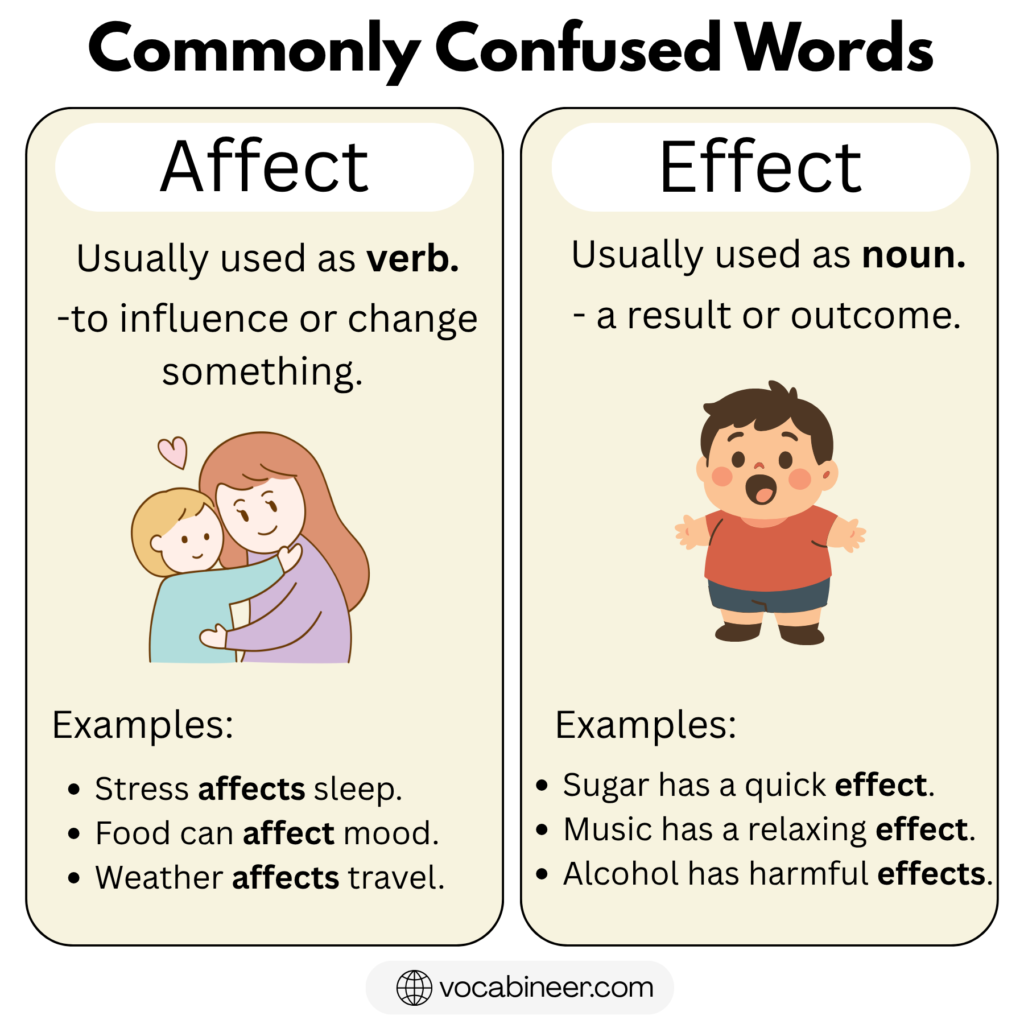
Affect vs Effect: Key Difference Explained
The main difference in Affect vs Effect depends on grammar role and meaning direction. Affect usually shows the action of influencing something. Effect usually names the result that comes from that influence.
If the sentence needs a verb that shows impact, choose Affect.
If the sentence needs a noun that names the outcome, choose Effect.
Here is the difference in one sentence:
Affect influences a situation.
Effect is the outcome of that influence.
Affect vs Effect: Difference in One Look
| Feature | Affect | Effect |
|---|---|---|
| Part of Speech | Usually a verb | Usually a noun |
| Meaning | To influence or change | Result or outcome |
| Shows Action | Yes | No |
| Changes Form | Yes, affects, affected | No tense change |
| Replace With | Influence | Result |
Notice something important. Because Affect is a verb, it changes tense. Effect does not change form when used as a noun.
Affect vs Effect: Side by Side Sentence Contrast
- Lack of sleep can affect your mood.
- Lack of sleep has a negative effect on your mood.
- The policy affected small businesses.
- The policy had a strong effect on small businesses.
- Weather can affect travel plans.
- Weather has an immediate effect on travel plans.
In each pair, Affect shows the action of influencing. Effect names the outcome produced by that influence.
Affect vs Effect: Sentence Structure Comparison
Understanding structure makes the choice easier.
| Structure Type | Affect Pattern | Effect Pattern |
|---|---|---|
| Basic Pattern | Subject + affect + object | Have + effect + on |
| With Tense | The change affected sales | The change had an effect on sales |
| With Modal | Stress can affect memory | Stress can have an effect on memory |
| Negative Form | The issue did not affect results | The issue had no effect on results |
| Passive Context | Results were affected | The effect was noticeable |
If the word needs tense change or direct object after it, it is usually Affect. If the word appears after have, create, cause, or produce, it is usually Effect.
When to Use Affect and When to Use Effect
Choosing between Affect vs Effect becomes easier when you check what the sentence needs. Ask yourself whether the word should show an action or name a result.
Use Affect when the sentence shows:
- Influence
- Change
- Impact
- Alteration
- Action on something
Examples:
- Noise can affect concentration.
- The delay affected the outcome.
- Weather may affect attendance.
- Stress can affect sleep quality.
- The decision will affect everyone.
- Budget cuts affected services.
- Lighting can affect visibility.
- Poor planning can affect results.
- His attitude affects teamwork.
- The storm affected transportation.
Use Effect when the sentence shows:
- Result
- Outcome
- Consequence
- Impact as a noun
- Aftermath
Examples:
- The new policy had a positive effect.
- The storm had a serious effect on travel.
- Exercise has a beneficial effect on health.
- The medicine had no side effect.
- The change produced a noticeable effect.
- The campaign had a lasting effect.
- The speech had an emotional effect.
- Rising prices have an economic effect.
- The delay had little effect.
- The treatment had a strong effect.
If the sentence shows action of influencing, choose Affect. If it names the result of that action, choose Effect.
Context Based Usage Guide
Context gives strong clues in Affect vs Effect decisions. Certain surrounding words often signal the correct choice.
Affect frequently appears:
- Before a direct object
- With modal verbs like can, may, will
- In action based sentences
- With subjects that cause change
Examples:
- Changes in policy can affect growth.
- Lack of funding may affect progress.
- Technology affects communication.
- The update affected performance.
Effect often appears:
- After have, has, had
- With on after it
- With words like positive, negative, direct
- In noun phrase positions
Examples:
- The decision had an effect on sales.
- The news had a strong effect on investors.
- The rule had little effect.
- The medication had a side effect.
You may notice a helpful clue. If the word follows have and is followed by on, it is usually Effect, not Affect.
Grammar Difference Between Affect and Effect
The grammar difference between Affect vs Effect is structural.
Affect is usually a verb.
Effect is usually a noun.
Affect changes tense:
- It affects results.
- It affected results.
- It will affect results.
Effect does not change form when used as a noun:
- It had an effect on results.
- The effect was noticeable.
- The effect remains unclear.
If the sentence needs a verb showing influence, use Affect. If the sentence needs a noun naming the result, use Effect.
Pronunciation Difference Between Affect and Effect
Although Affect vs Effect look similar, their pronunciation has a small but noticeable difference. The stress pattern changes depending on the word.
Affect usually has stress on the second syllable when used as a verb.
Effect usually has stress on the second syllable as a noun, but the starting vowel sound differs slightly.
Below is a quick pronunciation comparison:
| Feature | Affect | Effect |
|---|---|---|
| Common Role | Verb | Noun |
| Stress Pattern | af-FECT | ef-FECT |
| Final Sound | -fect | -fect |
| Changes Form | Yes | No |
Common Mistakes With Affect and Effect
Most errors in Affect vs Effect happen when writers confuse the verb and noun roles. The meaning connection makes the mistake easy to overlook.
Below are common mistakes with corrections.
- Incorrect: The weather had a strong affect on travel.
Correct: The weather had a strong effect on travel. - Incorrect: The policy will effect everyone.
Correct: The policy will affect everyone. - Incorrect: Stress has a bad affect on sleep.
Correct: Stress has a bad effect on sleep. - Incorrect: The delay effected the results.
Correct: The delay affected the results. - Incorrect: The medicine had no affect.
Correct: The medicine had no effect. - Incorrect: Budget cuts will effect operations.
Correct: Budget cuts will affect operations. - Incorrect: The change had little affect.
Correct: The change had little effect. - Incorrect: The update effected performance.
Correct: The update affected performance. - Incorrect: The speech had an emotional affect.
Correct: The speech had an emotional effect. - Incorrect: The storm will effect travel plans.
Correct: The storm will affect travel plans.
FAQs
The main difference in Affect vs Effect is grammar role. Affect is usually a verb that means to influence something. Effect is usually a noun that means the result of that influence.
Affect is most commonly used as a verb meaning to influence or change something. In rare formal contexts, it can also be a noun referring to emotion, but that use is less common in everyday writing.
Effect can be used as a verb in formal language, meaning to bring about or make something happen. For example, The company will effect changes next year. However, this use is less common than the noun form.
The correct phrase is have an effect because the sentence requires a noun that names the result. Using affect in that position would be incorrect in most cases.
A simple memory trick is A for Action and E for End result. Affect usually shows the action of influencing, while Effect names the outcome of that action.
Final Summary
Affect vs Effect may look similar, but their grammar roles differ in most situations. Affect usually acts as a verb that means to influence something. Effect usually acts as a noun that means the result of that influence. If the sentence shows action, choose Affect. If it names the outcome, choose Effect. Understanding this action versus result contrast prevents common writing mistakes and strengthens sentence accuracy.
Read More
