

Learning antonyms for abrupt helps readers understand how English expresses smoothness, gradual change, continuity, and careful progression instead of sudden or unexpected action. When something is not abrupt, language shifts to show steadiness, calm transition, or controlled development. These opposite words are common in writing, conversations, academic texts, storytelling, and professional communication, helping ideas flow clearly and naturally.
This article explains antonyms for abrupt with clear meanings and usage. Understanding these opposites improves clarity when describing behavior, events, movements, tone, or change over time.
In This Page
What Does Abrupt Mean in English?
Abrupt in English means something that happens suddenly and unexpectedly, often without warning or a smooth transition. It is commonly used to describe actions, changes, endings, or behavior that feel sharp, brief, or harsh, leaving little time to prepare or adjust. An abrupt event can interrupt the normal flow of things, while an abrupt manner or tone may sound rude or unfriendly. The word often carries a slightly negative feeling because it suggests lack of softness, explanation, or gradual movement.
Common Antonyms for Abrupt With Meanings
These words show how actions, changes, or behavior can be smooth, gradual, and controlled instead of sudden or sharp.
- Happens slowly – Gradual: occurring over time rather than suddenly, allowing step-by-step adjustment
- Feels seamless – Smooth: happening without sudden stops, breaks, or sharp changes
- Soft and mild – Gentle: acting or moving in a way that is not harsh or shocking
- Moves slowly – Slow: taking time to develop instead of happening all at once
- Consistent pace – Steady: continuing evenly without sudden shifts or interruptions
- Develops step by step – Progressive: unfolding gradually through planned stages
- Carefully controlled – Measured: deliberate and thoughtful rather than impulsive
- Peaceful and calm – Calm: lacking sudden intensity or abruptness
- Well-organized – Orderly: following a clear, structured sequence without disruption
- Considerate in tone – Polite: behaving respectfully and avoiding bluntness or abruptness
- Planned and prepared – Deliberate: done intentionally and thoughtfully, not sudden
- Smooth transition – Flowing: moving or progressing naturally without sharp breaks
- Gentle progression – Moderate: balanced and restrained rather than extreme or sudden
- Continuous movement – Uninterrupted: happening without sudden stops or breaks
- Softened approach – Cautious: careful and controlled, avoiding abruptness or rashness
- Calm unfolding – Even: uniform and stable, lacking sudden spikes or drops
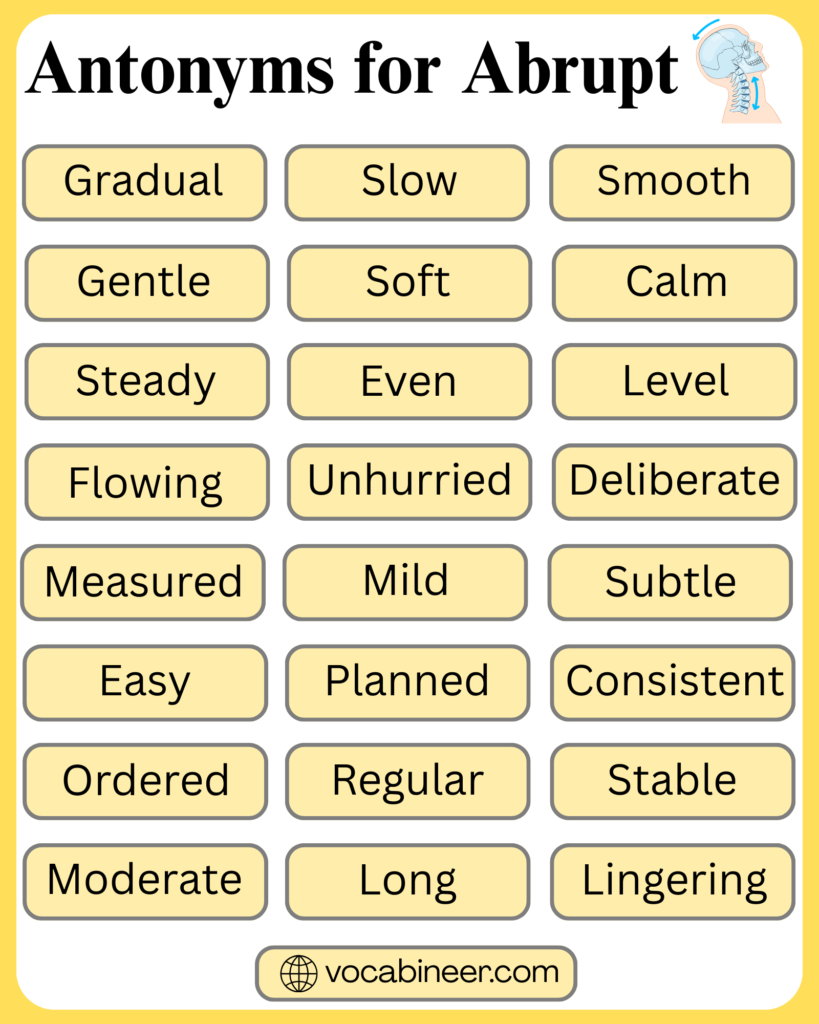
Antonyms for Abrupt by Context
Different situations call for different opposites of ‘abrupt,’ whether in behavior, emotions, daily routines, or professional settings.
Thoughts and Attitude
When describing mindset or behavior, choose words that convey calm, careful, or considerate thinking:
- Measured – thinking or acting with care and deliberation
- Considerate – showing awareness of others and avoiding sudden rudeness
- Patient – able to wait or respond without abrupt reactions
- Thoughtful – taking time to plan or reflect instead of acting suddenly
Feelings and Emotions
For emotional tone or reactions, pick words that express calmness and smoothness:
- Gentle – soft and mild in expression or action
- Calm – peaceful, relaxed, and not easily shocked
- Controlled – managing feelings to avoid abrupt responses
- Reassuring – comforting and steady rather than sudden or startling
Daily Life and Actions
When describing movements, routines, or processes, use words that show smooth transitions:
- Gradual – happening slowly, step by step
- Steady – even and consistent in pace
- Smooth – flowing naturally without sharp breaks
- Moderate – balanced and restrained rather than sudden
Learning, Work, and Communication
In education, professional writing, or instructions, these words help explain clear, deliberate, and well-paced action:
- Progressive – developing in stages or steps
- Orderly – structured, organized, and easy to follow
- Uninterrupted – continuing without sudden stops
- Deliberate – done intentionally and thoughtfully
Abrupt vs Similar Words
Abrupt shows suddenness, but these similar words each highlight a slightly different kind of sharp or unexpected change.
| Starting Line | Word | Meaning & Usage |
|---|---|---|
| Happens without warning | Abrupt | Describes something that occurs suddenly and sharply, often without preparation or smooth transition. It can sound rude, harsh, or unsettling. |
| Focuses only on timing | Sudden | Emphasizes that something happens quickly or unexpectedly, but does not always suggest harshness or interruption. |
| Sounds rough or severe | Harsh | Highlights cruelty, roughness, or severity in tone or action rather than speed or timing. |
| Short and rude in manner | Brusque | Refers mainly to speech or behavior that is overly brief and impolite, not necessarily unexpected. |
| Catches people by surprise | Unexpected | Stresses surprise, but the event may still be calm or smooth rather than sharp. |
| Stops normal flow | Disruptive | Focuses on interruption of continuity, systems, or routines rather than suddenness alone. |
| Ends things quickly | Sharp | Often used for changes, movements, or remarks that feel quick and intense, but not always unplanned. |
| Feels emotionally jarring | Jolting | Emphasizes emotional or mental shock rather than abrupt physical action. |
How to Choose the Right Antonym for Abrupt
Choosing the right antonym for abrupt depends on the situation and what kind of suddenness you want to avoid. If you are talking about changes or events over time, words like gradual, slow, or progressive work best. If you are describing behavior or tone, use gentle, polite, or calm. For transitions, processes, or movements, words like smooth, flowing, or steady fit naturally.
Final Thoughts
Antonyms for abrupt reveal how English handles calmness, continuity, and gradual change instead of sudden disruption. By learning these opposites, writers can describe actions, emotions, and events with greater control and clarity. Whether you’re explaining a process, narrating a story, or communicating professionally, choosing the right antonym helps your message feel smooth, intentional, and easy to understand.
Read More
