

The word appease means to calm someone down, reduce anger, or satisfy a demand in order to restore peace. It is often used in situations involving conflict, disagreement, or strong emotions. However, in many real-life situations, people do the opposite of appeasing. They may increase tension, provoke anger, or refuse to calm a situation. Learning the antonyms for appease helps English learners describe conflict, reactions, and behavior more accurately.
This article explains the meaning of appease, lists its common antonyms with clear explanations, and shows how these words are used in thoughts, emotions, daily life, and learning or work. The language is simple, natural, and learner-friendly.
In This Page
What Does Appease Mean?
Appease means to calm someone down, reduce anger, or satisfy a complaint or demand in order to restore peace. When you appease someone, you try to stop conflict by easing their emotions or meeting their concerns.
Appeasing behavior often appears in arguments, negotiations, or tense situations. It may involve apologizing, offering a solution, or making a compromise so the situation does not become worse.
Common Antonyms for Appease
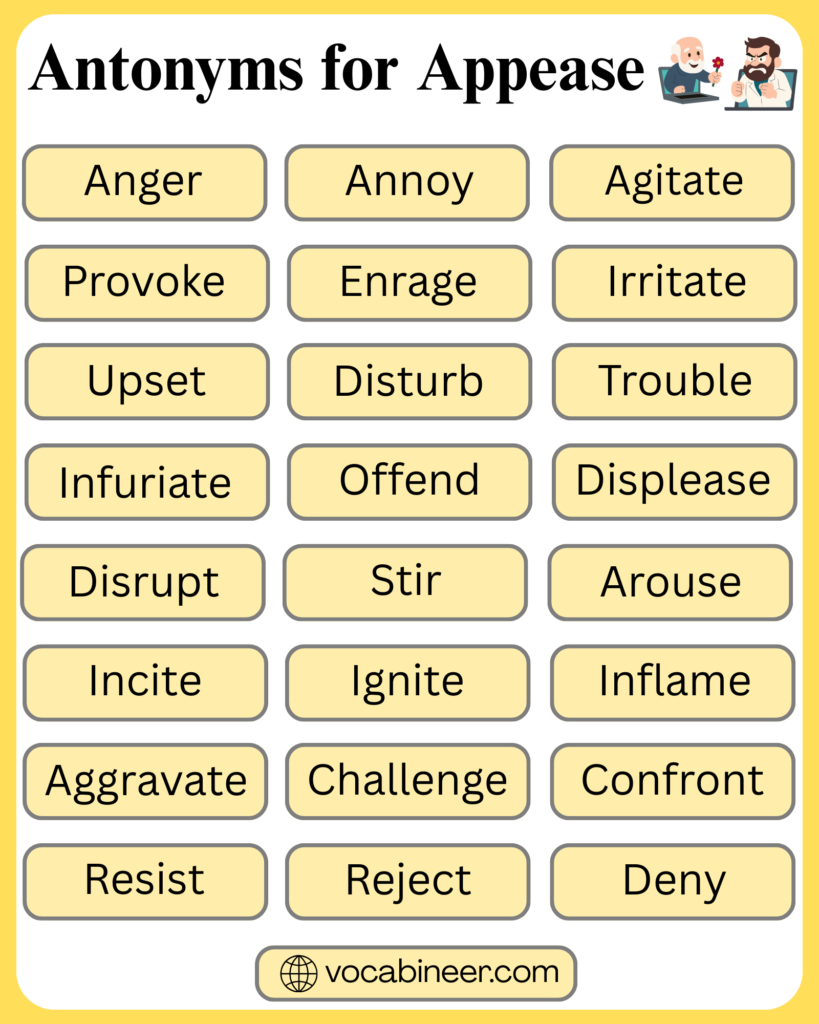
These words are commonly used to describe actions or behavior that increase tension or anger instead of calming a situation.
- Provoke – to deliberately cause anger, reaction, or conflict
- Agitate – to disturb someone emotionally or make them uneasy
- Irritate – to make someone slightly but repeatedly angry
- Annoy – to cause mild anger through repeated actions or words
- Upset – to disturb someone emotionally or mentally
- Inflame – to make emotions or situations more intense or heated
- Antagonize – to cause hostility or opposition in others
- Exasperate – to make someone extremely annoyed or frustrated
- Anger – to make someone feel strong displeasure
- Enrage – to make someone very angry or furious
Antonyms for Appease in Thoughts and Attitude
When someone does not try to appease, their mindset often involves resistance, defiance, or disregard for harmony. These words describe attitudes that increase tension instead of reducing it.
- Provoking – intentionally encouraging a negative reaction
- Defiant – refusing to give in or calm a situation
- Uncooperative – unwilling to work toward peace
- Confrontational – mentally prepared to argue or challenge
- Dismissive – ignoring concerns instead of calming them
Antonyms for Appease in Feelings and Emotions
Emotionally, the opposite of appeasing behavior often leads to heightened anger or agitation. These words describe emotional states rather than actions.
- Agitated – emotionally disturbed or unsettled
- Irritated – mildly but persistently angry
- Angry – feeling strong displeasure
- Furious – feeling intense rage
- Resentful – holding anger due to perceived unfairness
Antonyms for Appease in Daily Life
In daily interactions, failing to appease often means escalating arguments, refusing compromise, or reacting harshly. These words describe common real-life behavior.
- Argue – to engage in disagreement rather than calming discussion
- Antagonize – to create opposition in relationships
- Irritate – to annoy through words or actions
- Provoke – to spark conflict intentionally
- Upset – to disturb someone emotionally
Antonyms for Appease in Learning and Work
In schools and workplaces, appeasement often helps maintain cooperation. Its absence can harm communication, teamwork, and morale.
- Confront – to challenge rather than calm
- Agitate – to disturb group harmony
- Dismiss – to ignore concerns instead of resolving them
- Provoke – to trigger conflict intentionally
- Antagonize – to create hostility among peers
Antonyms for Appease Used in Sentences
Using antonyms in sentences helps learners understand how they work in real communication.
- His comments only provoked more anger.
- She felt irritated by the constant interruptions.
- The decision inflamed public opinion.
- He antagonized his teammates with harsh criticism.
- Her words upset everyone in the room.
Appease vs Related Words: Meaning and Differences
Words like appease, placate, and soothe are often used in similar situations, but their meanings differ. The table below compares appease with related words to show how each responds to anger or emotional tension.
| Word | Meaning and How It Is Different |
|---|---|
| Appease | Appease means to calm someone down or reduce anger by satisfying a demand or concern, often to restore peace. |
| Placate | Placate means to calm someone temporarily, usually by giving in to demands, without fully solving the problem. |
| Soothe | Soothe focuses on comforting emotions or easing distress rather than resolving conflict or demands. |
| Calm | Calm means to reduce emotional intensity, but it does not always involve satisfying someone’s wishes. |
| Pacify | Pacify means to stop anger or violence, sometimes by force or authority rather than understanding. |
| Console | Console means to comfort someone who is sad or upset, focusing on emotional support rather than conflict resolution. |
| Mollify | Mollify means to soften anger or hostility through gentle actions or words, similar to appease but often less direct. |
Why Learning Antonyms for Appease Matters
Learning antonyms improves vocabulary and communication skills. It helps learners describe conflict, emotional escalation, and social behavior more precisely.
Understanding these words is especially useful in storytelling, workplace communication, emotional discussions, and conflict resolution contexts. It also improves reading comprehension by helping learners recognize tone and intent.
Conclusion
Appeasement aims to reduce conflict and restore peace, but its opposites appear frequently in everyday life. Learning antonyms for appease such as provoke, irritate, antagonize, inflame, and enrage helps learners describe emotional escalation and conflict clearly. By understanding these words and their usage, English learners can communicate more accurately, understand interactions better, and build stronger language confidence.
Read More
