

Antonyms for build helps readers understand how English expresses destruction, removal, breakdown, or weakening instead of creation or development. When building does not happen, language shifts to show damage, collapse, loss, or reduction, making negative change easier to recognize. These opposite words appear often in stories, school texts, conversations, and descriptive writing, shaping how actions, processes, and outcomes are clearly communicated and understood.
In This Page
What Does Build Mean in English?
Build means to create, form, or develop something by putting parts together. It can refer to constructing physical objects like houses and roads, developing skills or habits, or strengthening relationships and systems. Build often suggests growth, progress, or improvement over time.
The word build is common in academic writing, daily conversation, and descriptive texts. When building is absent or reversed, English uses different words to show destruction, damage, or reduction.
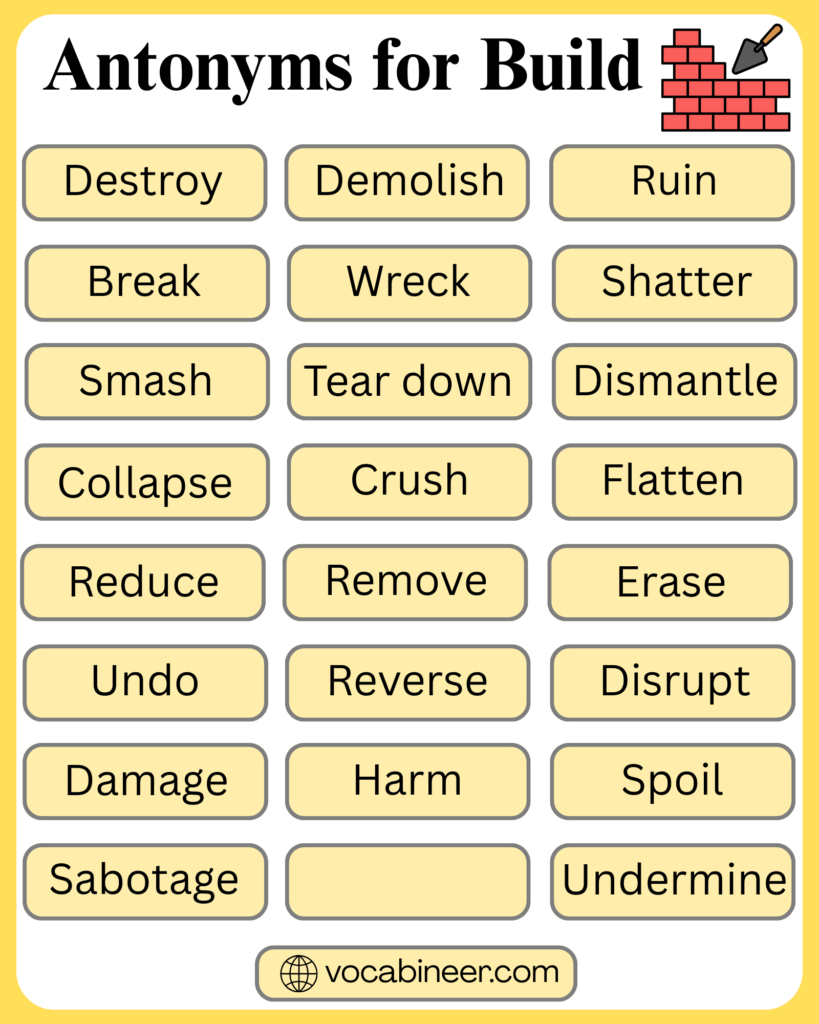
Common Antonyms for Build With Meanings
Some words clearly express the opposite of build by showing destruction, breakdown, removal, or weakening instead of creation or development. These antonyms appear often in school texts, conversations, formal writing, and descriptive passages.
- Destroy: To completely damage or ruin something.
- Demolish: To tear down a structure deliberately.
- Ruin: To spoil something so it cannot be repaired easily.
- Break: To damage something so it stops working properly.
- Dismantle: To take something apart piece by piece.
- Collapse: To fall down suddenly or give way.
- Weaken: To make something less strong or stable.
- Reduce: To make something smaller in size or amount.
- Remove: To take something away.
- Erase: To eliminate something completely.
- Erode: To slowly wear away over time.
- Decay: To break down gradually.
- Shatter: To break into many pieces.
- Wreck: To cause severe damage.
- Raze: To completely destroy a building or structure.
Antonyms for Build Related to Destruction
Some antonyms focus on complete damage or tearing down.
- Destroy: Causing total damage.
- Demolish: Breaking down structures intentionally.
- Raze: Completely flattening something.
- Wreck: Damaging something badly.
- Shatter: Breaking into many pieces.
Antonyms for Build Related to Taking Apart
Some antonyms emphasize undoing what was built.
- Dismantle: Taking apart carefully.
- Disassemble: Separating parts.
- Unbuild: Reversing construction.
- Strip: Removing layers or parts.
- Undo: Reversing progress.
Antonyms for Build Related to Weakening or Loss
Some words focus on gradual decline rather than sudden destruction.
- Weaken: Reducing strength.
- Erode: Slowly wearing away.
- Decay: Gradual breakdown over time.
- Deteriorate: Becoming worse.
- Fade: Slowly disappearing.
Words Related to Damage and Breakdown
Some words support the idea of not building without directly replacing the word.
- Destruction: State of being ruined.
- Damage: Harm that reduces value or function.
- Collapse: Sudden failure.
- Decline: Gradual loss.
- Disintegration: Breaking into parts.
Build vs Similar Words
Below is a comparison showing how build differs from related words in meaning and use.
| Word | Difference from Build |
|---|---|
| Build | Means to create or develop something by putting parts together. |
| Create | Focuses on bringing something into existence, not structure. |
| Construct | More formal term, often used for buildings or systems. |
| Form | Emphasizes shape rather than process. |
| Develop | Focuses on growth over time, not physical assembly. |
| Assemble | Means putting parts together without long-term growth. |
| Establish | Focuses on starting something stable, like a system or rule. |
| Design | Focuses on planning, not actual construction. |
Antonyms for Build in Sentences
Seeing antonyms used in sentences helps learners understand natural usage.
- The storm destroyed the bridge.
- The old house was demolished.
- Years of neglect weakened the structure.
- The plan slowly collapsed.
- Rust eroded the metal.
- He dismantled the machine carefully.
How to Choose the Right Antonym for Build
Choosing the correct antonym depends on context. If the focus is complete destruction, destroy or demolish works best. If the focus is careful removal, dismantle or disassemble fits better. For gradual loss, erode, weaken, or deteriorate is more accurate.
Understanding whether the change is sudden, gradual, intentional, or accidental helps select the most natural antonym.
Why Learning Antonyms for Build Matters
Understanding antonyms for build helps readers recognize contrast between growth and loss. These words explain how progress can turn into damage and how creation can become destruction. They are important for describing physical change, emotional decline, and failure clearly.
Learning these opposites improves clarity in writing and strengthens understanding of cause and effect.
Conclusion
Understanding antonyms for build helps readers recognize how English expresses destruction, breakdown, and decline instead of creation and growth. These words appear across stories, school texts, and conversations, shaping how change and outcomes are described. Learning them through explanation and sentence use builds clearer expression and deeper understanding of building and loss in English.
Read More
