

Learning the antonyms for capacity helps readers understand how ability, space, and limits change when something cannot hold, manage, or perform much. Capacity often connects to volume, skill, mental ability, or workload, while its opposites point to limitation, shortage, or inability. These contrasts appear frequently in reading passages, classroom explanations, and daily situations where limits and ability matter.
This article explains how antonyms for capacity work in different situations involving space, ability, workload, and performance. Knowing these opposite words helps learners talk about limited space, reduced ability, low tolerance, and restricted potential in school and everyday communication.
In This Page
What Does Capacity Mean in English?
The word capacity is used in English to describe how much something can hold, do, or manage. It can refer to the capacity of a container, a person’s mental capacity, work capacity, or emotional capacity. A large capacity means more ability or space, while limited capacity means less. Because the meaning of capacity changes by context, its opposite words also change depending on use.
Common Antonyms for Capacity With Meanings
Understanding opposites of capacity helps readers describe limits in space, ability, workload, and tolerance. These words are commonly used in school texts and everyday descriptions when something cannot hold, manage, or perform much.
- Incapacity: Lack of ability or power to do something.
- Inability: Not having the skill or strength to perform a task.
- Limitation: A fixed boundary or restriction on size or ability.
- Restriction: A rule or condition that limits action or amount.
- Deficiency: Lack of a required amount or quality.
- Shortage: Not enough supply, space, or ability.
- Insufficiency: Not enough to meet needs or demands.
- Constraint: A condition that limits freedom or performance.
- Smallness: Limited size or volume.
- Narrowness: Limited range, scope, or space.
- Overload: More than can be handled or supported.
- Crowding: Too little space for the amount present.
- Under-capacity: Less ability or space than required.
- Scarcity: Very limited availability.
- Exhaustion: Complete loss of ability or energy.
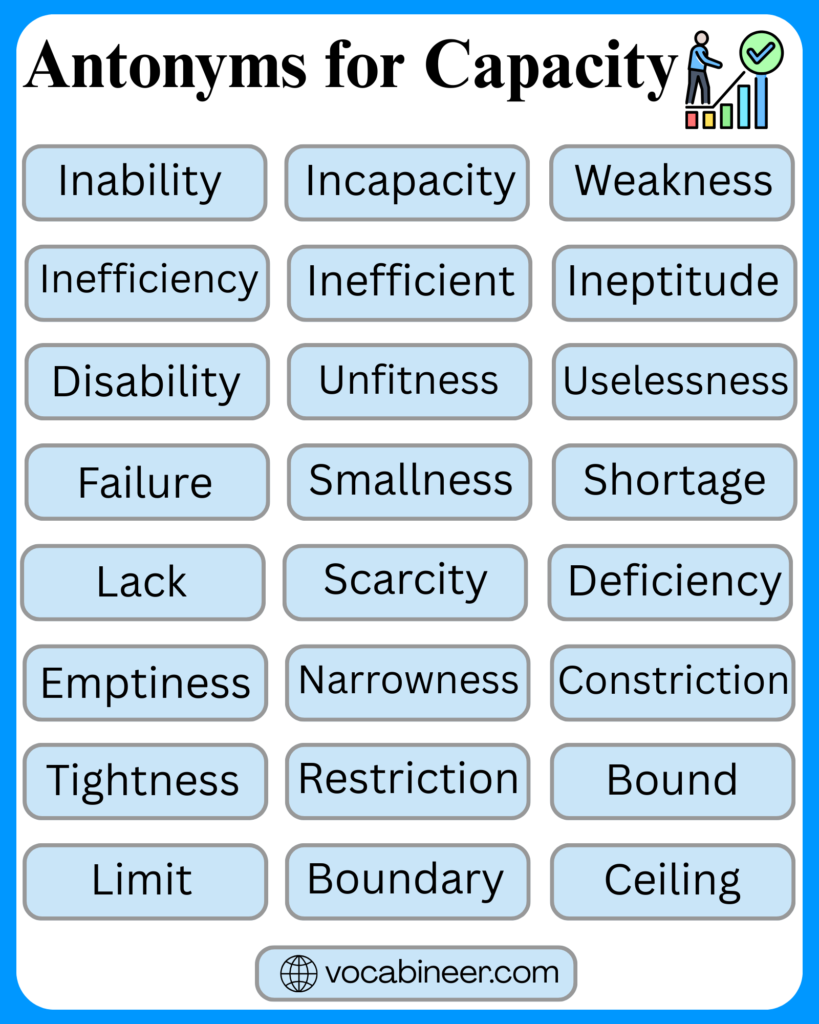
Antonyms for Capacity by Context
The opposite of capacity can change depending on what kind of capacity you’re talking about, such as space, ability, workload, or tolerance. Choosing the right antonym helps your meaning stay clear and accurate.
Space and Volume
When capacity refers to physical space or volume, antonyms describe lack of room or holding ability.
- Limitation – restricted space
- Smallness – limited size
- Crowding – too little space
- Narrowness – reduced width or volume
- Overload – more than space allows
Ability and Skill
When capacity refers to mental or physical ability, antonyms describe inability or weakness.
- Incapacity – lack of ability
- Inability – cannot perform
- Deficiency – lacking skill
- Limitation – restricted ability
- Weakness – reduced power
Workload and Performance
When capacity refers to workload or performance level, antonyms describe excess demand or low tolerance.
- Overload – too much to handle
- Under-capacity – less than needed
- Strain – pressure beyond limits
- Burnout – loss of working ability
- Exhaustion – no remaining capacity
Emotional and Mental Tolerance
When capacity refers to emotional or mental limits, antonyms describe lack of tolerance.
- Overwhelm – more than can be handled
- Limitation – restricted tolerance
- Fragility – low emotional strength
- Stress – pressure beyond capacity
- Breakdown – failure to cope
Capacity vs Similar Words
Understanding capacity vs similar words helps readers choose the correct term when talking about ability, space, limits, or performance. Some words focus on physical volume, while others describe skill, tolerance, or potential. The table below explains how these words differ in meaning and use.
| Word | Meaning & Usage |
|---|---|
| Capacity | The ability, space, or limit to hold, manage, or perform something. |
| Ability | Skill or power to do a specific task or action. |
| Capability | Potential or possibility to perform an action. |
| Volume | The amount of physical space something can hold. |
| Limit | The maximum point that cannot be exceeded. |
| Potential | Possible future ability or growth. |
| Tolerance | Ability to endure pressure, stress, or discomfort. |
| Range | The extent or scope something can cover. |
| Strength | Power to perform, resist, or endure. |
| Endurance | Ability to continue over time without stopping. |
How to Choose the Right Antonym for Capacity
Choosing the right antonym for capacity depends on context. For space or containers, words like limitation, smallness, or crowding fit best. When talking about ability, incapacity or inability is more accurate. For workload or stress, overload, exhaustion, or burnout works naturally. Thinking about what kind of limit exists helps select the correct opposite.
Conclusion
Understanding antonyms for capacity helps you describe limits in space, ability, workload, and tolerance. Whether you are talking about limited storage, inability to perform, emotional overload, or restricted performance, knowing the right opposite words makes communication clearer and more precise in everyday learning and communication.
Read More
