

Learning antonyms for create helps readers understand how English expresses destruction, removal, loss, or elimination instead of making, forming, or producing something new. When creation does not take place, language shifts to reflect damage, disappearance, breakdown, or cancellation, making negative change easier to recognize. These opposite words appear often in stories, school texts, conversations, instructions, and descriptive writing, shaping how actions, processes, and outcomes are clearly communicated.
This article explains antonyms for create through clear meanings, natural sentence examples, and practical context. Understanding these opposites helps describe change, events, and results more accurately in everyday English.
In This Page
Meaning of Create in English
Create means to make, build, produce, or bring something into existence. It can involve forming ideas, designing objects, writing stories, inventing tools, or shaping plans. Creation often reflects imagination, effort, growth, and development.
The word create is common in education, writing, art, science, daily communication, and professional work. When creation is reversed or removed, English uses different words to express destruction, loss, removal, or cancellation.
Common Antonyms for Create
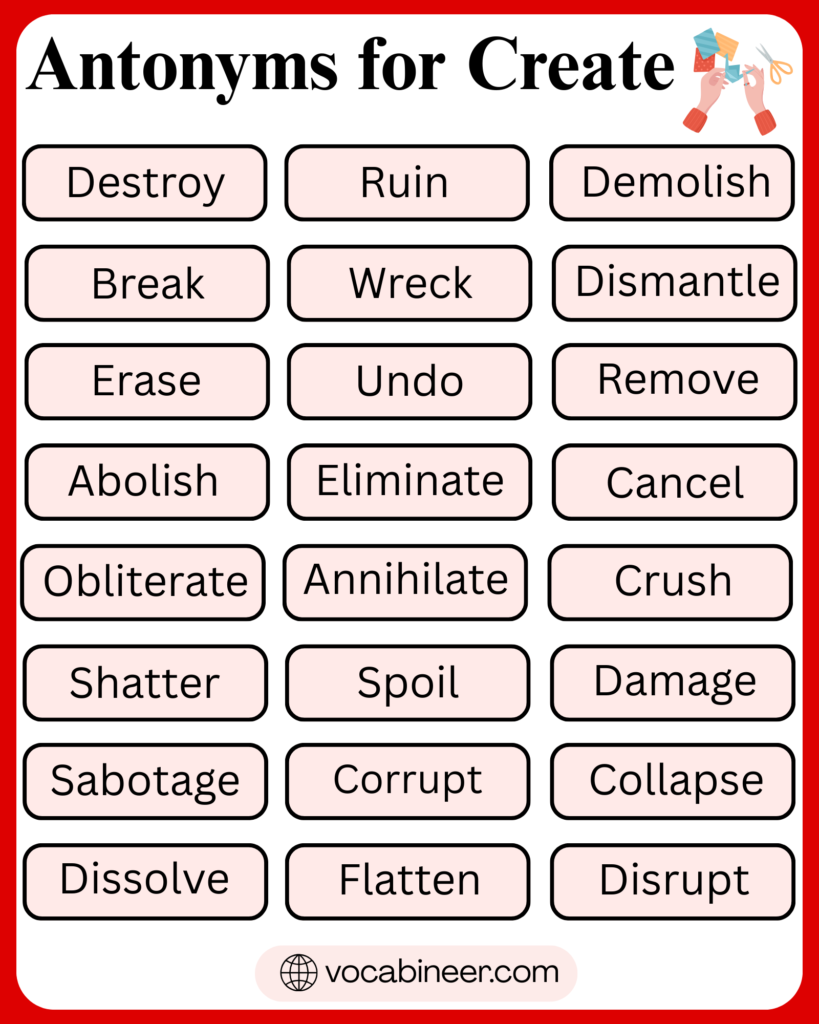
Some words clearly express the opposite of create by showing destruction, removal, loss, or cancellation instead of making or producing something new. These antonyms appear often in school texts, conversations, instructions, and descriptive writing.
- Destroy: To damage something completely or beyond repair.
- Demolish: To tear down a structure or object.
- Ruin: To spoil or damage severely.
- Erase: To remove all traces of something.
- Delete: To remove written or digital content.
- Eliminate: To remove or get rid of completely.
- Remove: To take something away.
- Cancel: To stop a planned action or event.
- Abolish: To officially end a system, rule, or practice.
- Terminate: To end something formally or permanently.
- Dismantle: To take apart piece by piece.
- Break: To damage physically.
- Annihilate: To destroy totally.
- Extinguish: To cause something to disappear or go out.
- Nullify: To cancel the effect or force of something.
Antonyms for Create Related to Destruction
Some antonyms focus on breaking, damaging, or destroying.
- Destroy: Causing total damage.
- Demolish: Tearing something down.
- Ruin: Spoiling completely.
- Break: Causing physical damage.
- Annihilate: Destroying beyond recovery.
Antonyms for Create Related to Removal and Elimination
Some antonyms emphasize taking away or deleting.
- Erase: Removing marks or memory.
- Delete: Removing data or writing.
- Eliminate: Removing completely.
- Remove: Taking something away.
- Dismantle: Taking apart piece by piece.
Antonyms for Create Related to Cancellation and Ending
Some antonyms describe stopping something before or after creation.
- Cancel: Ending plans.
- Abolish: Ending officially.
- Terminate: Ending formally.
- Nullify: Canceling effect or power.
- Extinguish: Ending existence.
Words Related to Loss and Destruction
Some words add emotional or situational depth when describing lack of creation.
- Destruction: Act of destroying.
- Loss: Absence or removal.
- Damage: Harm caused.
- Breakdown: Failure of structure or system.
- Disappearance: Loss from sight or existence.
Create vs Similar Words
Below is a comparison showing how create differs from related words in meaning and use.
| Word | Difference from Create |
|---|---|
| Create | Means to make something new or bring something into existence. |
| Make | A general word for forming or producing something, often less imaginative. |
| Build | Focuses on constructing something physically or step by step. |
| Design | Emphasizes planning, structure, and visual arrangement before making. |
| Produce | Highlights manufacturing, output, or large-scale creation. |
| Invent | Means creating something completely new that did not exist before. |
| Develop | Refers to gradual creation, improvement, or growth over time. |
| Form | Focuses on shaping or organizing parts into a whole. |
| Construct | A formal word for building or assembling carefully. |
| Compose | Used mainly for writing, music, or artistic arrangement. |
Antonyms for Create in Sentences
Seeing antonyms used in sentences helps learners understand natural usage.
- The fire destroyed the old building.
- They deleted the unnecessary files.
- The storm ruined the crops.
- The manager cancelled the event.
- Workers dismantled the broken machine.
- The decision abolished the old system.
- His mistake erased months of progress.
How to Choose the Right Antonym for Create
Choosing the right antonym for create depends on what kind of opposite meaning you want to express. If the focus is on physical damage or destruction, words like destroy, demolish, or ruin fit best. When the meaning involves removing written or digital content, erase, delete, or eliminate is more suitable. For plans, systems, or rules that are stopped, cancel, abolish, or terminate works better.
Conclusion
Understanding antonyms for create helps readers recognize how English expresses destruction, removal, loss, or cancellation instead of making or producing. These words appear across stories, school texts, conversations, and instructions, shaping how actions, processes, and results are described. Learning them through explanation and natural examples builds clearer expression and deeper understanding of creation and destruction in English.
Read More
