

Learning antonyms for deep helps you talk about things that stay on the surface rather than going far down, inside, or beyond what’s obvious. When something isn’t deep, we naturally switch to words that suggest shallowness, lightness, simplicity, or limited intensity—whether we’re describing water, emotions, thinking, colors, or experiences. These opposites show up all the time in everyday speech, storytelling, classrooms, and writing, making it easier to explain ideas that don’t carry much depth or complexity.
In This Page
Common Antonyms for Deep With Meanings
Learning antonyms for deep helps you describe things that are not intense, not complex, or stay on the surface. These opposite words are useful for physical spaces, thoughts, emotions, and everyday situations.
- Shallow – Something that has little physical depth or lacks seriousness or emotional intensity.
- Surface-level – Ideas, explanations, or observations that do not explore details or underlying meaning.
- Superficial – Lacking depth in thought, feeling, or understanding; often focused only on appearances.
- Light – Not heavy, intense, or serious, especially in mood, conversation, or content.
- Thin – Limited in thickness or lacking richness, detail, or substance.
- Simple – Easy to understand; not complex or layered.
- Basic – Minimal, introductory, or lacking advanced detail.
- Flat – Lacking emotional depth, variation, or richness.
- Mild – Low in intensity of feelings, reactions, or effects.
- Trivial – Small, unimportant, or lacking depth and seriousness.
- Weak – Lacking strength, power, or impact.
- Shallow-minded – Having limited or superficial understanding; not thoughtful.
- Frivolous – Not serious or meaningful; focused on trivial matters.
- Insubstantial – Lacking substance, significance, or importance.
- Limited – Confined in scope, depth, or richness.
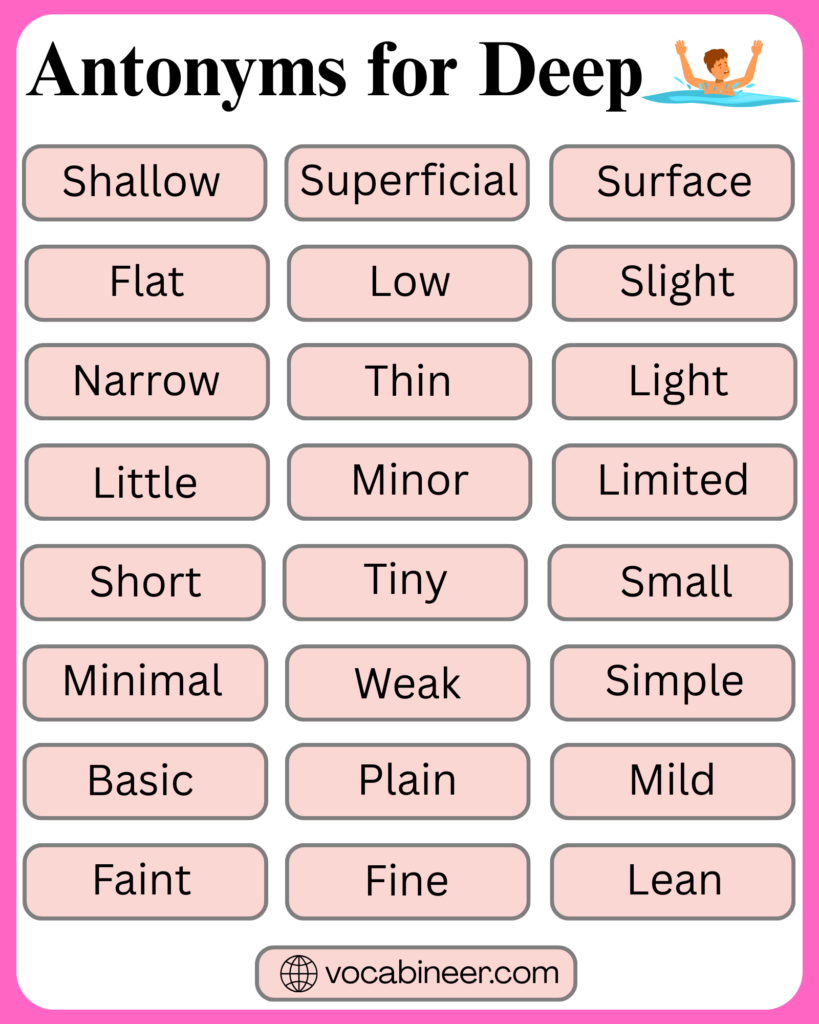
Antonyms for Deep by Context
The opposite of deep can change depending on what kind of depth you’re talking about—physical, emotional, intellectual, or conversational. Choosing the right word makes your writing or speech more precise and natural.
Physical Depth
When deep refers to something below the surface, its antonyms highlight limited or shallow depth:
- Shallow – not extending far below the surface
- Thin – lacking thickness or volume
- Surface-level – staying near the top, not going deeper
Thoughts and Ideas
When deep describes complex thinking or understanding, opposites suggest simplicity or lack of insight:
- Simple – easy to understand, not layered or complex
- Basic – minimal or introductory, without depth
- Superficial – focused only on appearances, ignoring underlying meaning
Emotions and Feelings
When deep shows strong emotional intensity, antonyms express lighter or weaker feelings:
- Light – gentle, not intense
- Mild – low in strength or impact
- Shallow – lacking emotional intensity
Conversations and Writing
When deep refers to meaningful discussion or writing, opposites suggest casualness or limited engagement:
- Trivial – unimportant or insignificant
- Surface-level – only covering obvious points
- Flat – lacking variation, interest, or emotional resonance
Personality and Attitude
When deep describes reflective or thoughtful people, antonyms show a lack of introspection or insight:
- Superficial – focusing on appearances rather than substance
- Unreflective – not thinking deeply about actions or ideas
- Shallow – lacking depth in character or thought
Deep vs Similar Words
While ‘deep’ describes strong intensity, complexity, or distance below the surface, these similar words highlight specific types of depth in emotions, thoughts, or ideas.
| Word | Meaning & Usage |
|---|---|
| Deep | Describes strong intensity, complexity, or distance below the surface, both literally and figuratively. |
| Profound | Suggests very thoughtful, serious, or intellectual depth in ideas, meaning, or insight. |
| Intense | Focuses on emotional or physical strength rather than layered or conceptual depth. |
| Serious | Highlights importance, gravity, or significance rather than literal or emotional depth. |
| Complex | Refers to something with multiple layers or elements, often intellectually or structurally deep. |
| Philosophical | Focuses on abstract thinking, reflection, or contemplation about life, ideas, or principles. |
| Heartfelt | Expresses strong, sincere emotions rather than intellectual or conceptual depth. |
| Insightful | Indicates awareness or comprehension that goes beyond the obvious surface. |
| Profoundly felt | Emphasizes experiences or feelings that leave a lasting impression on people. |
| Far-reaching | Covers broad or extensive scope in meaning, impact, or understanding, both literal and figurative. |
How to Choose the Right Antonym for Deep
Choosing the right antonym for deep depends on what kind of depth you are referring to. If you’re talking about physical depth, words like shallow, thin, or surface-level fit best. For emotions or feelings, use light, mild, or shallow to show weaker intensity. When describing ideas, thoughts, or conversations, words such as simple, basic, or superficial work well to indicate a lack of complexity. By considering the context—whether it’s physical, emotional, intellectual, or conversational—you can select the antonym that makes your writing or speech clear, natural, and precise.
Conclusion
Understanding antonyms for deep helps you express the opposite of intensity, complexity, or depth in a clear and precise way. Whether you are describing physical spaces, emotions, thoughts, or conversations, knowing the right opposite words—like shallow, light, simple, or superficial—makes your writing and speech more accurate and relatable. By choosing the correct antonym for the context, you can convey subtle differences, highlight contrasts, and communicate ideas with greater clarity and impact.
Read More
