

Antonyms for discover helps readers understand how English expresses concealment, ignorance, loss of information, or failure to find instead of uncovering or learning something new. When discovery does not happen, language shifts to show hiding, overlooking, forgetting, or remaining unaware, making gaps in knowledge easier to recognize. These opposite words appear often in stories, school texts, conversations, and descriptive writing, shaping how events, knowledge, and outcomes are clearly communicated and understood.
In This Page
Meaning of Discover in English
Discover means to find something that was unknown, hidden, or not previously recognized. It can refer to learning new information, finding a place or object, or realizing a fact or truth. Discovery may happen by accident, effort, or research.
The word discover appears often in education, science, storytelling, and daily conversation. When something is not discovered, English uses other words to express concealment, lack of awareness, or failure to notice.
Common Antonyms for Discover
Some words clearly express the opposite of discover by showing hiding, missing information, or remaining unaware. These antonyms appear often in school texts, stories, conversations, and descriptive writing, especially when facts, objects, or truths are not found or revealed.
- Hide: To keep something out of sight or knowledge.
- Conceal: To deliberately keep something secret.
- Miss: To fail to notice or find something.
- Overlook: To not see or recognize something important.
- Ignore: To intentionally pay no attention.
- Forget: To lose memory of information or facts.
- Lose: To no longer have or be able to find something.
- Suppress: To prevent information from being revealed.
- Cover up: To hide the truth or facts deliberately.
- Withhold: To keep information back.
- Obscure: To make something difficult to see or understand.
- Remain unaware: To not know or realize something.
- Neglect: To fail to give attention or care.
- Disregard: To choose not to pay attention.
- Misplace: To lose something by putting it in the wrong place.
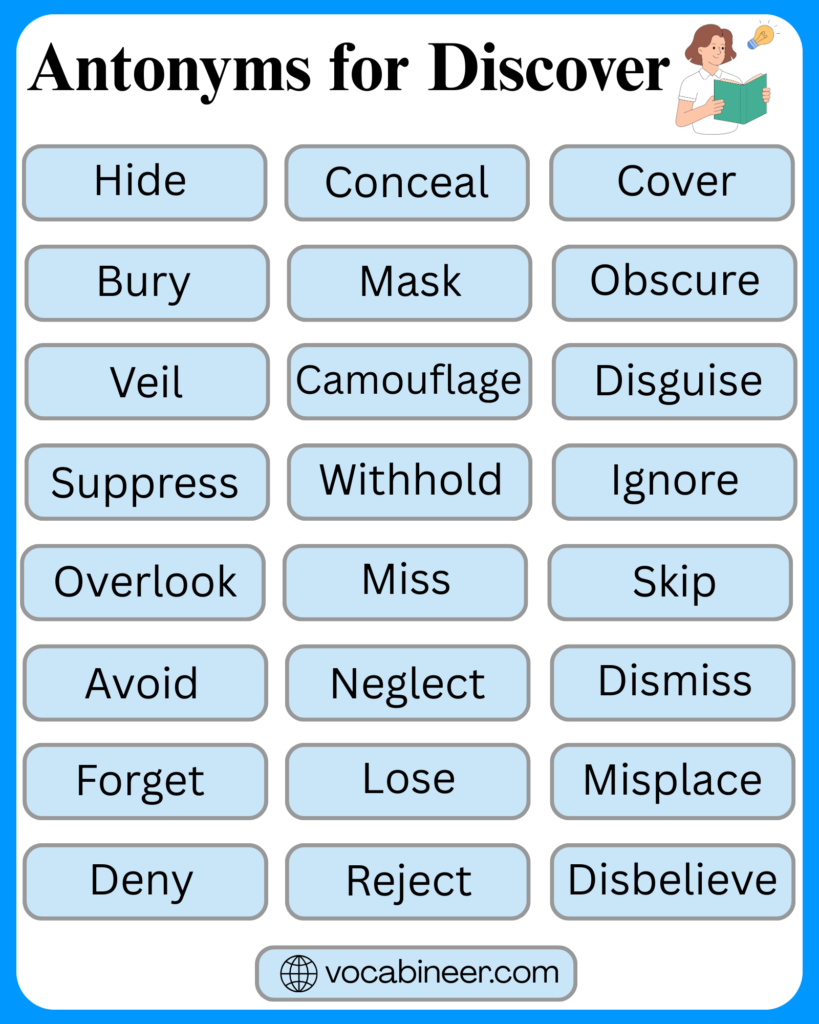
Antonyms for Discover Related to Hiding
Some antonyms of discover focus on intentional concealment or secrecy.
- Conceal: Hiding something deliberately.
- Mask: Covering the true nature of something.
- Obscure: Making something hard to see or understand.
- Bury: Hiding something deeply or completely.
- Withhold: Keeping information from being revealed.
Antonyms for Discover Related to Failure to Notice
Some antonyms describe situations where discovery does not happen because of inattention.
- Miss: Failing to notice or find.
- Overlook: Ignoring something unintentionally.
- Neglect: Failing to give attention.
- Disregard: Choosing not to pay attention.
- Skip: Passing over something without noticing.
Antonyms for Discover Related to Loss of Knowledge
Some words focus on losing awareness rather than never finding it.
- Forget: Losing memory of information.
- Unlearn: Losing previously learned knowledge.
- Misplace: Losing something by putting it in the wrong place.
- Discard: Getting rid of information or ideas.
- Erase: Removing information completely.
Words Related to Secrecy and Lack of Awareness
Some words do not directly replace discover but help describe environments where information is hidden or unknown.
- Secrecy: State of keeping information hidden.
- Ignorance: Lack of knowledge or awareness.
- Mystery: Something not understood or explained.
- Oblivion: State of being completely unaware.
- Uncertainty: Lack of clarity or knowledge.
Discover vs Similar Words
Below is a comparison showing how discover differs from related words in meaning and use.
| Word | Difference from Discover |
|---|---|
| Discover | Means to find or learn something that was previously unknown or hidden. |
| Find | A general word for locating something, often physical, without emphasis on new knowledge. |
| Uncover | Focuses on removing what hides something, while discover focuses on gaining knowledge. |
| Realize | Refers to understanding something mentally rather than finding it. |
| Identify | Means recognizing something already known, not learning something new. |
| Detect | Emphasizes noticing signs or clues, often through careful observation. |
| Explore | Involves searching or examining, without guaranteeing discovery. |
| Reveal | Means to show or make something known, often by someone else. |
Antonyms for Discover in Sentences
Seeing antonyms used in sentences helps learners understand natural usage.
- The truth was concealed for years.
- He missed the important detail.
- She overlooked the warning signs.
- The facts were suppressed.
- He forgot what he had learned earlier.
- The mistake was carefully covered up.
How to Choose the Right Antonym for Discover
Choosing the correct antonym depends on context. If the focus is intentional secrecy, conceal, hide, or suppress fits best. If the focus is inattention, miss or overlook works better. For loss of knowledge, forget or erase is more accurate.
Understanding whether discovery failed because of secrecy, carelessness, or loss helps select the most natural antonym.
Why Learning Antonyms for Discover Matters
Understanding antonyms for discover helps readers recognize contrast in knowledge and awareness. These words explain how truth becomes hidden, facts remain unknown, and opportunities are missed. They also help writers describe mystery, failure, and secrecy more clearly.
Learning these opposites strengthens comprehension and improves clarity in both academic and everyday communication.
Conclusion
Understanding antonyms for discover helps readers recognize how English expresses concealment, ignorance, or failure to find instead of uncovering or learning something new. These words appear across stories, school texts, and conversations, shaping how knowledge and events are described. Learning them through explanation and sentence use builds clearer expression and deeper understanding of discovery in English.
Read More
