

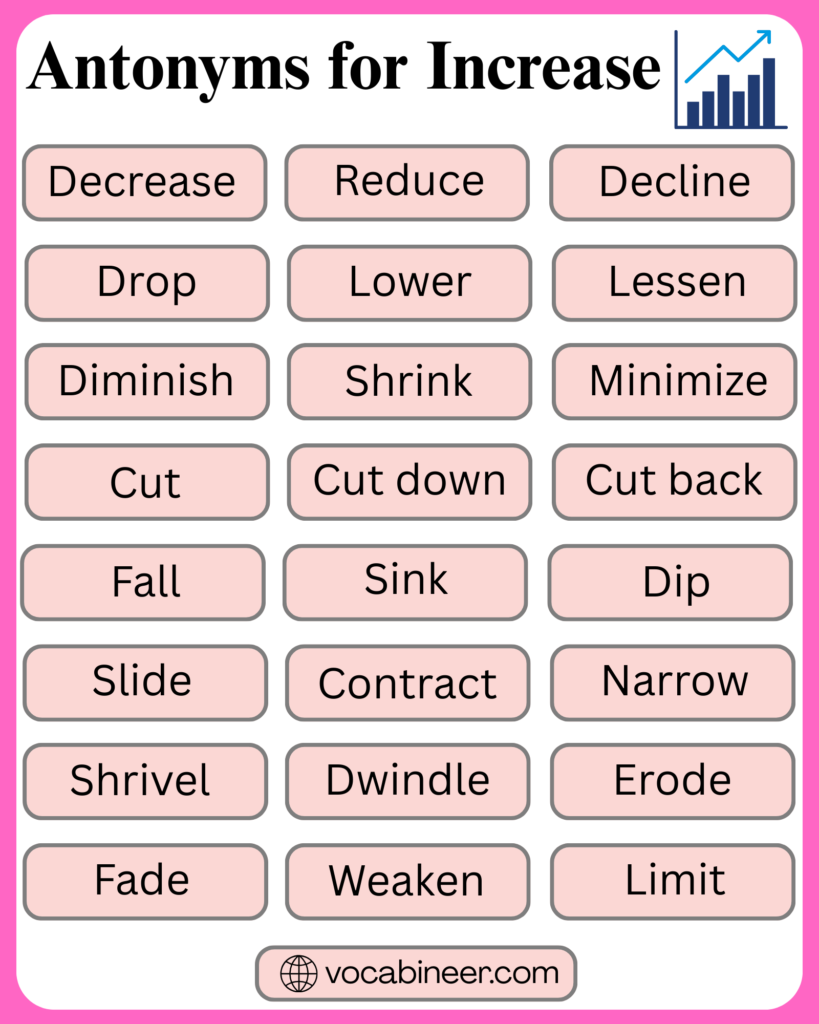
Antonyms for increase helps readers understand how English expresses reduction, decrease, decline, or loss instead of growth or expansion. When increase does not happen, language shifts to show lowering, shrinking, weakening, or slowing down, making downward change easier to recognize. These opposite words appear often in stories, school texts, conversations, and descriptive writing, shaping how quantities, changes, and outcomes are clearly communicated and understood.
In This Page
Meaning of Increase in English
Increase means to become greater in size, number, amount, or level. It can describe rising prices, growing population, improving skills, or expanding influence. Increase often suggests progress, growth, or upward movement over time.
The word increase is common in mathematics, science, economics, daily conversation, and descriptive writing. When increase is absent or reversed, English uses different words to express reduction, decline, or loss.
Common Antonyms for Increase With Meanings
Some words clearly express the opposite of increase by showing reduction, decline, lowering, or loss instead of growth or expansion. These antonyms appear often in school texts, conversations, reports, and descriptive writing.
- Decrease: To become smaller in size, number, or amount.
- Reduce: To make something less or smaller intentionally.
- Lower: To bring something down in level or amount.
- Drop: To fall or decrease suddenly.
- Decline: To gradually become less or weaker over time.
- Diminish: To slowly reduce in strength, importance, or size.
- Shrink: To become smaller physically or in quantity.
- Cut: To reduce deliberately, often by decision.
- Fall: To move downward or decrease.
- Lessen: To make something smaller or weaker.
- Plunge: To fall sharply and quickly.
- Erode: To wear away slowly over time.
- Fade: To gradually disappear or weaken.
- Collapse: To fall suddenly or fail completely.
- Contract: To become smaller or shorter.
Antonyms for Increase Related to Reduction
Some antonyms focus on actively making something smaller.
- Reduce: Making something less.
- Cut: Lowering deliberately.
- Lower: Bringing something down.
- Trim: Reducing slightly or carefully.
- Scale back: Reducing plans or size.
Antonyms for Increase Related to Natural Decline
Some antonyms describe gradual or natural reduction.
- Decline: Gradual decrease over time.
- Diminish: Slow reduction in strength or importance.
- Fade: Gradual disappearance.
- Erode: Slow wearing away.
- Drop off: Gradual reduction.
Antonyms for Increase Related to Sudden Loss
Some antonyms focus on quick or sharp reduction.
- Drop: Sudden fall.
- Fall: Quick decrease.
- Plunge: Sharp downward movement.
- Crash: Sudden and dramatic fall.
- Collapse: Sudden failure or reduction.
Words Related to Decrease and Reduction
Some words support the idea of not increasing without directly replacing the word.
- Reduction: Act of making smaller.
- Decline: State of becoming less.
- Loss: Absence or reduction.
- Drop: Decrease in amount or level.
- Decrease: Opposite state of increase.
Increase vs Similar Words
Below is a comparison showing how increase differs from related words in meaning and use.
| Word | Difference from Increase |
|---|---|
| Increase | Means to become greater in size, number, or amount. |
| Grow | Suggests natural or organic increase over time. |
| Expand | Focuses on becoming larger in size or area. |
| Rise | Emphasizes upward movement or level change. |
| Boost | Refers to a quick or intentional increase. |
| Raise | Means causing something to increase actively. |
| Multiply | Refers to rapid numerical increase. |
| Develop | Focuses on improvement or progress, not numbers alone. |
Antonyms for Increase in Sentences
Seeing antonyms used in sentences helps learners understand natural usage.
- Prices decreased after the sale.
- The company reduced its workforce.
- Water levels dropped overnight.
- Interest rates fell sharply.
- His influence slowly diminished.
- Spending was cut last year.
How to Choose the Right Antonym for Increase
Choosing the correct antonym depends on context. If the change is gradual, decline, diminish, or fade fits best. For deliberate action, reduce, cut, or lower works better. When the change is sudden, drop, fall, or plunge is more accurate.
Understanding whether the reduction is planned, natural, or sudden helps select the most natural antonym.
Why Learning Antonyms for Increase Matters
Understanding antonyms for increase helps readers recognize contrast in quantity, growth, and change. These words explain how progress turns into decline and how expansion becomes reduction. They are essential for describing trends, outcomes, and comparisons clearly.
Learning these opposites improves clarity in academic writing, daily conversation, and descriptive language.
Conclusion
Understanding antonyms for increase helps readers recognize how English expresses decrease, reduction, decline, or loss instead of growth and expansion. These words appear across stories, school texts, and conversations, shaping how change and outcomes are described. Learning them through explanation and sentence use builds clearer expression and deeper understanding of increase and decrease in English.
Read More
