

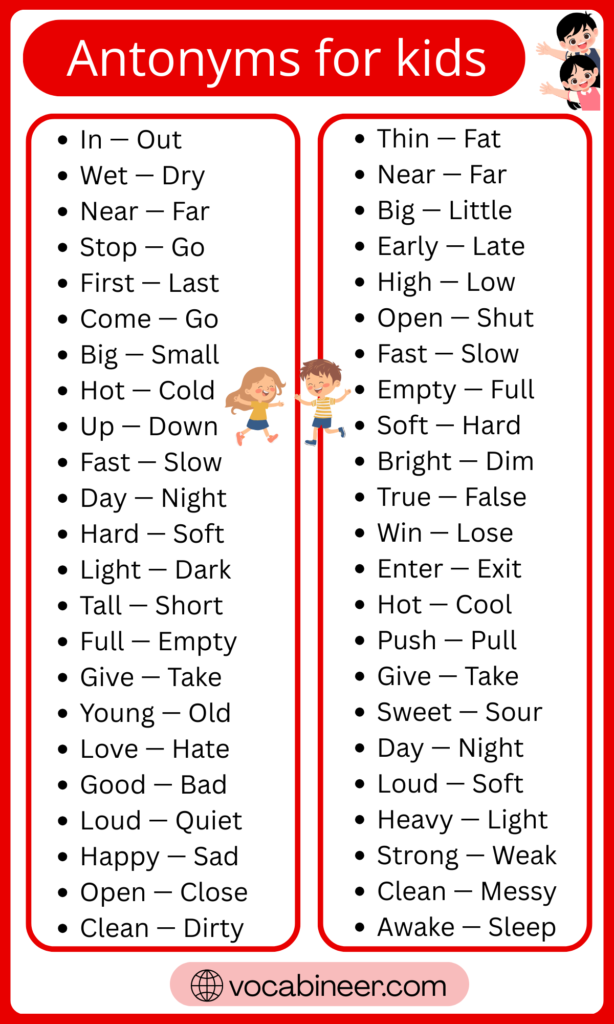
Antonyms for kids help show how meaning changes when one word is replaced with its opposite. Children understand ideas more easily when they see contrast, such as big and small or happy and sad. Learning opposite words builds early reading confidence and supports clearer speaking because kids begin to notice how language works through comparison rather than explanation.
This article presents opposite words in a way that matches how children learn naturally. The pairs come from daily life, school language, stories, and simple questions. Meanings are added only when they support understanding, and examples stay familiar so kids can connect words to situations they already know.
In This Page
Everyday Opposite Words Kids Use
Everyday opposite words are the pairs children hear most often during daily routines at home and school. These antonyms appear naturally in short sentences, instructions, and casual conversation. Because kids already recognize these ideas, learning them as pairs makes meaning clearer and easier to remember.
- Big – Small
Big means large in size, while small means not large. - Hot – Cold
Hot describes high temperature, while cold describes low temperature. - Happy – Sad
Happy shows a good feeling, while sad shows an unhappy feeling. - Fast – Slow
Fast means moving quickly, while slow means moving with less speed. - Up – Down
Up means toward a higher place, while down means toward a lower place. - In – Out
In means inside something, while out means not inside. - Open – Closed
Open means not shut, while closed means shut. - Day – Night
Day is the time with light, while night is the time with darkness. - Full – Empty
Full means having no space left, while empty means nothing inside. - Clean – Dirty
Clean means not dirty, while dirty means not clean. - Loud – Quiet
Loud means making a lot of noise, while quiet means making little noise. - Light – Dark
Light means bright, while dark means having little or no light. - Near – Far
Near means close, while far means a long distance away. - Soft – Hard
Soft means easy to press, while hard means firm. - Wet – Dry
Wet means covered with water, while dry means not wet. - Right – Wrong
Right means correct, while wrong means incorrect. - Early – Late
Early means before the expected time, while late means after it. - Easy – Hard
Easy means not difficult, while hard means difficult. - High – Low
High means tall or raised, while low means not high. - Old – New
Old means used for a long time, while new means recent.
Easy Antonyms Kids Learn First
Some antonyms are taught early because they describe very clear and simple ideas. These opposite words are often introduced in reading books, worksheets, and spoken practice. They help children build confidence because the contrast is easy to picture.
- Good – Bad
Good means nice or right, while bad means not nice or wrong. - Tall – Short
Tall means having great height, while short means having small height. - Heavy – Light
Heavy means weighing a lot, while light means not heavy. - Long – Short
Long means having great length, while short means little length. - Strong – Weak
Strong means having power, while weak means lacking strength. - Rich – Poor
Rich means having a lot of money, while poor means having little. - Thick – Thin
Thick means wide from side to side, while thin means narrow. - Wide – Narrow
Wide means broad, while narrow means not wide. - Bright – Dim
Bright means full of light, while dim means not very bright. - Safe – Dangerous
Safe means not harmful, while dangerous means likely to cause harm. - Same – Different
Same means exactly alike, while different means not alike. - Before – After
Before means earlier in time, while after means later. - Begin – End
Begin means to start, while end means to finish. - Buy – Sell
Buy means pay for something, while sell means receive money for it. - Give – Take
Give means hand something over, while take means receive it. - Win – Lose
Win means succeed, while lose means not succeed. - Laugh – Cry
Laugh shows happiness, while cry shows sadness. - Push – Pull
Push means move away, while pull means bring closer. - Sit – Stand
Sit means rest on a seat, while stand means be on feet. - Come – Go
Come means move toward, while go means move away.
Short Opposite Word Pairs for Beginners
Short antonym pairs are easy to read, easy to say, and easy to remember. These pairs often appear in early reading books and spoken language, helping beginner learners recognize contrast quickly.
- Yes – No
- On – Off
- Go – Stop
- Up – Down
- In – Out
- Over – Under
- Left – Right
- Front – Back
- Top – Bottom
- Open – Shut
- Hot – Cold
- Big – Small
- Old – New
- Day – Night
- Buy – Sell
- Give – Take
- Win – Lose
- Start – End
- Laugh – Cry
- Come – Go
Common Opposite Words Used in School
School lessons include many opposite words that appear in instructions, questions, and reading passages. Knowing these antonyms helps kids follow directions and understand classroom language more clearly.
- Correct – Incorrect
- Present – Absent
- Pass – Fail
- Inside – Outside
- Quiet – Loud
- Early – Late
- Finish – Start
- Answer – Question
- Remember – Forget
- Careful – Careless
- Polite – Rude
- Busy – Free
- Easy – Difficult
- Clean – Messy
- True – False
- Same – Different
- Start – Stop
- Listen – Ignore
- Ready – Unready
- Strong – Weak
Opposite Words Kids Often Confuse
Some opposite words confuse kids because they depend on direction, point of view, or how a sentence is framed. Seeing these word pairs together, with short explanations, helps children understand how meaning changes based on use and situation.
Borrow – Lend
Borrow means to take something with the plan to return it later, while lend means to give something to someone for a short time.
Bring – Take
Bring means to move something toward the speaker or listener, while take means to move something away from them.
Buy – Sell
Buy means to get something by paying money, while sell means to give something in exchange for money.
Teach – Learn
Teach means to give knowledge or information, while learn means to receive or gain that knowledge.
Come – Go
Come means to move toward a place or person, while go means to move away from them.
Give – Receive
Give means to hand something to another person, while receive means to get something from someone.
Push – Pull
Push means to move something away from you, while pull means to bring something closer to you.
Before – After
Before means earlier in time, while after means later in time.
Near – Far
Near means close in distance, while far means a long distance away.
Right – Left
Right and left describe opposite directions, and the meaning depends on the person’s position or facing direction.
Antonyms in Common Questions
Opposite words appear often in questions when children compare choices or situations. Recognizing these antonyms helps kids understand questions faster.
- Is the box big or small?
- Is the water hot or cold?
- Are you happy or sad?
- Is the road near or far?
- Was the work easy or hard?
- Is the door open or closed?
- Is it day or night?
- Are we early or late?
- Is the bag heavy or light?
- Is the answer right or wrong?
Simple Opposite Words with Example Sentences
Seeing opposite words used in short sentences helps children understand contrast clearly. Only one word changes, but the meaning becomes opposite.
- The box is big. The box is small.
- The soup is hot. The soup is cold.
- She feels happy. She feels sad.
- The car is fast. The car is slow.
- The room is clean. The room is dirty.
- The door is open. The door is closed.
- The sound is loud. The sound is quiet.
- It is day. It is night.
- The shop is near. The shop is far.
- The bag is heavy. The bag is light.
Tips to Remember Antonyms
Antonyms are easier to remember when children learn them in pairs instead of as single words. Seeing two opposite ideas together helps the brain notice contrast more clearly. Repeating these pairs in short sentences or daily conversation helps make them familiar and easier to recall.
Grouping similar ideas also improves memory. Learning opposite words related to daily routines, school activities, or simple actions keeps them connected to real situations. Reading them aloud, hearing them used by others, and practicing them a little each day helps children remember opposites naturally over time.
FAQs About Antonyms for Kids
Antonyms are words that have opposite meanings and help kids understand contrast in language.
Yes, antonyms is the grammar term used for words that have opposite meanings.
No, some words do not have a clear opposite.
Yes, depending on the situation or meaning, a word can have different opposites.
Kids can practice antonyms by using them in short sentences and everyday conversation.
Conclusion
Antonyms help children understand meaning by showing clear contrast between words. When kids learn opposite words through familiar examples, simple practice, and repeated use, they begin to recognize differences easily and use language more confidently in reading, speaking, and writing.
Read More
