

Antonyms for kind helps readers understand how English expresses cruelty, coldness, or lack of care instead of warmth and compassion. When kindness fades, language shifts to show harsh behavior, emotional distance, or disregard for others. These opposite words appear often in stories, school texts, conversations, and descriptive writing, shaping how personalities, relationships, and actions are clearly communicated.
In This Page
What Does Kind Mean?
Kind describes behavior that is caring, gentle, and considerate toward others. A kind person shows sympathy, offers help, and treats people with respect. Kindness can be shown through words, actions, or emotional support.
The word kind appears often in character descriptions and moral discussions. When kindness is missing, English uses other words to express cruelty, harshness, or emotional coldness.
Common Antonyms for Kind
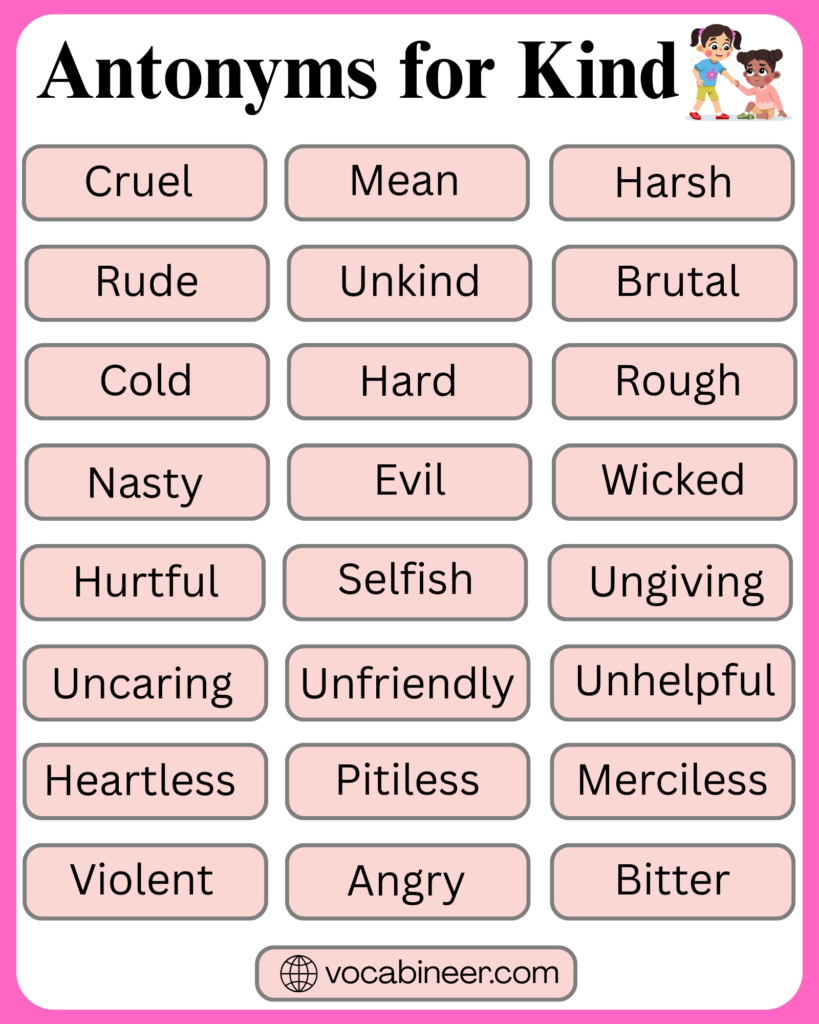
Some words clearly express the opposite of kind by showing cruelty, coldness, or lack of care for others. These antonyms appear often in school texts, reading passages, conversations, and descriptive writing, especially when warmth or empathy is missing.
- Cruel: Causing pain or suffering without sympathy.
- Mean: Deliberately unkind or hurtful in words or actions.
- Harsh: Severe, rough, or unforgiving in behavior or speech.
- Cold: Emotionally distant and lacking warmth or care.
- Heartless: Showing no compassion or concern for others.
- Unkind: Not caring or considerate toward others.
- Rude: Disrespectful or impolite in behavior or language.
- Callous: Emotionally hardened and insensitive to feelings.
- Spiteful: Acting with the intention to hurt or offend.
- Hostile: Showing anger, aggression, or unfriendliness.
- Insensitive: Not considering others’ feelings.
- Unsympathetic: Showing no understanding of pain or trouble.
- Aloof: Emotionally distant or detached from others.
- Abusive: Treating others with cruelty or violence.
- Dismissive: Ignoring or belittling others’ needs or feelings.
Emotional Antonyms of Kind
Some antonyms of kind focus mainly on emotional attitude. These words describe lack of warmth, empathy, or concern.
- Insensitive: Not caring about others’ feelings.
- Unsympathetic: Showing no understanding of suffering.
- Aloof: Emotionally distant or detached.
- Indifferent: Showing no interest or care.
- Detached: Emotionally separate from others.
Behavioral Antonyms of Kind
Some antonyms of kind describe actions and behavior rather than emotion alone.
- Abusive: Treating others with cruelty.
- Aggressive: Acting in a threatening or hostile way.
- Bullying: Using power to harm or control others.
- Rough: Lacking gentleness in action or speech.
- Dismissive: Ignoring or belittling others.
Words Related to Cruelty
Some words do not directly replace kind but help describe environments or attitudes where care and warmth are missing.
- Cruelty: Deliberate infliction of pain.
- Hostility: Angry or unfriendly attitude.
- Neglect: Failure to care or provide attention.
- Severity: Extreme strictness or harshness.
- Bitterness: Resentful or angry attitude.
Kind vs Similar Words
Kind describes caring, gentle, and considerate behavior toward others. It reflects warmth, empathy, and a willingness to treat people with respect and understanding.
| Word | Meaning and How It Is Different |
|---|---|
| Kind | Kind describes being friendly, caring, and thoughtful toward others. It focuses on gentle behavior and concern for people’s feelings. |
| Nice | Nice means pleasant or agreeable, but it is weaker than kind and does not always involve care or empathy. |
| Friendly | Friendly refers to being warm, welcoming, and easy to talk to, especially in social situations, but not necessarily helpful or caring. |
| Helpful | Helpful means giving assistance or support through actions, while kindness may be shown through attitude or words as well. |
| Generous | Generous focuses on giving time, money, or resources freely, whereas kind is more about emotional behavior. |
| Caring | Caring means showing concern and emotional involvement with others, often deeper and more personal than general kindness. |
| Compassionate | Compassionate refers to feeling sympathy for someone’s suffering and wanting to help, given stronger emotional depth than kind. |
| Polite | Polite means showing good manners and respect, but politeness does not always come from kindness. |
| Considerate | Considerate means thinking about how actions affect others, closely related to kind but more focused on awareness than emotion. |
| Warm-hearted | Warm-hearted describes someone with sincere affection and emotional warmth, often expressing kindness naturally. |
Antonyms for Kind in Sentences
Seeing antonyms used in sentences helps learners understand how these words fit naturally into English.
- His cruel remarks shocked everyone.
- She gave a cold response to the request.
- The manager sounded harsh during the meeting.
- His mean behavior upset the group.
- The comment felt callous and unnecessary.
- She became hostile during the argument.
How to Choose the Right Antonym for Kind
Choosing the correct antonym depends on context. If the focus is emotional lack of care, words like cold, insensitive, or unsympathetic fit best. If the focus is behavior, cruel, mean, or abusive are more accurate.
When describing attitude, hostile or callous may work better. Identifying whether kindness is missing emotionally, behaviorally, or socially helps select the most natural antonym.
Conclusion
Understanding antonyms for kind helps readers recognize how English expresses cruelty, harshness, or lack of compassion instead of care and warmth. These words appear across stories, school texts, and conversations, shaping how behavior and emotions are described. Learning them through explanation and sentence use builds clearer expression and stronger understanding of social behavior.
Read More
