

Antonyms for loyal helps readers understand how English expresses betrayal, disloyalty, and lack of commitment instead of faithfulness and trust. When loyalty weakens or disappears, language shifts to show abandonment, self-interest, or unreliability, making changes in behavior and intention easier to recognize. These opposite words appear often in stories, school texts, conversations, and descriptive writing, shaping how relationships, character traits, and moral choices are clearly communicated and understood.
In This Page
Meaning of Loyal in English
Loyal describes a person who remains faithful, supportive, and committed to someone, something, or a cause. A loyal person stands by others in difficult times, keeps promises, and does not betray trust. Loyalty can apply to friendships, families, teams, beliefs, or institutions.
The word loyal appears frequently in character descriptions and moral discussions. When loyalty is absent, English uses other words to express betrayal, unfaithfulness, or lack of commitment.
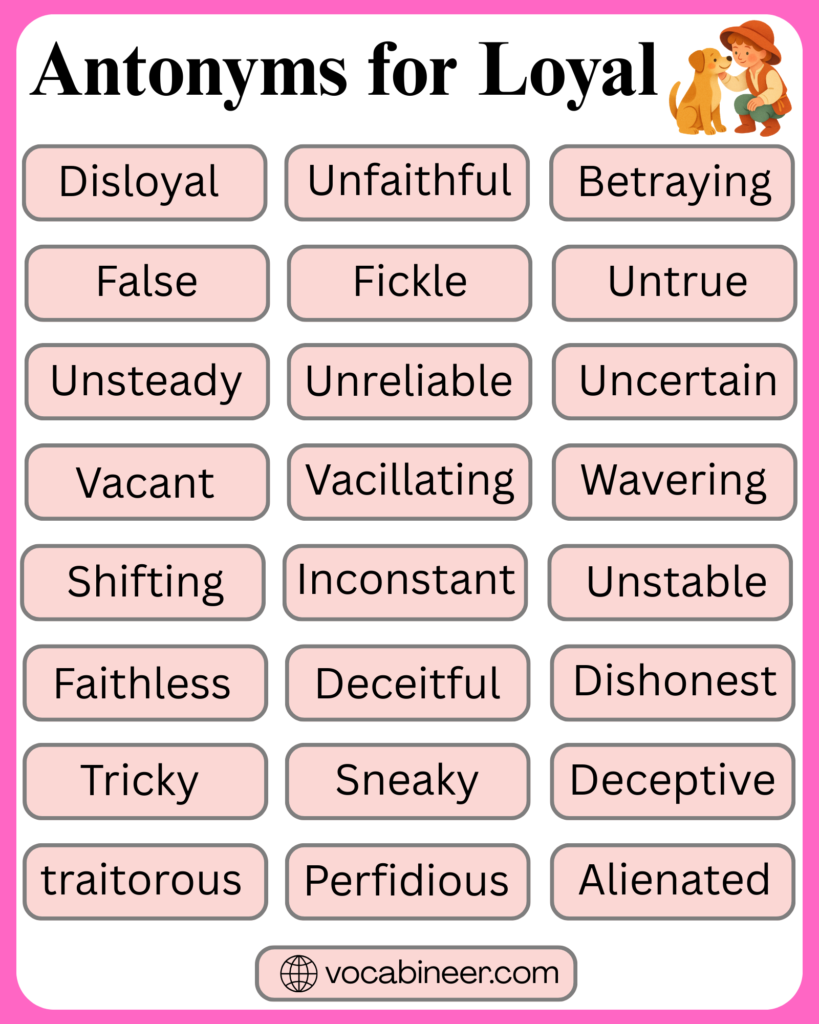
Common Antonyms for Loyal With Meanings
Some words clearly express the opposite of loyal by showing betrayal, unfaithfulness, or lack of commitment. These antonyms appear often in school texts, stories, conversations, and descriptive writing, especially when trust or allegiance breaks down.
- Disloyal: Not faithful or supportive to a person, group, or cause.
- Unfaithful: Breaking trust or commitment, especially in relationships.
- Treacherous: Willing to betray trust in a dangerous or secret way.
- Faithless: Lacking loyalty or belief in promises or bonds.
- Betraying: Turning against someone who depended on you.
- Unreliable: Cannot be depended on to stay committed or supportive.
- Backstabbing: Betraying someone secretly or unfairly.
- Inconstant: Changing loyalties easily and often.
- False: Pretending loyalty without sincerity.
- Disaffected: No longer supportive or loyal.
- Self-serving: Acting mainly for personal gain rather than loyalty.
- Abandoning: Giving up support or allegiance.
- Defecting: Leaving one side or group for another.
- Two-faced: Showing loyalty in words but betrayal in actions.
- Uncommitted: Lacking dedication or long-term allegiance.
Emotional Antonyms of Loyal
Some antonyms of loyal focus on emotional distance or lack of attachment. These words describe weakened bonds and absence of devotion.
- Detached: Emotionally distant or uninvolved.
- Indifferent: Showing no care or concern.
- Apathetic: Lacking interest or commitment.
- Cold: Emotionally distant and unsupportive.
- Self-centered: Focused on personal benefit rather than loyalty.
Behavioral Antonyms of Loyal
Some antonyms of loyal describe actions and conduct rather than emotional attitude alone.
- Deserting: Abandoning someone or something.
- Defecting: Leaving one side for another.
- Abandoning: Giving up support or commitment.
- Turning against: Opposing someone previously supported.
- Selling out: Betraying values or people for gain.
Words Related to Betrayal
Some words do not directly replace loyal but help describe situations where trust and allegiance are damaged.
- Betrayal: Act of breaking trust.
- Treacherousness: Willingness to deceive or betray.
- Deceit: Dishonest behavior.
- Disaffection: Loss of loyalty or support.
- Defection: Leaving allegiance behind.
Loyal vs Similar Words
Loyal describes steady faithfulness and support toward a person, group, or cause. It reflects trust and commitment over tim
| Word | Difference from Loyal |
|---|---|
| Loyal | Shows steady faithfulness, support, and commitment to a person, group, or cause. |
| Faithful | Focuses on keeping promises or relationships, often personal rather than active support. |
| Devoted | Emphasizes strong emotional attachment, while loyal may exist without deep emotion. |
| Trustworthy | Means reliable and honest, but does not always include personal allegiance. |
| Reliable | Refers to dependability in action, not emotional or moral commitment. |
| Supportive | Involves helping or encouraging, but may not imply long-term allegiance. |
Antonyms for Loyal in Sentences
Seeing antonyms used in sentences helps learners understand how these words fit naturally into English.
- He was disloyal to his team.
- She felt hurt by his betraying actions.
- The spy proved treacherous.
- His faithless behavior broke trust.
- They accused her of selling out.
- The ally suddenly defected.
How to Choose the Right Antonym for Loyal
Choosing the correct antonym depends on context. If the focus is broken trust, disloyal, unfaithful, or faithless fits best. If the focus is active betrayal, treacherous, backstabbing, or selling out works better.
When describing emotional distance, indifferent or detached may be more accurate. Identifying whether loyalty is missing emotionally, morally, or behaviorally helps select the most natural antonym.
Conclusion
Understanding antonyms for loyal helps readers recognize how English expresses betrayal, unfaithfulness, and lack of commitment instead of trust and allegiance. These words appear across stories, school texts, and conversations, shaping how relationships and moral choices are described. Learning them through explanation and sentence use builds clearer expression and deeper understanding of loyalty in English.
Read More
