

Learning the antonyms for order helps readers understand how arrangement, structure, and control change when organization is missing. Order often connects to neatness, sequence, rules, or stability, while its opposites point to disorder, confusion, or lack of control. These contrasts appear frequently in reading passages, classroom instructions, and everyday situations where organization and structure matter.
This article explains how antonyms for order work in different situations involving arrangement, behavior, systems, and environments. Knowing these opposite words helps learners talk about messy spaces, confused systems, uncontrolled behavior, and irregular patterns in school and daily communication.
In This Page
What Does Order Mean in English?
The word order is used in English to describe a state of organization, arrangement, or proper sequence. It can refer to tidy spaces, correct steps, rules in society, or controlled behavior. When something is in order, it follows a clear structure. When order is missing, confusion or instability appears. Because the meaning of order changes by context, its opposite words also change depending on use.
Common Antonyms for Order With Meanings
Understanding opposites of order helps learners notice how structure turns into confusion in daily communication. These words appear often in reading passages and classroom tasks.
Disorder
Disorder means a lack of organization, structure, or control. It describes situations where things are not arranged properly.
Chaos
Chaos refers to complete confusion and absence of control. Nothing follows a clear pattern or rule.
Confusion
Confusion is a state where order is unclear, mixed up, or hard to understand.
Mess
Mess describes an untidy or disorganized condition, especially in physical spaces.
Clutter
Clutter means too many items placed together without organization, making order difficult.
Disarray
Disarray refers to a condition of being untidy or thrown into disorder.
Turmoil
Turmoil describes strong disturbance or confusion, often involving emotions or social situations.
Anarchy
Anarchy means the absence of rules, laws, or authority controlling behavior.
Irregularity
Irregularity refers to a lack of consistent pattern, sequence, or structure.
Randomness
Randomness describes a situation where there is no clear order or predictable arrangement.
Mayhem
Mayhem means violent or noisy disorder with loss of control.
Unrest
Unrest refers to disturbance or lack of calm order, often in groups or society.
Lawlessness
Lawlessness means absence of laws or failure to follow established rules.
Instability
Instability describes a lack of steady order or balance, causing uncertainty.
Disorganization
Disorganization means failure to arrange things in a clear or orderly way.
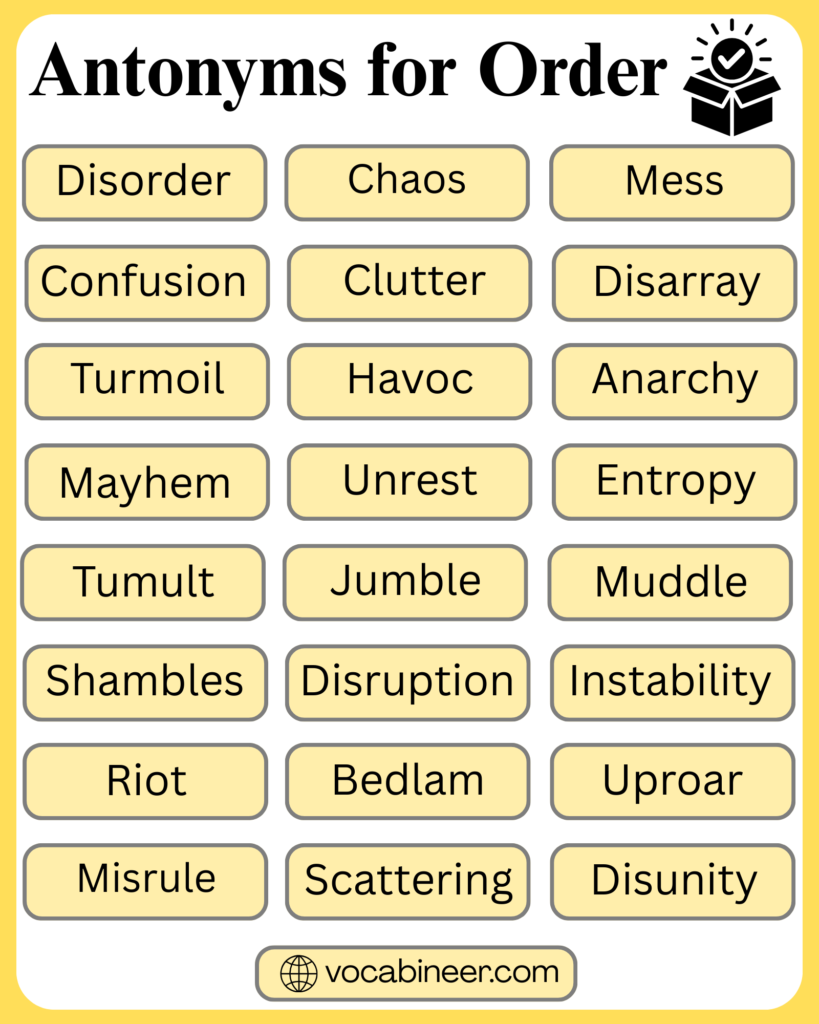
Antonyms for Order by Context
The opposite of order can change depending on what kind of order you’re talking about, such as physical arrangement, rules, systems, or behavior. Choosing the right antonym helps your meaning stay clear and accurate.
Physical Arrangement and Space
When order refers to arrangement or neatness, antonyms describe untidiness.
- Mess – untidy state
- Clutter – crowded disorder
- Disarray – lack of arrangement
- Disorder – no structure
- Chaos – complete mess
Rules and Authority
When order refers to rules or control, antonyms describe lack of authority.
- Anarchy – no governing rules
- Lawlessness – absence of law
- Unrest – public disturbance
- Turmoil – social disorder
- Rebellion – refusal to follow order
Systems and Processes
When order refers to systems or steps, antonyms focus on confusion.
- Confusion – unclear process
- Randomness – no sequence
- Irregularity – inconsistent pattern
- Breakdown – system failure
- Disorganization – lack of structure
Behavior and Conduct
When order refers to behavior, antonyms describe uncontrolled actions.
- Disorder – unruly behavior
- Chaos – lack of control
- Mayhem – violent disorder
- Unruliness – refusal to behave
- Turbulence – restless behavior
Order vs Similar Words
Understanding order vs similar words helps readers choose the correct term when talking about arrangement, control, or structure. Some words focus on neat placement, while others describe systems, rules, or stability. The table below explains how these words differ in meaning and use.
| Word | Meaning & Usage |
|---|---|
| Order | State of organization, control, or proper arrangement. |
| Organization | Act of arranging things in a planned and structured way. |
| Arrangement | Specific placement or positioning of items. |
| Structure | Clear framework or organized system. |
| Discipline | Control maintained through rules or training. |
| System | Set of organized methods or processes. |
| Sequence | Correct or logical order of steps or events. |
| Control | Power to manage, direct, or regulate actions. |
| Stability | Condition of being steady and balanced. |
| Neatness | Clean and tidy appearance or order. |
How to Choose the Right Antonym for Order
Choosing the right antonym for order depends on context. For physical spaces, mess, clutter, or disarray fits best. When talking about rules or society, anarchy or lawlessness is more accurate. For systems or processes, confusion or breakdown works naturally. Thinking about what kind of order is missing helps select the correct opposite.
Conclusion
Understanding antonyms for order helps you describe situations where structure, control, or arrangement is absent. Whether you are talking about a messy room, confused system, unruly behavior, or lack of rules, knowing the right opposite words makes communication clearer and more precise in everyday learning and communication.
Read More
