Learning the antonyms for progress helps readers understand how improvement, development, and forward movement change when growth slows or stops. Progress often connects to advancement, success, or positive change, while its opposites point to delay, decline, or backward movement. These contrasts appear frequently in reading passages, classroom discussions, and everyday situations where growth or improvement is measured.
This article explains how antonyms for progress work in different situations involving learning, work, development, and results. Knowing these opposite words helps learners talk about delays, failures, decline, and lack of improvement in school and daily communication.
In This Page
What Does Progress Mean in English?
The word progress is used in English to describe forward movement, improvement, or development toward a goal. It can refer to progress in studies, work, health, technology, or personal growth. When progress happens, things improve over time. When progress is missing, growth may slow, stop, or move backward. Because the meaning of progress changes by context, its opposite words also change depending on use.
Common Antonyms for Progress With Meanings
Understanding opposites of progress helps learners notice how improvement turns into delay or decline in daily communication. These words appear often in reading passages and classroom tasks.
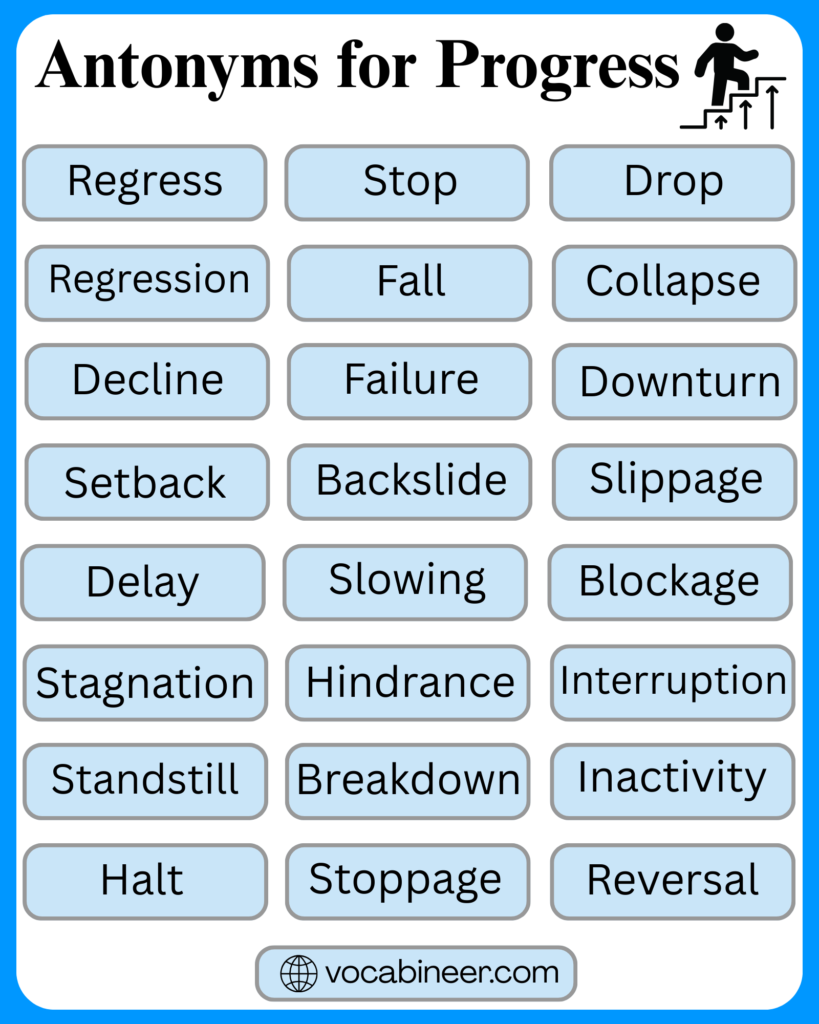
Stagnation
Stagnation means a complete lack of movement or improvement. It describes situations where growth stops entirely.
Regression
Regression refers to moving backward instead of forward. It is used when progress is lost over time.
Decline
Decline describes a gradual reduction in quality, strength, or improvement.
Setback
A setback is a problem or event that slows down or reverses progress temporarily.
Failure
Failure means the inability to achieve progress or reach expected goals.
Delay
Delay refers to progress happening later than planned or expected.
Standstill
Standstill means a complete stop in movement, growth, or development.
Deterioration
Deterioration describes gradual worsening in condition, quality, or performance.
Collapse
Collapse refers to sudden and complete failure of progress or development.
Backslide
Backslide means returning to a worse condition after some improvement.
Halt
Halt means a sudden stop in progress or forward movement.
Impediment
Impediment refers to something that blocks or slows progress.
Obstacle
Obstacle describes a barrier that prevents advancement or improvement.
Downturn
Downturn means a change from progress to decline, often in performance or growth.
Slump
Slump refers to a period of reduced activity, growth, or improvement.
Antonyms for Progress by Context
The opposite of progress can change depending on what kind of progress you’re talking about, such as learning, work, development, or results. Choosing the right antonym helps your meaning stay clear and accurate.
Learning and Education
When progress refers to learning, antonyms describe lack of improvement.
- Stagnation – no learning growth
- Regression – learning backward
- Failure – goals not met
- Delay – slow improvement
- Confusion – lack of clarity
Work and Development
When progress refers to work or development, antonyms focus on slowing or stopping.
- Setback – interrupted work
- Standstill – no movement
- Obstacle – blocking growth
- Impediment – slowing progress
- Halt – stopped advancement
Growth and Improvement
When progress refers to improvement, antonyms describe decline.
- Decline – gradual worsening
- Deterioration – loss of quality
- Downturn – negative change
- Slump – reduced growth
- Collapse – complete failure
Results and Outcomes
When progress refers to results, antonyms show lack of success.
- Failure – unsuccessful outcome
- Regression – backward results
- Delay – late results
- Backslide – loss of gains
- Breakdown – system failure
Progress vs Similar Words
Understanding progress vs similar words helps readers choose the correct term when talking about improvement, growth, or forward movement. Some words focus on gradual change, while others describe speed, success, or sudden improvement. The table below explains how these words differ in meaning and use.
| Word | Meaning & Usage |
|---|---|
| Progress | Forward movement or improvement over time. |
| Advancement | Moving ahead in position or level. |
| Improvement | Becoming better in quality or skill. |
| Development | Gradual growth or change. |
| Growth | Increase in size, ability, or strength. |
| Success | Achievement of positive results. |
| Expansion | Increase or spreading outward. |
| Breakthrough | Sudden major progress. |
| Momentum | Speed or force gained in progress. |
| Evolution | Slow and steady development over time. |
How to Choose the Right Antonym for Progress
Choosing the right antonym for progress depends on context. For learning or growth, stagnation or regression fits best. When talking about work or systems, setback, halt, or obstacle works naturally. For results or conditions, decline, deterioration, or failure is more accurate. Thinking about how improvement is blocked helps select the correct opposite.
Conclusion
Understanding antonyms for progress helps you describe situations where improvement slows, stops, or moves backward. Whether you are talking about delayed learning, work setbacks, declining performance, or lack of growth, knowing the right opposite words makes communication clearer and more precise in everyday learning and communication.
Read More