

Antonyms for shallow helps readers understand how English expresses depth, seriousness, and strong understanding instead of surface-level thinking or limited meaning. When something is no longer shallow, language shifts to show thoughtfulness, complexity, or emotional depth. These opposite words appear often in stories, school texts, conversations, and descriptive writing, shaping how ideas, people, and situations are clearly communicated.
In This Page
Meaning of Shallow in English
Shallow describes something that lacks depth. This meaning can be physical, such as shallow water, or abstract, such as shallow thinking or shallow emotions. When used to describe people or ideas, shallow often suggests lack of seriousness, understanding, or emotional range.
The word shallow appears frequently in descriptive writing and character analysis. When depth replaces shallowness, English uses many other words to express seriousness, insight, or physical depth.
Common Antonyms for Shallow
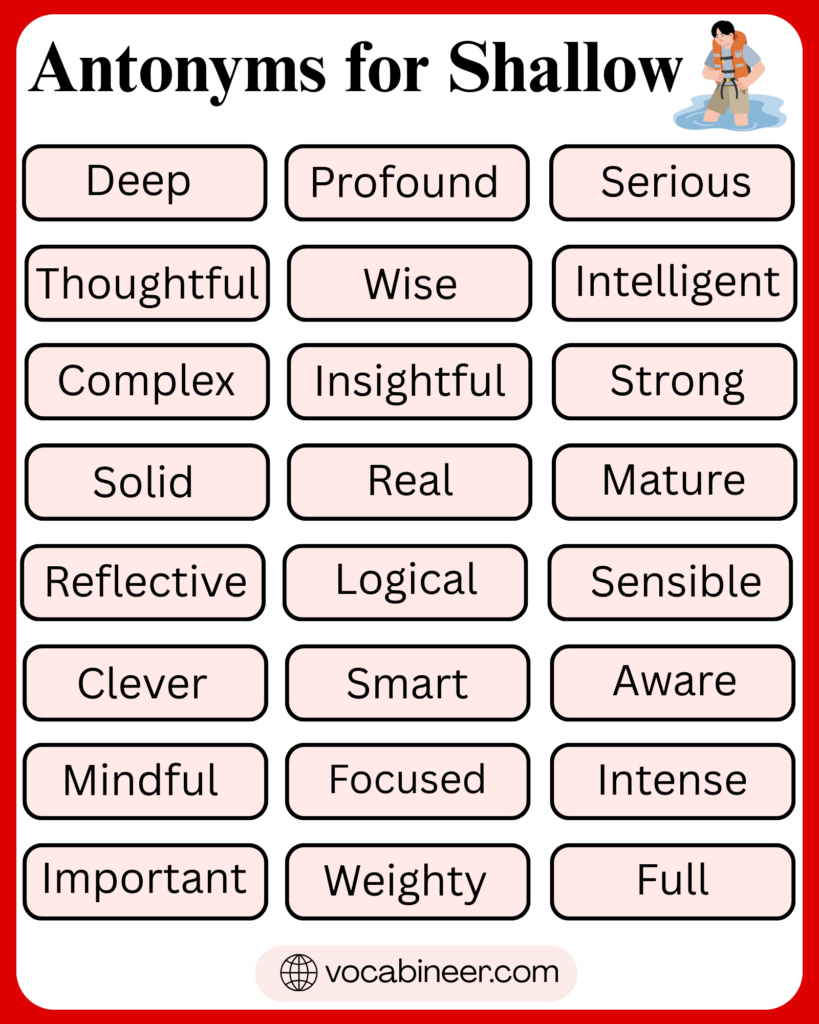
Some words clearly express the opposite of shallow by showing depth, seriousness, or strong understanding. These antonyms appear often in school texts, reading passages, conversations, and descriptive writing, especially when surface-level ideas are replaced by thoughtful or meaningful ones.
- Deep: Having great physical, emotional, or intellectual depth.
- Profound: Showing very deep meaning or understanding.
- Thoughtful: Giving careful attention and consideration.
- Insightful: Showing clear and deep awareness of ideas or situations.
- Meaningful: Having purpose, value, or importance.
- Serious: Focused and not trivial or surface-level.
- Complex: Made of many connected ideas or layers.
- Substantial: Having real depth, weight, or importance.
- Reflective: Showing careful thought and self-examination.
- Analytical: Examining ideas closely and in detail.
- Perceptive: Quickly noticing deeper meanings.
- Intense: Showing strong depth of feeling or focus.
- Informed: Based on solid knowledge rather than surface facts.
- Mature: Showing emotional or mental depth.
- Sincere: Honest and deeply felt rather than superficial.
Antonyms for Shallow in Thinking and Ideas
When shallow describes thinking or ideas, its antonyms highlight intellectual depth and understanding.
- Analytical: Examining ideas carefully and deeply.
- Perceptive: Quickly understanding deeper meanings.
- Informed: Based on strong knowledge rather than surface facts.
- Reasoned: Supported by logical thought.
- Considered: Thought through carefully.
Emotional Antonyms of Shallow
Some antonyms of shallow focus on emotional depth. These words describe feelings that go beyond surface emotion.
- Deep-feeling: Having strong emotional depth.
- Sincere: Showing honest and genuine emotion.
- Emotionally rich: Full of feeling and sensitivity.
- Passionate: Showing strong emotional involvement.
- Earnest: Showing seriousness and heartfelt intention.
Antonyms for Shallow in Physical Description
Shallow can also describe physical space. Its antonyms focus on depth and dimension.
- Deep: Extending far downward.
- Bottomless: Appearing to have no visible depth.
- Sunken: Extending well below the surface.
- Steep: Descending sharply.
- Immense: Vast in physical depth or size.
Words Related to Depth and Understanding
Some words do not directly replace shallow but support descriptions where depth and seriousness are present.
- Wisdom: Knowledge gained through experience and reflection.
- Maturity: Emotional and mental depth developed over time.
- Awareness: Conscious understanding beyond surface details.
- Perspective: Ability to see situations broadly and deeply.
- Introspection: Thoughtful self-examination.
Shallow vs Similar Words
Shallow describes a lack of depth, either physically, emotionally, or intellectually. It often suggests surface-level focus without seriousness, insight, or strong understanding.
Shallow vs Superficial
Although superficial focuses on appearance or surface details, shallow goes further by suggesting limited depth in thinking, emotion, or meaning.
Shallow vs Simple
The word simple means easy to understand or not complex. Shallow does not mean easy; it implies lack of depth or seriousness.
Shallow vs Trivial
Trivial refers to something of little importance. Shallow emphasizes lack of depth rather than lack of value alone.
Shallow vs Narrow-minded
Being narrow-minded means refusing to accept new ideas. Shallow refers to limited depth of thought, not resistance to different views.
Shallow vs Careless
Careless describes lack of attention or concern. Shallow suggests limited thought or emotional depth, even if attention is present.
Antonyms for Shallow in Sentences
Seeing antonyms used in sentences helps learners understand how these words fit naturally into English.
- Her response was thoughtful and well considered.
- The novel explored deep emotional themes.
- His speech carried a profound message.
- She gave an insightful explanation.
- Their discussion became more serious over time.
- The water was surprisingly deep near the shore.
How to Choose the Right Antonym for Shallow
Choosing the correct antonym depends on context. If shallow describes thinking, words like thoughtful, insightful, or analytical work best. If shallow refers to emotions, sincere, deep-feeling, or passionate are more accurate.
When shallow describes physical space, deep, sunken, or steep fit better. Identifying whether the lack of depth is mental, emotional, or physical helps select the most natural antonym.
Conclusion
Understanding antonyms for shallow helps readers recognize how English expresses depth, seriousness, and strong understanding instead of surface-level thinking or emotion. These words appear across stories, school texts, and conversations, shaping how ideas and feelings are described. Learning them through explanation and sentence use builds clearer expression and deeper understanding in English.
Read More
