

Learning antonyms for start helps readers understand how English expresses stopping, ending, finishing, or pausing instead of beginning or initiating. When an action does not move forward, language shifts to reflect closure, delay, interruption, or conclusion, making changes in progress easier to recognize. These opposite words appear often in stories, school texts, conversations, instructions, and descriptive writing, shaping how actions, timelines, and outcomes are clearly communicated and understood.
In This Page
Meaning of Start in English
Start means to begin something, initiate an action, or cause a process to begin. It can refer to beginning an activity, launching a project, opening an event, or setting something into motion. Start often suggests movement, action, or the first step toward completion.
The word start is very common in daily conversation, academic writing, instructions, storytelling, and professional communication. When starting does not happen or is reversed, English uses different words to express ending, stopping, delay, or interruption.
Common Antonyms for Start With Meanings
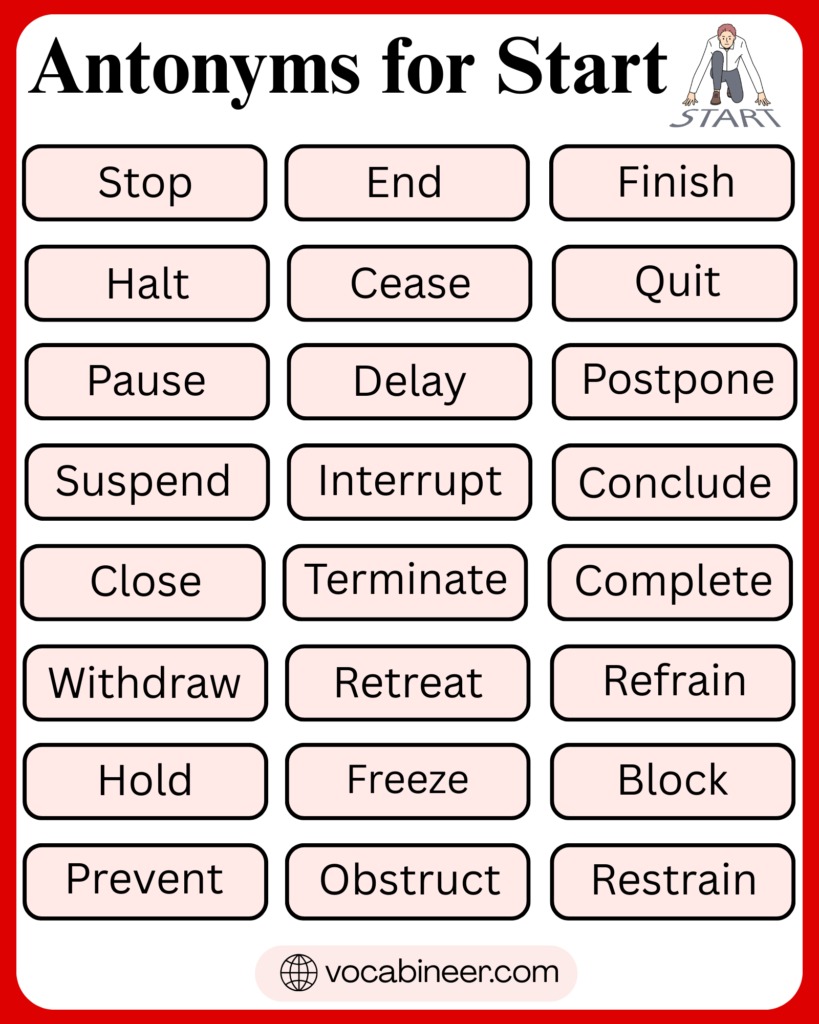
Some words clearly express the opposite of start by showing stopping, ending, completion, delay, or cancellation instead of beginning or initiation. These antonyms appear often in school texts, instructions, conversations, and descriptive writing.
- Stop: To bring an action or process to an end.
- End: To finish or conclude something completely.
- Finish: To complete all parts of a task or activity.
- Conclude: To bring something to a formal or final end.
- Close: To shut or end an event, activity, or operation.
- Cease: To stop completely, often suddenly.
- Halt: To bring movement or action to an immediate stop.
- Terminate: To end something officially or formally.
- Cancel: To decide not to continue or begin a planned activity.
- Suspend: To pause or stop temporarily.
- Abort: To stop before full completion or progress.
- Postpone: To delay something until a later time.
- Delay: To put off starting or continuing something.
- Wrap up: To finish or complete something informally.
- Break off: To stop suddenly or unexpectedly.
Antonyms for Start Related to Ending
Some antonyms focus on completing or closing something.
- Finish: Completing all steps of a task.
- End: Bringing something to its final point.
- Conclude: Ending in a formal or structured way.
- Close: Ending business, events, or operations.
- Wrap up: Informally finishing something.
Antonyms for Start Related to Stopping
Some antonyms emphasize halting movement or action.
- Stop: Bringing action to a halt.
- Cease: Ending completely.
- Halt: Stopping suddenly.
- Pause: Temporary stopping.
- Break off: Ending suddenly.
Antonyms for Start Related to Cancellation or Delay
Some antonyms describe situations where something never begins.
- Cancel: Ending plans before they begin.
- Abort: Stopping before full beginning.
- Postpone: Delaying until later.
- Delay: Pushing the beginning forward in time.
- Suspend: Temporarily stopping planned action.
Words Related to Stopping and Completion
Some words support the meaning of not starting without directly replacing the word.
- Completion: State of being finished.
- Closure: Emotional or official ending.
- Interruption: Break in action.
- Termination: Formal ending.
- Conclusion: Final stage of something.
Start vs Similar Words
Below is a comparison showing how start differs from related words in meaning and use.
| Word | Difference from Start |
|---|---|
| Start | Means to begin or initiate an action, event, or process. |
| Begin | Very close in meaning, slightly more formal. |
| Launch | Suggests a formal or public beginning. |
| Initiate | Refers to starting something formally or officially. |
| Open | Focuses on starting access or operation. |
| Commence | Formal word for begin, often used in official writing. |
| Activate | Means causing something to start functioning. |
| Set off | Focuses on beginning movement or travel. |
Antonyms for Start in Sentences
Seeing antonyms used in sentences helps learners understand natural usage.
- The teacher told the students to stop writing.
- The movie ended late at night.
- She finished her homework early.
- The meeting concluded after two hours.
- They cancelled the event due to rain.
- The train suddenly halted.
- The program was suspended for maintenance.
How to Choose the Right Antonym for Start
Choosing the correct antonym depends on context. If the focus is finishing, end, finish, or conclude works best. If the focus is stopping suddenly, halt, stop, or cease fits better. For planned activities that never begin, cancel, postpone, or abort is more accurate.
Understanding whether the situation involves completion, interruption, or cancellation helps select the most natural antonym.
Why Learning Antonyms for Start Matters
Understanding antonyms for start helps readers recognize contrast between beginning and ending. These words explain how action turns into stillness and how progress becomes closure. They help describe timelines, instructions, emotions, and decisions clearly.
Learning these opposites improves reading comprehension, writing clarity, and accurate communication in daily and academic contexts.
Conclusion
Understanding antonyms for start helps readers recognize how English expresses stopping, ending, completion, or cancellation instead of beginning or initiation. These words appear across stories, school texts, conversations, and instructions, shaping how actions, timing, and outcomes are described. Learning them through explanation and sentence use builds clearer expression and deeper understanding of beginnings and endings in English.
Read More
