

Learning the antonyms for strength helps readers understand how power, force, and ability change when weakness or limitation is present. Strength often connects to physical power, emotional firmness, influence, or durability, while its opposites point to weakness, fragility, or lack of force. These contrasts appear frequently in reading passages, classroom explanations, and everyday situations where ability or resilience matters.
This article explains how antonyms for strength work in different situations involving people, objects, emotions, and performance. Knowing these opposite words helps learners talk about weak muscles, fragile materials, low endurance, and reduced power in school and daily communication.
In This Page
What Does Strength Mean in English?
The word strength is used in English to describe the quality of being strong in body, mind, or character. It can refer to physical strength, emotional strength, mental strength, or structural strength. Strength also describes influence, intensity, or power. Because the meaning of strength changes by context, its opposite words also change depending on use.
Common Antonyms for Strength With Meanings
Understanding opposites of strength helps learners notice how power and ability decrease in daily communication. These words appear often in reading passages and classroom tasks.
Weakness
Weakness means a lack of physical power, force, or ability. It can refer to the body, mind, or character.
Fragility
Fragility describes a condition where something can break or be damaged easily due to low strength.
Feebleness
Feebleness refers to extreme physical weakness and very limited power or energy.
Frailty
Frailty means being physically weak or delicate, often because of age or poor health.
Infirmity
Infirmity describes long-term physical weakness or illness that reduces strength.
Softness
Softness refers to a lack of firmness, resistance, or structural strength.
Delicacy
Delicacy means being easily harmed or damaged due to low strength or toughness.
Instability
Instability describes a lack of support or firmness, making something unreliable or weak.
Vulnerability
Vulnerability means being easily affected, harmed, or overcome because of limited strength.
Powerlessness
Powerlessness refers to the absence of control, influence, or strength to act.
Helplessness
Helplessness describes a state where a person cannot resist, act, or protect themselves.
Ineffectiveness
Ineffectiveness means a lack of strength or power to produce results.
Faintness
Faintness refers to weak physical condition or low energy levels.
Thinness
Thinness describes a lack of material or structural strength.
Brittleness
Brittleness means the tendency to break or snap easily under pressure.
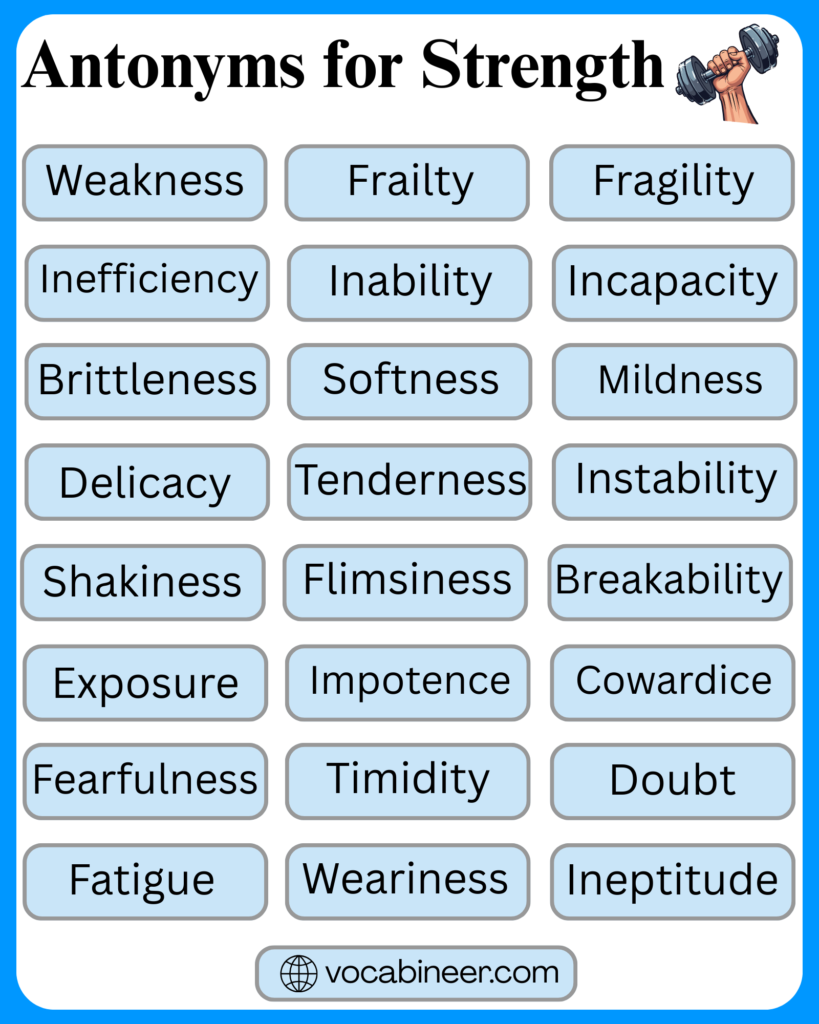
Antonyms for Strength by Context
The opposite of strength can change depending on what kind of strength you’re talking about, such as physical, emotional, mental, or structural. Choosing the right antonym helps your meaning stay clear and accurate.
Physical Strength
When strength refers to the body, antonyms describe lack of power or endurance.
- Weakness – lack of power
- Feebleness – very low strength
- Frailty – physical delicacy
- Infirmity – weak health
- Faintness – low energy
Emotional and Mental Strength
When strength refers to emotions or mindset, antonyms describe low resilience.
- Vulnerability – easily affected
- Helplessness – lack of control
- Instability – emotional weakness
- Fearfulness – lack of courage
- Fragility – emotional sensitivity
Materials and Structure
When strength refers to objects or materials, antonyms focus on poor durability.
- Fragility – breaks easily
- Brittleness – snaps under pressure
- Softness – lacks firmness
- Thinness – not sturdy
- Instability – weak support
Influence and Effect
When strength refers to influence or impact, antonyms describe lack of effect.
- Powerlessness – no influence
- Ineffectiveness – no impact
- Weakness – low force
- Insignificance – little importance
- Limitation – reduced capacity
Strength vs Similar Words
Understanding strength vs similar words helps readers choose the correct term based on power, endurance, influence, or durability. Some words focus on physical force, while others describe resilience, control, or lasting ability. The table below explains how these words differ in meaning and use.
| Word | Meaning & Usage |
|---|---|
| Strength | Power, force, or ability to act or endure. |
| Power | Ability to control, influence, or produce effect. |
| Force | Physical or applied strength. |
| Might | Great strength or power. |
| Energy | Physical or mental activity power. |
| Endurance | Ability to last over time. |
| Stamina | Sustained physical strength. |
| Resilience | Ability to recover from difficulty. |
| Durability | Strength to resist damage. |
| Toughness | Ability to withstand pressure. |
How to Choose the Right Antonym for Strength
Choosing the right antonym for strength depends on context. For physical ability, weakness, frailty, or feebleness fits best. When describing emotions, vulnerability or helplessness works naturally. For materials, fragility or brittleness is more accurate. Thinking about what kind of strength is missing helps select the correct opposite.
Conclusion
Understanding antonyms for strength helps you describe people, emotions, materials, and situations that lack power or resilience. Whether you are talking about physical weakness, emotional vulnerability, fragile objects, or low influence, knowing the right opposite words makes communication clearer and more precise in everyday learning and communication.
Read More
