

Learning the antonyms for success helps readers understand how achievement, progress, and positive outcomes change when goals are not reached. Success often connects to winning, accomplishment, or favorable results, while its opposites point to failure, loss, or lack of achievement. These contrasts appear frequently in reading passages, classroom discussions, and everyday situations where effort and results are evaluated.
This article explains how antonyms for success work in different situations involving goals, performance, outcomes, and effort. Knowing these opposite words helps learners talk about setbacks, mistakes, poor results, and unsuccessful attempts in school and daily communication.
In This Page
What Does Success Mean in English?
The word success is used in English to describe the achievement of a goal or a desired result. It can refer to success in exams, work, business, sports, or personal plans. A successful action brings positive results, while lack of success means goals are not achieved. Because the meaning of success changes by context, its opposite words also change depending on use.
Common Antonyms for Success With Meanings
Understanding opposites of success helps readers describe outcomes where goals are not achieved or results fall short. These words are commonly used in school texts and everyday communication to explain failure, loss, or lack of achievement.
Failure
Failure means not achieving a goal or intended result, even after effort or planning.
Defeat
Defeat refers to losing in a contest, exam, competition, or direct comparison.
Loss
Loss describes an unfavorable result where success is missed or something valuable is gone.
Setback
A setback is a difficulty that slows progress or temporarily blocks success.
Collapse
Collapse means a sudden and complete failure of a plan, system, or effort.
Mistake
A mistake is a wrong decision or action that leads to poor or unsuccessful results.
Misfortune
Misfortune refers to bad luck or events that prevent success despite effort.
Downfall
Downfall describes a sudden loss of success, position, or advantage after progress.
Flop
A flop is a complete lack of success, especially in projects or performances.
Disappointment
Disappointment is the feeling caused when expected success does not happen.
Ineffectiveness
Ineffectiveness means actions fail to produce the intended or successful outcome.
Abortive
Abortive describes efforts that end early without achieving success.
Reversal
Reversal means a sudden change from success to failure.
Shortcoming
A shortcoming is a weakness or missing element that prevents success.
Deficiency
Deficiency refers to a lack of skills, resources, or preparation needed for success.
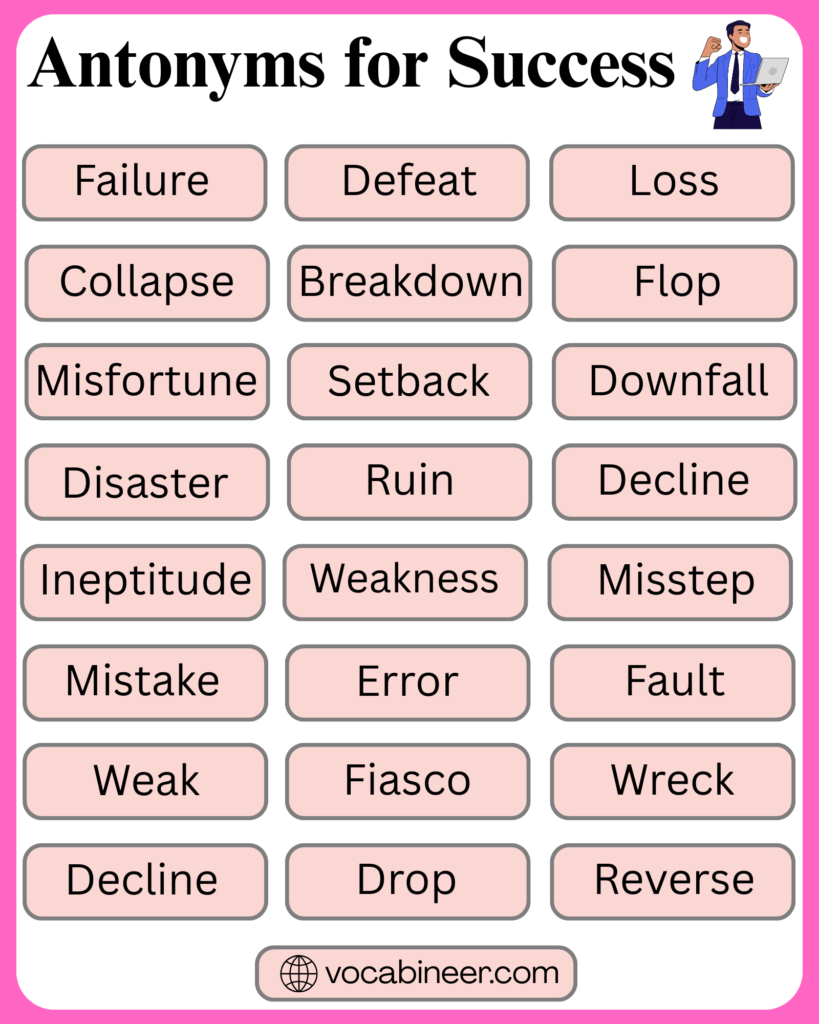
Antonyms for Success by Context
The opposite of success can change depending on what kind of success you’re talking about, such as goals, performance, results, or plans. Choosing the right antonym helps your meaning stay clear and accurate.
Goals and Plans
When success refers to reaching goals, antonyms describe failure or delay.
- Failure – goal not achieved
- Setback – progress delayed
- Abortive – ending without result
- Breakdown – plan stops working
- Miss – failing to reach target
Competition and Performance
When success refers to competition or performance, antonyms focus on loss.
- Defeat – losing effort
- Loss – unsuccessful result
- Flop – total failure
- Reversal – turning from winning to losing
- Collapse – sudden performance failure
Effort and Action
When success refers to actions or attempts, antonyms describe ineffective effort.
- Ineffectiveness – no impact
- Mistake – wrong action
- Misstep – small failure
- Error – incorrect move
- Misjudgment – poor decision
Outcome and Results
When success refers to results, antonyms describe negative endings.
- Disappointment – unmet expectations
- Misfortune – bad outcome
- Downfall – major loss
- Deficiency – missing elements
- Shortcoming – lack causing failure
Success vs Similar Words
Understanding success vs similar words helps readers choose the most accurate term when talking about achievement, results, or progress. Some words focus on winning, while others describe completion, growth, or positive outcomes. The table below explains how these words differ in meaning and use.
| Word | Meaning & Usage |
|---|---|
| Success | Achievement of a desired goal or result. |
| Achievement | Something accomplished through effort. |
| Victory | Success in a contest or competition. |
| Win | Act of succeeding in a game or contest. |
| Accomplishment | Completion of a task or goal. |
| Progress | Forward movement toward a goal. |
| Prosperity | Long-term success and growth. |
| Breakthrough | Sudden major success. |
| Triumph | Great or dramatic success. |
| Attainment | Reaching or achieving a goal. |
How to Choose the Right Antonym for Success
Choosing the right antonym for success depends on context. For goals or plans, failure or setback fits best. When talking about competition, defeat or loss works naturally. For actions or efforts, mistake or ineffectiveness is more accurate. Thinking about what kind of success is missing helps select the correct opposite.
Conclusion
Understanding antonyms for success helps you describe situations where goals are not achieved or results are unfavorable. Whether you are talking about failure in exams, defeat in sports, mistakes at work, or disappointing outcomes, knowing the right opposite words makes communication clearer and more precise in everyday learning and communication.
Read More
