

Learning antonyms for support helps readers understand how English expresses opposition, resistance, neglect, harm, or lack of assistance instead of encouragement or help. When support is absent, language shifts to show obstruction, disagreement, abandonment, or weakening. These opposite words appear often in stories, school texts, conversations, arguments, instructions, and descriptive writing, shaping how actions, relationships, opinions, and outcomes are clearly communicated.
This article explains antonyms for support using meanings and sentence examples. Understanding these opposites helps describe emotional reactions, social behavior, academic ideas, and everyday situations more accurately.
In This Page
Meaning of Support in English
Support means to help, assist, encourage, protect, or strengthen someone or something. It can involve emotional help, physical aid, financial assistance, approval of ideas, or backing of decisions. Support often reflects care, cooperation, agreement, loyalty, and encouragement.
The word support is commonly used in relationships, education, workplace communication, debates, politics, and daily conversation. When support is missing or reversed, English uses different words to express opposition, neglect, harm, resistance, or refusal.
Common Antonyms for Support With Meanings
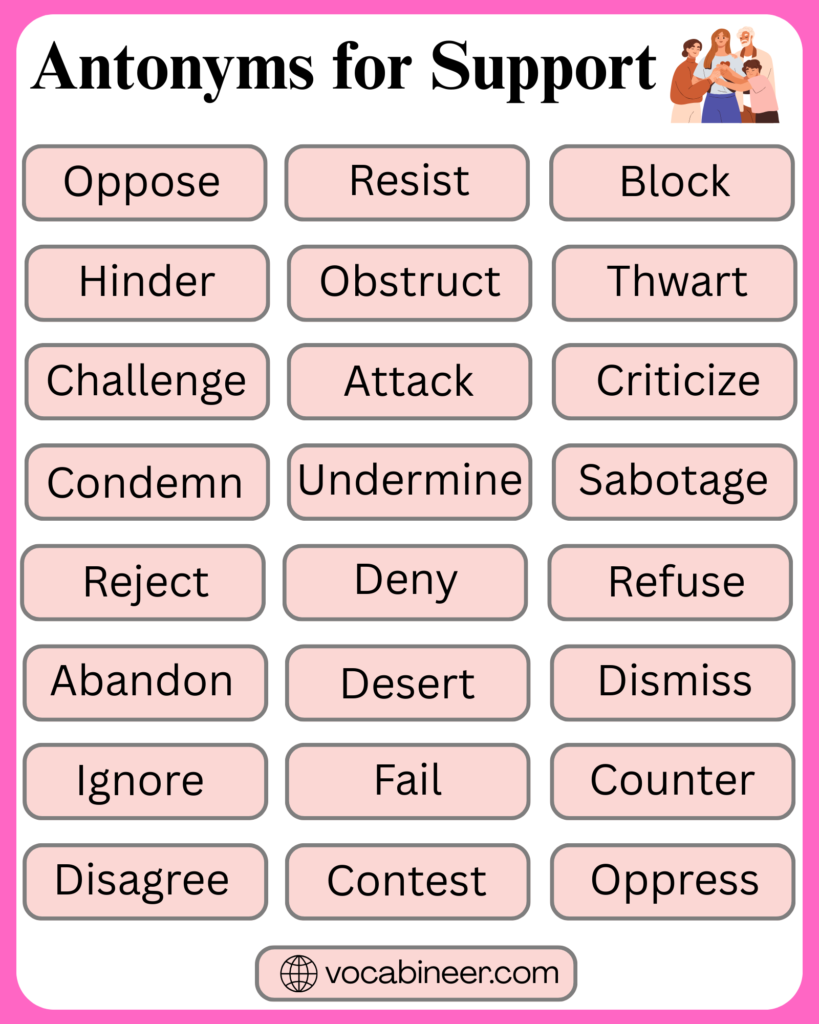
Some words clearly express the opposite of support by showing opposition, resistance, neglect, or harm instead of assistance or encouragement. These antonyms appear often in reading passages, school exams, debates, conversations, and descriptive writing.
- Oppose: To act against or disagree strongly.
- Resist: To struggle against or refuse cooperation.
- Undermine: To weaken gradually or secretly.
- Hinder: To slow down or block progress.
- Obstruct: To block movement or action.
- Weaken: To reduce strength or effectiveness.
- Neglect: To fail to care for or help properly.
- Abandon: To leave without support.
- Reject: To refuse acceptance or approval.
- Disapprove: To express lack of approval.
- Harm: To cause damage or injury.
- Damage: To negatively affect strength or quality.
- Ignore: To choose not to respond or assist.
- Block: To stop movement or development.
- Sabotage: To deliberately damage success.
Antonyms for Support Related to Opposition
Some antonyms focus on disagreement and active resistance.
- Oppose: Acting against an idea, plan, or action.
- Resist: Refusing to cooperate or comply.
- Challenge: Questioning or confronting directly.
- Fight: Actively working against something.
- Counter: Acting in opposition.
Antonyms for Support Related to Obstruction
Some antonyms emphasize blocking progress or success.
- Hinder: Making progress slow or difficult.
- Obstruct: Blocking movement or development.
- Impede: Slowing down progress.
- Block: Preventing movement or success.
- Interfere: Disrupting helpful action.
Antonyms for Support Related to Harm or Weakening
Some antonyms describe causing damage instead of strength.
- Undermine: Weakening gradually.
- Weaken: Reducing strength.
- Harm: Causing physical or emotional pain.
- Damage: Reducing value or effectiveness.
- Sabotage: Intentionally destroying success.
Antonyms for Support Related to Neglect or Refusal
Some antonyms focus on failing to help or care.
- Neglect: Failing to provide care or attention.
- Ignore: Choosing not to respond.
- Reject: Refusing help, ideas, or people.
- Abandon: Leaving someone without help.
- Dismiss: Treating as unimportant.
Words Related to Lack of Support and Opposition
Some words add emotional or situational meaning when describing lack of support.
- Resistance: Act of opposing.
- Opposition: Act of standing against.
- Interference: Disrupting assistance.
- Neglect: Failure to care.
- Isolation: Being left without support.
Support vs Similar Words
Below is a comparison showing how support differs from related words in meaning and use.
| Word | Difference from Support |
|---|---|
| Support | Means to help, assist, encourage, or strengthen. |
| Help | General term for assistance. |
| Assist | Formal word for help, often professional. |
| Aid | Formal or emergency assistance. |
| Encourage | Emotional support and motivation. |
| Back | Informal approval or agreement. |
| Promote | Helping something grow or succeed. |
| Uphold | Supporting rules, values, or laws. |
Antonyms for Support in Sentences
Seeing antonyms used in sentences helps learners understand natural usage.
- Many people opposed the new law.
- His comments undermined her confidence.
- The heavy traffic obstructed rescue work.
- Poor management weakened team performance.
- He ignored the request for help.
- They abandoned the project midway.
- False rumors sabotaged the campaign.
How to Choose the Right Antonym for Support
Choosing the correct antonym depends on context. If the focus is disagreement, oppose, resist, or reject fits best. If the focus is blocking progress, hinder, impede, or obstruct works better. For emotional or social damage, undermine, harm, or neglect is more accurate.
Why Learning Antonyms for Support Matters
Understanding antonyms for support helps readers recognize contrast between encouragement and resistance. These words explain how cooperation turns into conflict and how care becomes neglect. They help describe emotional struggles, disagreements, failures, and setbacks clearly.
Conclusion
Understanding antonyms for support helps readers recognize how English expresses opposition, resistance, neglect, or harm instead of encouragement and assistance. These words appear across stories, school texts, debates, conversations, and instructions, shaping how actions, emotions, and outcomes are described. Learning them through explanation and sentence use builds clearer expression and deeper understanding of support and opposition in English.
Read More
