
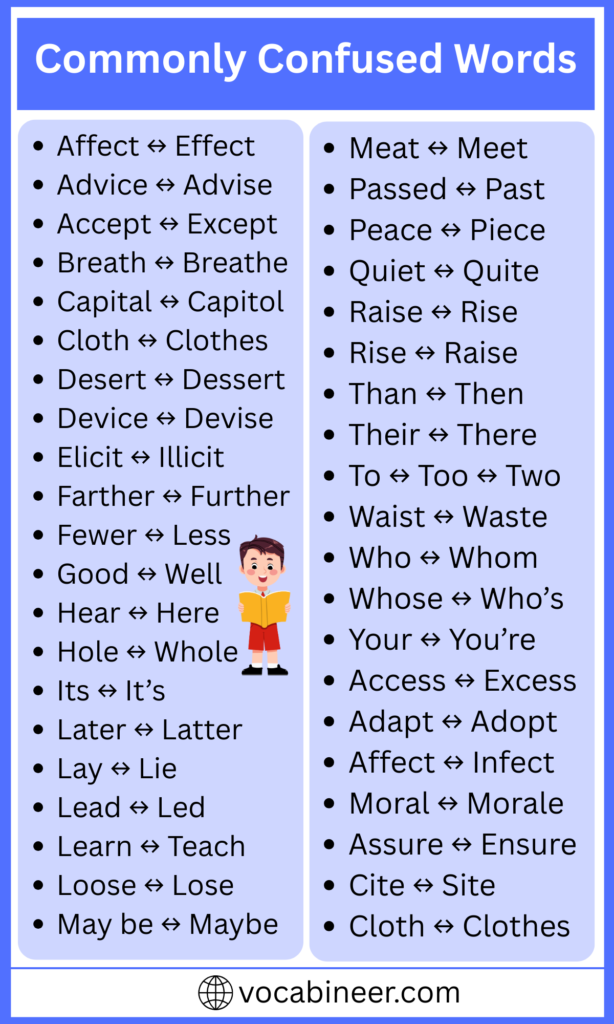
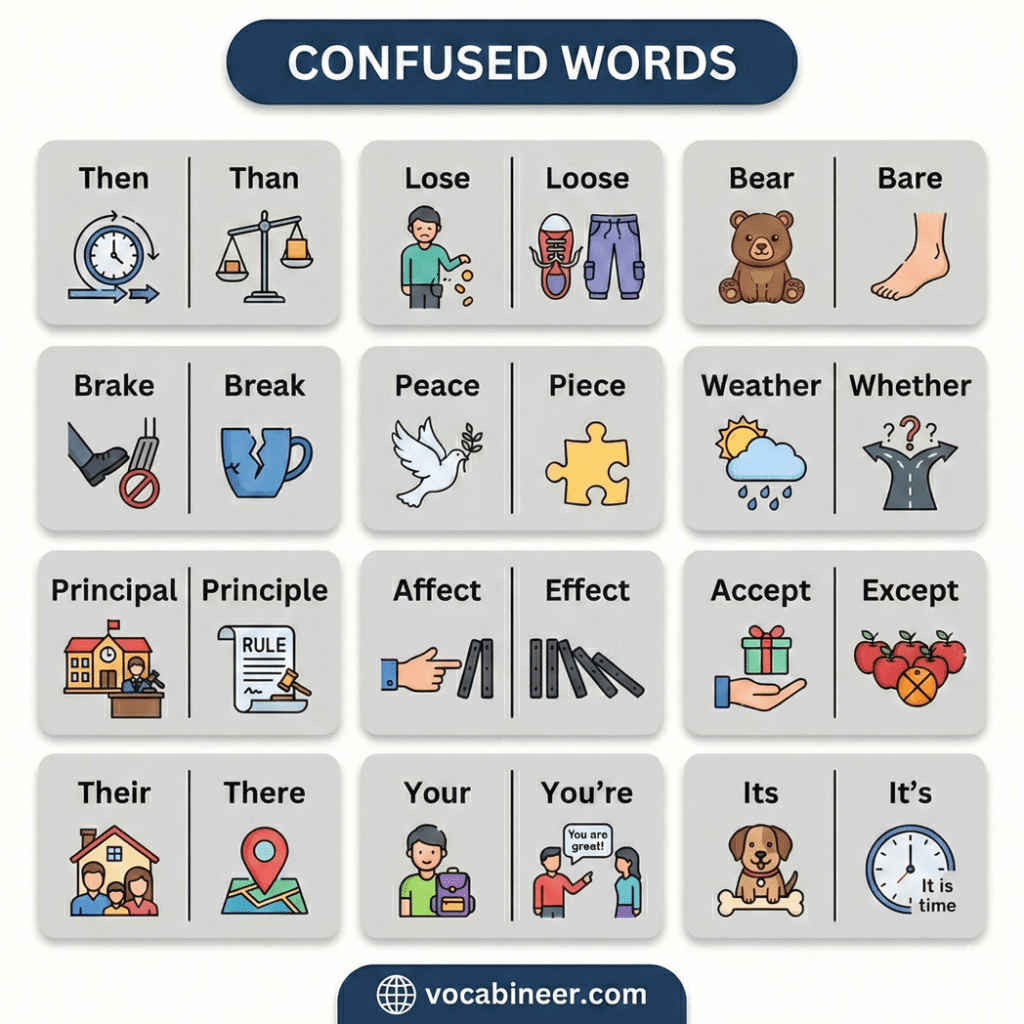
Confused words are words that look similar, sound similar, or have closely related meanings, so learners often mix them up. These words are all correct, but they are used in different situations and do not mean the same thing. Examples include pairs like then and than, accept and except, or their and there, where a small difference in form changes the meaning of a sentence. Learning confused words helps readers understand English more clearly and avoid mistakes in reading and writing.
Learning Confused Words helps readers understand why similar words cannot always replace each other in a sentence. Often, these words appear alike in meaning, spelling, or everyday use; as a result, small mistakes happen and the message changes. In many cases, each word carries a specific role, and by noticing this, sentences stay accurate and sound more natural.
By studying 1000 Commonly Confused Word Pairs, readers learn to choose words with confidence in schoolwork, daily communication, and common written tasks, especially when learning through pictures and clear word groupings.
In This Page
Commonly Confused Words in Everyday English
Everyday English contains many word pairs that appear similar but carry different meanings. These words are used in short sentences, daily instructions, and routine communication. Understanding their short meanings helps readers choose the correct word naturally and avoid confusion that changes the sense of a sentence.
- Accept: Agree to receive.
Except: Leave out. - Bring: Carry toward.
Take: Carry away. - Borrow: Take and return.
Lend: Give temporarily. - Buy: Pay to get.
Purchase: Buy formally. - Choose: Decide between options.
Select: Pick carefully. - Big: Large in size.
Large: Big, more formal. - Fast: High speed.
Quick: Short time. - Job: Paid work.
Work: Tasks or effort. - Say: Speak words.
Tell: Give information. - Look: Direct eyes.
See: Notice visually. - Hear: Receive sound.
Listen: Pay attention to sound. - Start: Begin action.
Begin: Start formally. - End: Stop something.
Finish: Complete fully. - Help: Give support.
Assist: Help formally. - Use: Put to action.
Utilize: Use fully. - Give: Hand over.
Provide: Supply something. - Ask: Request information.
Request: Ask formally. - Need: Require something.
Want: Desire something. - Try: Make an effort.
Attempt: Try formally. - Show: Make visible.
Display: Show clearly. - Beginner: New learner.
Starter: One who begins. - Live: Reside somewhere.
Stay: Remain for a time. - Leave: Go away.
Exit: Leave formally. - Right: Correct.
Correct: Free from error. - Wrong: Incorrect.
False: Not true. - Easy: Not hard.
Simple: Not complex. - Hard: Difficult.
Tough: Hard to handle. - Old: Aged.
Elderly: Old people. - Young: Not old.
Youthful: Young in spirit. - Early: Before time.
Soon: In a short time. - Late: After time.
Delay: Cause to be late. - Open: Not closed.
Unlock: Open with a key. - Close: Shut.
Shut: Close firmly. - Safe: Not dangerous.
Secure: Protected. - Clean: Not dirty.
Clear: Free from clutter. - Dirty: Not clean.
Messy: Untidy. - Full: Completely filled.
Complete: Having all parts. - Empty: Nothing inside.
Vacant: Not occupied. - Same: Not different.
Equal: The same in value. - Different: Not same.
Separate: Kept apart. - Quiet: Little noise.
Silent: No noise. - Loud: High sound.
Noisy: Making noise. - Kind: Caring.
Nice: Pleasant. - Mean: Unkind.
Rude: Impolite. - Happy: Feeling joy.
Glad: Pleased. - Sad: Feeling unhappy.
Upset: Emotionally disturbed. - Angry: Feeling mad.
Annoyed: Slightly angry. - Fear: Feeling afraid.
Scare: Cause fear. - Love: Strong affection.
Like: Mild enjoyment. - Hate: Strong dislike.
Dislike: Not like. - Begin: Start.
Open: Start officially. - Stop: Cease action.
Pause: Stop briefly. - Move: Change position.
Shift: Move slightly. - Push: Move away by force.
Pull: Draw toward. - Hold: Keep in hand.
Keep: Continue having. - Drop: Let fall.
Fall: Drop naturally. - Fix: Repair.
Repair: Fix formally. - Break: Damage.
Damage: Harm something. - Win: Achieve victory.
Earn: Gain by effort. - Lose: Fail to keep.
Miss: Fail to reach.
- Arrive: Reach a place.
Reach: Get to a point. - Leave: Go away from a place.
Depart: Leave formally. - Stay: Remain in a place.
Remain: Continue to be. - Live: Have a home.
Reside: Live formally. - Begin: Start something.
Launch: Start officially. - Stop: End an action.
Quit: Stop permanently. - Continue: Keep going.
Proceed: Continue formally. - Make: Create something.
Create: Make formally. - Do: Perform an action.
Act: Do intentionally. - Get: Receive or obtain.
Obtain: Get formally. - Put: Place something.
Place: Put carefully. - Set: Put in position.
Place: Put somewhere. - Keep: Continue having.
Hold: Keep in hand. - Carry: Hold and move.
Wear: Carry on the body. - Send: Cause to go.
Deliver: Send to destination. - Receive: Get something.
Accept: Agree to receive. - Open: Make not closed.
Uncover: Remove covering. - Close: Shut something.
Seal: Close tightly. - Enter: Go inside.
Join: Become part of. - Exit: Go out.
Leave: Go away. - Wait: Stay until ready.
Delay: Cause waiting. - Meet: Come together.
Visit: Go to see. - Call: Contact by phone.
Phone: Call someone. - Ask: Seek information.
Question: Ask formally. - Answer: Reply to something.
Respond: Answer formally. - Help: Give support.
Aid: Help formally. - Care: Feel concern.
Mind: Care about. - Like: Enjoy something.
Prefer: Like more. - Want: Desire something.
Wish: Want strongly. - Need: Require something.
Require: Need formally. - Try: Make effort.
Test: Try to check. - Plan: Decide in advance.
Arrange: Plan details. - Think: Use the mind.
Believe: Think something is true. - Know: Have knowledge.
Understand: Know clearly. - Learn: Gain knowledge.
Study: Learn by reading. - Teach: Help others learn.
Train: Teach skills. - Watch: Look carefully.
Observe: Watch closely. - Find: Discover something.
Locate: Find exact place. - Lose: Fail to keep.
Drop: Let fall. - Win: Achieve success.
Beat: Win against someone. - Play: Take part in activity.
Perform: Play formally. - Run: Move quickly.
Operate: Run a machine. - Walk: Move by steps.
Stroll: Walk slowly. - Sit: Rest on a seat.
Seat: Cause to sit. - Stand: Be upright.
Rise: Stand up. - Sleep: Rest the body.
Rest: Relax briefly. - Wake: Stop sleeping.
Awake: Be not asleep. - Eat: Take food.
Dine: Eat formally. - Drink: Take liquid.
Sip: Drink slowly. - Cook: Prepare food.
Bake: Cook in oven. - Buy: Pay for something.
Order: Buy by request. - Sell: Exchange for money.
Trade: Sell and buy. - Pay: Give money.
Spend: Use money. - Save: Keep for later.
Store: Save in place. - Open: Start business hours.
Begin: Start activity. - Close: End business hours.
Shut: Close firmly. - Clean: Remove dirt.
Wash: Clean with water. - Fix: Make right.
Adjust: Fix slightly. - Break: Damage something.
Crack: Break slightly. - Build: Make structure.
Construct: Build formally.
- Destroy: Damage completely.
Ruin: Damage badly. - Cut: Divide with a sharp tool.
Slice: Cut thinly. - Hit: Strike something.
Strike: Hit with force. - Catch: Grab something moving.
Grab: Take quickly. - Throw: Send through air.
Toss: Throw lightly. - Fall: Move downward.
Drop: Let fall. - Climb: Move upward.
Rise: Go up. - Turn: Change direction.
Rotate: Turn around a center. - Open: Allow entry.
Admit: Let enter formally. - Close: End access.
Lock: Close with a key. - Push: Move away by force.
Press: Push steadily. - Pull: Draw toward.
Drag: Pull along a surface. - Hold: Keep in hand.
Grip: Hold firmly. - Carry: Move while holding.
Transport: Carry formally. - Send: Cause to go.
Mail: Send by post. - Receive: Get something sent.
Collect: Receive by gathering. - Meet: Come together.
Gather: Meet in a group. - Visit: Go to see.
Attend: Go formally. - Call: Contact someone.
Invite: Ask to come. - Speak: Use the voice.
Talk: Speak casually. - Shout: Speak loudly.
Yell: Shout strongly. - Whisper: Speak softly.
Murmur: Speak quietly. - Ask: Seek information.
Beg: Ask strongly. - Answer: Give a reply.
Reply: Answer briefly. - Explain: Make clear.
Describe: Tell details. - Show: Make visible.
Point: Show with a finger. - Learn: Gain knowledge.
Memorize: Learn by heart. - Teach: Help learn.
Educate: Teach formally. - Practice: Train regularly.
Exercise: Practice physically. - Improve: Make better.
Develop: Improve gradually. - Change: Make different.
Modify: Change slightly. - Fix: Repair something.
Mend: Fix small damage. - Check: Look at carefully.
Inspect: Check formally. - Test: Try to check.
Examine: Test closely. - Choose: Decide between options.
Pick: Choose quickly. - Decide: Make a choice.
Determine: Decide firmly. - Agree: Share the same view.
Consent: Agree formally. - Refuse: Say no.
Reject: Refuse firmly. - Allow: Give permission.
Permit: Allow formally. - Stop: End action.
Halt: Stop suddenly. - Wait: Stay until time.
Pause: Stop briefly. - Hurry: Move quickly.
Rush: Hurry strongly. - Slow: Move at low speed.
Delay: Slow progress. - Begin: Start something.
Initiate: Begin formally. - Finish: Complete fully.
Complete: Finish entirely. - Continue: Keep going.
Resume: Continue again. - Try: Make effort.
Attempt: Try formally. - Fail: Not succeed.
Miss: Fail to reach. - Win: Gain victory.
Succeed: Achieve goal. - Lose: Fail to win.
Defeat: Lose against. - Buy: Pay money.
Rent: Pay to use. - Sell: Exchange for money.
Offer: Present for sale. - Pay: Give money.
Charge: Ask for money. - Save: Keep for later.
Reserve: Save formally. - Spend: Use money.
Waste: Spend badly. - Keep: Continue having.
Store: Keep in place. - Use: Put to action.
Apply: Use for purpose. - Open: Make accessible.
Reveal: Open to show. - Close: Bring to an end.
Conclude: Close formally. - Start: Begin activity.
Launch: Start officially.
- Keep: Continue having something.
Maintain: Keep in good condition. - Hold: Keep in your hand.
Retain: Keep possession of. - Get: Receive something.
Fetch: Go and get. - Bring: Carry toward a place.
Deliver: Bring to a destination. - Take: Carry away.
Remove: Take away formally. - Put: Place something somewhere.
Lay: Put something down flat. - Set: Put in a position.
Arrange: Set in order. - Leave: Go away.
Abandon: Leave completely. - Stay: Remain in a place.
Linger: Stay longer than expected. - Come: Move toward the speaker.
Arrive: Reach a place. - Go: Move away.
Depart: Go formally. - Return: Come back.
Back: Return informally. - Meet: Come together.
Encounter: Meet unexpectedly. - Visit: Go to see.
Tour: Visit many places. - See: Notice visually.
Watch: Look carefully. - Look: Direct the eyes.
Glance: Look briefly. - Hear: Receive sound.
Overhear: Hear by chance. - Listen: Pay attention to sound.
Attend: Listen carefully. - Speak: Use spoken words.
Express: Speak thoughts clearly. - Talk: Speak casually.
Chat: Talk informally. - Ask: Request information.
Inquire: Ask formally. - Answer: Give a reply.
Respond: Answer formally. - Explain: Make something understood.
Clarify: Explain more clearly. - Show: Make visible.
Demonstrate: Show how something works. - Learn: Gain knowledge.
Acquire: Learn gradually. - Teach: Help others learn.
Instruct: Teach formally. - Practice: Train regularly.
Rehearse: Practice before performing. - Try: Make an effort.
Attempt: Try seriously. - Test: Check something.
Trial: Test period. - Check: Look at closely.
Verify: Check for correctness. - Fix: Repair something.
Restore: Fix to original state. - Break: Damage something.
Shatter: Break into pieces. - Build: Make something.
Create: Build something new. - Change: Make different.
Alter: Change slightly. - Improve: Make better.
Enhance: Improve quality. - Help: Give support.
Support: Help continuously. - Care: Feel concern.
Protect: Care for safety. - Love: Feel strong affection.
Adore: Love deeply. - Like: Feel enjoyment.
Enjoy: Take pleasure in. - Hate: Feel strong dislike.
Detest: Hate strongly.
Commonly Confused Words With Similar Meanings
Words with similar meanings often feel interchangeable, but each carries a slightly different sense or strength. These differences matter when choosing the most accurate word for a sentence. Short meanings help readers notice how one word is softer, stronger, more formal, or more specific than the other.
- Big: Large in size.
Huge: Extremely large. - Small: Little in size.
Tiny: Very small. - Happy: Feeling joy.
Cheerful: Happily positive. - Sad: Feeling unhappy.
Depressed: Deeply sad. - Angry: Feeling mad.
Furious: Very angry. - Afraid: Feeling fear.
Scared: Suddenly afraid. - Easy: Not difficult.
Simple: Easy to understand. - Hard: Difficult.
Challenging: Hard but possible. - Fast: Moving quickly.
Rapid: Very fast. - Slow: Not fast.
Gradual: Slow over time. - Begin: Start something.
Commence: Begin formally. - End: Finish something.
Conclude: End formally. - Help: Give support.
Assist: Help formally. - Try: Make an effort.
Attempt: Try seriously. - Want: Desire something.
Desire: Want strongly. - Need: Require something.
Require: Need formally. - Show: Make visible.
Reveal: Show something hidden. - Hide: Keep unseen.
Conceal: Hide carefully. - Look: Direct the eyes.
Gaze: Look steadily. - See: Notice visually.
Observe: See carefully. - Say: Speak words.
State: Say clearly. - Tell: Give information.
Inform: Tell formally. - Ask: Seek information.
Question: Ask formally. - Answer: Give a reply.
Respond: Answer formally. - Think: Use the mind.
Consider: Think carefully. - Know: Have knowledge.
Realize: Know suddenly. - Learn: Gain knowledge.
Discover: Learn by finding. - Teach: Help others learn.
Educate: Teach formally. - Work: Do tasks.
Labor: Physical work. - Job: Paid work.
Occupation: Job formally. - Live: Have a home.
Exist: Live in fact. - Stay: Remain somewhere.
Remain: Stay formally. - Leave: Go away.
Depart: Leave formally. - Go: Move away.
Travel: Go long distance. - Come: Move toward.
Arrive: Reach a place. - Make: Create something.
Produce: Make formally. - Fix: Repair something.
Repair: Fix carefully. - Break: Damage something.
Destroy: Break completely. - Clean: Remove dirt.
Clear: Remove objects. - Dirty: Not clean.
Messy: Untidy.
- Full: Completely filled.
Complete: Having all parts. - Empty: Nothing inside.
Vacant: Empty of people. - Strong: Having power.
Powerful: Very strong. - Weak: Lacking strength.
Frail: Physically weak. - Good: Nice or right.
Excellent: Very good. - Bad: Not good.
Terrible: Very bad. - Interesting: Holding attention.
Fascinating: Extremely interesting. - Boring: Not interesting.
Dull: Very boring. - Important: Having value.
Significant: Very important. - Old: Aged.
Ancient: Very old. - New: Recently made.
Modern: New in style. - Right: Correct.
Accurate: Exactly correct. - Wrong: Incorrect.
Mistaken: Wrong by error. - Safe: Not dangerous.
Secure: Protected. - Dangerous: Risky.
Hazardous: Very dangerous. - Early: Before time.
Prompt: On time. - Late: After time.
Delayed: Made late. - Quiet: Little noise.
Calm: Peaceful. - Loud: Much noise.
Noisy: Making noise. - Busy: Having much to do.
Occupied: Busy or in use. - Free: Not busy.
Available: Free to use. - Ready: Prepared.
Prepared: Made ready. - Sure: Certain.
Confident: Sure of ability. - Unsure: Not certain.
Doubtful: Feeling doubt. - Clear: Easy to see.
Obvious: Very clear. - Hidden: Not seen.
Secret: Kept hidden. - Public: Open to people.
Common: Shared by many. - Private: Not public.
Personal: Belonging to one. - Strong: Firm.
Sturdy: Strongly built. - Soft: Not hard.
Gentle: Soft in manner. - Hard: Solid or firm.
Solid: Hard throughout. - Light: Not heavy.
Lightweight: Very light. - Heavy: Weighing much.
Weighty: Heavy or serious. - Bright: Full of light.
Brilliant: Very bright. - Dark: Lacking light.
Dim: Slightly dark. - Clean: Free from dirt.
Pure: Clean in quality. - Dirty: Unclean.
Polluted: Made dirty. - Wet: Covered with liquid.
Damp: Slightly wet. - Dry: Not wet.
Arid: Very dry. - Hot: High heat.
Warm: Mildly hot.
- Cold: Low temperature.
Cool: Slightly cold. - Near: Close in distance.
Nearby: Very close. - Far: Distant.
Distant: Far away. - High: Tall or elevated.
Tall: High in height. - Low: Not high.
Short: Low in height. - Wide: Large in width.
Broad: Very wide. - Narrow: Not wide.
Slim: Narrow and thin. - Deep: Far down.
Shallow: Not deep. - Thick: Not thin.
Dense: Thick and packed. - Thin: Not thick.
Slim: Thin in shape. - Strong: Having strength.
Robust: Strong and healthy. - Weak: Lacking power.
Feeble: Very weak. - Rich: Having wealth.
Wealthy: Very rich. - Poor: Having little money.
Needy: Lacking resources. - Cheap: Low in price.
Inexpensive: Not costly. - Expensive: High in price.
Costly: Very expensive. - Quick: Taking little time.
Swift: Very quick. - Slow: Taking much time.
Sluggish: Very slow. - Easy: Not hard.
Effortless: Very easy. - Difficult: Hard to do.
Tough: Difficult or strong. - Clean: Free of dirt.
Neat: Clean and tidy. - Messy: Not neat.
Untidy: Disorderly. - Polite: Showing respect.
Courteous: Very polite. - Rude: Not polite.
Impolite: Lacking manners. - Kind: Caring.
Generous: Kind in giving. - Mean: Unkind.
Cruel: Very mean. - Friendly: Kind to others.
Warm: Friendly in manner. - Quiet: Little noise.
Silent: No noise. - Noisy: Making sound.
Loud: Very noisy. - Busy: Having much to do.
Active: Busy or energetic. - Lazy: Not active.
Idle: Doing nothing. - Brave: Not afraid.
Courageous: Very brave. - Fearful: Feeling fear.
Anxious: Worried or fearful. - Calm: Peaceful.
Relaxed: Calm and rested. - Nervous: Feeling worry.
Tense: Nervous or tight. - Happy: Feeling joy.
Pleased: Feeling satisfied. - Sad: Feeling unhappy.
Gloomy: Very sad. - Proud: Feeling satisfaction.
Confident: Proud of ability. - Shy: Quiet around others.
Timid: Very shy. - Smart: Intelligent.
Clever: Smart at thinking. - Stupid: Not smart.
Foolish: Acting without sense. - Strong: Firm or powerful.
Tough: Strong and durable. - Soft: Not hard.
Smooth: Soft to touch. - Hard: Firm.
Rigid: Very hard. - Bright: Full of light.
Vivid: Bright and clear. - Dark: Without light.
Shadowy: Slightly dark. - Clean: Pure.
Fresh: Newly clean. - Dirty: Not clean.
Grimy: Very dirty. - Wet: Covered with liquid.
Soaked: Very wet. - Dry: Lacking moisture.
Parched: Extremely dry.
- Hot: High temperature.
Scorching: Extremely hot. - Cold: Low temperature.
Freezing: Extremely cold. - Fast: Moving quickly.
Speedy: Very fast. - Slow: Not fast.
Leisurely: Slow and relaxed. - Early: Before the expected time.
Premature: Too early. - Late: After the expected time.
Overdue: Later than planned. - Old: Having lived long.
Aged: Old in years. - New: Recently made.
Fresh: New or recent. - Right: Correct.
Proper: Right for the situation. - Wrong: Not correct.
Incorrect: Wrong by fact. - Strong: Having power.
Mighty: Very strong. - Weak: Lacking strength.
Fragile: Easily broken. - Good: Of quality.
Fine: Good enough. - Bad: Poor in quality.
Awful: Very bad. - Big: Large in size.
Vast: Very big. - Small: Little in size.
Minor: Small in importance. - Wide: Large across.
Spacious: Wide with room. - Narrow: Not wide.
Tight: Narrow or limited. - High: Tall or raised.
Elevated: High above ground. - Low: Not high.
Reduced: Made lower. - Heavy: Having weight.
Bulky: Heavy and large. - Light: Not heavy.
Featherlight: Very light. - Hard: Firm or solid.
Stiff: Hard to bend. - Soft: Not hard.
Tender: Soft to touch. - Bright: Full of light.
Radiant: Bright and glowing. - Dark: Lacking light.
Murky: Dark and unclear. - Clean: Free from dirt.
Spotless: Completely clean. - Dirty: Not clean.
Filthy: Extremely dirty. - Wet: Covered with water.
Moist: Slightly wet. - Dry: Without moisture.
Brittle: Dry and breakable. - Busy: Having many tasks.
Occupied: Busy or in use. - Free: Not busy.
Idle: Free from work. - Quiet: Making little noise.
Hushed: Very quiet. - Loud: Making noise.
Boisterous: Loud and energetic. - Calm: Peaceful.
Serene: Calm and quiet. - Angry: Feeling mad.
Irate: Very angry. - Happy: Feeling joy.
Joyful: Full of happiness. - Sad: Feeling unhappy.
Miserable: Very sad. - Proud: Feeling pleased.
Arrogant: Proud in a bad way. - Brave: Not afraid.
Bold: Brave and confident. - Fearful: Feeling fear.
Terrified: Very afraid. - Kind: Caring.
Compassionate: Kind to suffering people. - Mean: Unkind.
Harsh: Mean in manner. - Friendly: Kind to others.
Amiable: Friendly and pleasant. - Rude: Not polite.
Disrespectful: Showing no respect. - Smart: Intelligent.
Bright: Quick to learn. - Stupid: Lacking sense.
Clumsy: Acting without care. - Quick: Taking little time.
Prompt: Done on time. - Slow: Taking long time.
Delayed: Made slow. - Easy: Not difficult.
Straightforward: Easy to follow.
- Difficult: Hard to do.
Complicated: Difficult to understand. - Simple: Easy to understand.
Plain: Simple in style. - Quick: Taking little time.
Immediate: Happening at once. - Slow: Taking much time.
Gradual: Slow and steady. - Strong: Having power.
Firm: Strong and steady. - Weak: Lacking power.
Delicate: Easily damaged. - Big: Large in size.
Enormous: Extremely large. - Small: Little in size.
Petite: Small and slight. - Wide: Large across.
Expansive: Wide and open. - Narrow: Limited in width.
Restricted: Narrow by limits. - High: Raised above ground.
Lofty: Very high. - Low: Near the ground.
Minimal: Very low. - Heavy: Having much weight.
Hefty: Heavy and solid. - Light: Not heavy.
Delicate: Light and fragile. - Hard: Firm or solid.
Sturdy: Strong and hard. - Soft: Not firm.
Plush: Soft and thick. - Bright: Full of light.
Luminous: Giving off light. - Dark: Without light.
Gloomy: Dark and sad. - Clean: Free of dirt.
Tidy: Clean and organized. - Dirty: Covered with dirt.
Soiled: Made dirty. - Wet: Covered in liquid.
Soggy: Very wet. - Dry: Not wet.
Dehydrated: Very dry. - Hot: High temperature.
Boiling: Extremely hot. - Cold: Low temperature.
Chilly: Slightly cold. - Quiet: Little noise.
Still: Quiet and calm. - Loud: Strong sound.
Deafening: Extremely loud. - Busy: Having many tasks.
Engaged: Busy with something. - Free: Not busy.
Spare: Free to use. - Happy: Feeling joy.
Content: Calmly happy. - Sad: Feeling unhappy.
Downcast: Looking sad. - Angry: Feeling mad.
Enraged: Extremely angry. - Calm: Peaceful.
Tranquil: Very calm. - Nervous: Feeling worry.
Uneasy: Slightly nervous. - Brave: Showing courage.
Fearless: Without fear. - Afraid: Feeling fear.
Alarmed: Suddenly afraid. - Kind: Caring.
Benevolent: Kind and generous. - Mean: Unkind.
Nasty: Mean in behavior. - Friendly: Pleasant to others.
Sociable: Enjoying company. - Rude: Lacking manners.
Crude: Rude in behavior. - Smart: Intelligent.
Sharp: Quick-thinking. - Stupid: Lacking sense.
Dull: Slow to understand. - Fast: Moving quickly.
Hasty: Too fast. - Slow: Moving at low speed.
Lagging: Falling behind. - Early: Before expected time.
Timely: Happening at right time. - Late: After expected time.
Tardy: Habitually late. - Old: Aged.
Elderly: Old people. - New: Recently made.
Novel: New and unusual. - Right: Correct.
Valid: Legally correct. - Wrong: Incorrect.
Faulty: Wrong due to error. - Easy: Not difficult.
Manageable: Easy to handle. - Difficult: Hard to do.
Demanding: Difficult and tiring. - Important: Having value.
Crucial: Extremely important. - Unimportant: Not important.
Trivial: Very unimportant. - Safe: Not dangerous.
Protected: Kept safe. - Dangerous: Unsafe.
Perilous: Very dangerous. - Clean: Pure.
Hygienic: Clean for health. - Dirty: Unclean.
Contaminated: Made dirty. - Wet: Covered with water.
Dripping: Wet and falling. - Dry: Without moisture.
Desiccated: Completely dry. - Hot: Warm to touch.
Fiery: Extremely hot.
- Cold: Low in temperature.
Icy: Extremely cold. - Near: Close in distance.
Adjacent: Directly next to. - Far: At a great distance.
Remote: Far and isolated. - High: Elevated.
Upper: Higher in position. - Low: Not elevated.
Lower: At a reduced level. - Wide: Large across.
Ample: More than enough space. - Narrow: Limited width.
Constricted: Made narrow. - Deep: Far down.
Profound: Very deep. - Shallow: Not deep.
Superficial: Only on the surface. - Thick: Not thin.
Chunky: Thick and solid. - Thin: Not thick.
Slender: Thin and graceful. - Heavy: Having much weight.
Massive: Very heavy. - Light: Having little weight.
Airy: Light and easy. - Hard: Firm.
Tough: Hard to break. - Soft: Not firm.
Spongy: Soft and springy. - Bright: Full of light.
Dazzling: Extremely bright. - Dark: Lacking light.
Obscure: Hard to see. - Clean: Free of dirt.
Immaculate: Perfectly clean. - Dirty: Not clean.
Stained: Marked with dirt. - Wet: Having moisture.
Saturated: Fully wet. - Dry: Without moisture.
Dusty: Dry with particles. - Busy: Having many tasks.
Hectic: Extremely busy. - Free: Not occupied.
Vacant: Free of people. - Quiet: Low sound.
Muted: Soft in sound. - Loud: High sound.
Piercing: Sharp and loud. - Calm: Peaceful.
Composed: Calm and controlled. - Angry: Feeling mad.
Hostile: Angry and unfriendly. - Happy: Feeling joy.
Elated: Very happy. - Sad: Feeling unhappy.
Melancholy: Gently sad. - Proud: Feeling satisfaction.
Dignified: Proud and calm. - Shy: Quiet with others.
Reserved: Not outgoing. - Confident: Sure of self.
Assured: Confident and calm. - Smart: Intelligent.
Astute: Sharp-minded. - Stupid: Lacking sense.
Dense: Slow to understand. - Quick: Fast.
Brisk: Quick and lively. - Slow: Not quick.
Plodding: Slow and steady. - Early: Before time.
Advance: Earlier than needed. - Late: After time.
Belated: Late but noted. - Old: Not new.
Worn: Old from use. - New: Recently made.
Unused: Not yet used.
- Right: Correct or proper.
Appropriate: Right for the situation. - Wrong: Not correct.
Improper: Not suitable. - Good: Of high quality.
Positive: Good in effect. - Bad: Of poor quality.
Negative: Bad in effect. - Strong: Having power.
Forceful: Strong in action. - Weak: Lacking power.
Powerless: Without strength. - Easy: Not difficult.
Effortless: Easy without effort. - Difficult: Hard to do.
Complex: Difficult with many parts. - Big: Large in size.
Colossal: Extremely big. - Small: Little in size.
Minute: Very small. - Fast: Moving quickly.
Lightning: Extremely fast. - Slow: Moving slowly.
Unhurried: Slow and calm. - Early: Before expected time.
Ahead: Earlier than planned. - Late: After expected time.
Behind: Later than planned. - Hot: High in heat.
Burning: Very hot. - Cold: Low in heat.
Frigid: Extremely cold. - Clean: Free from dirt.
Sanitary: Clean for health. - Dirty: Not clean.
Muddy: Dirty with soil. - Quiet: Making little noise.
Peaceful: Quiet and calm. - Loud: Making much noise.
Thunderous: Extremely loud. - Happy: Feeling joy.
Delighted: Very happy. - Sad: Feeling unhappy.
Heartbroken: Deeply sad. - Angry: Feeling mad.
Fuming: Very angry. - Calm: Not excited.
Levelheaded: Calm in thinking. - Brave: Showing courage.
Valiant: Very brave. - Afraid: Feeling fear.
Fearful: Full of fear. - Kind: Caring toward others.
Thoughtful: Kind in action. - Mean: Unkind.
Spiteful: Mean with intent. - Friendly: Kind and open.
Welcoming: Friendly to others. - Rude: Impolite.
Abrupt: Rude in manner. - Smart: Intelligent.
Knowledgeable: Smart from learning. - Stupid: Lacking sense.
Ignorant: Lacking knowledge. - Busy: Having many tasks.
Swamped: Extremely busy. - Free: Not occupied.
Unoccupied: Free from use. - Safe: Not dangerous.
Harmless: Safe to touch. - Dangerous: Unsafe.
Risky: Dangerous to try. - Important: Having value.
Essential: Necessary. - Unimportant: Not important.
Minor: Of small importance. - Old: Aged by time.
Outdated: Old in style. - New: Recently created.
Innovative: New in idea.
Commonly Confused Words That Look Similar
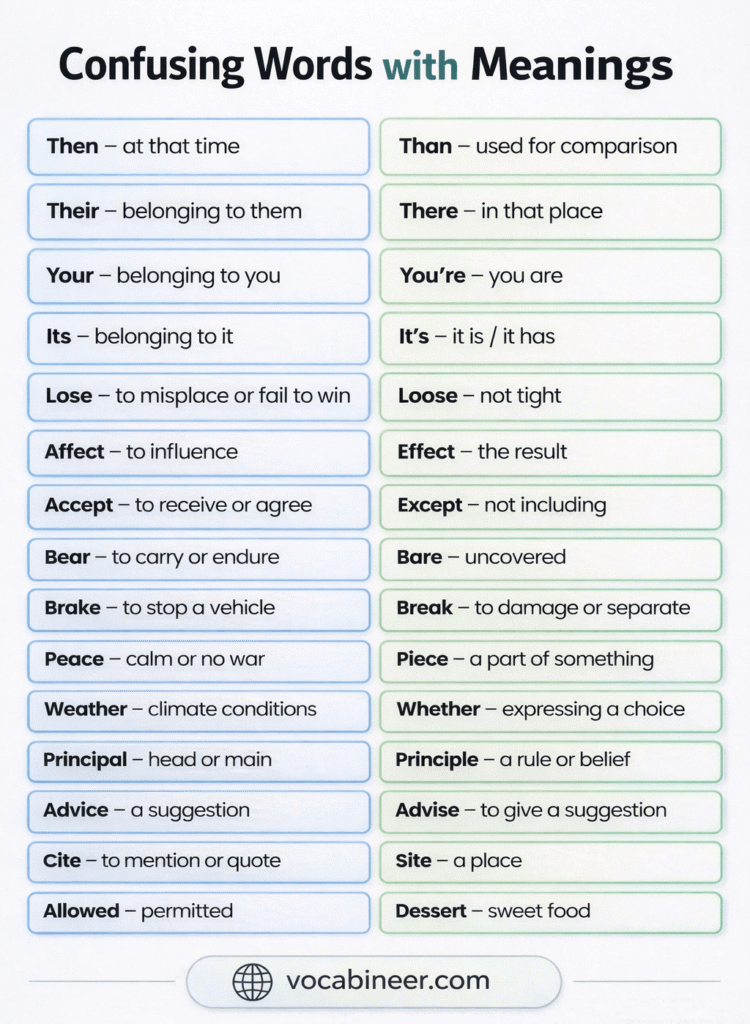
Some word pairs look almost the same in spelling, which causes confusion while reading or writing. A small change in letters can create a different meaning. Learning these pairs with short meanings helps readers notice spelling patterns and avoid choosing the wrong word by sight.
- Affect: Influence something.
Effect: Result or outcome. - Accept: Agree to receive.
Except: Leave out. - Advice: A suggestion.
Advise: To give a suggestion. - Loose: Not tight.
Lose: Fail to keep. - Quite: Very or completely.
Quiet: Making little noise. - Than: Used for comparison.
Then: Used for time or order. - Weather: Conditions outside.
Whether: Showing a choice. - Desert: Dry land.
Dessert: Sweet food. - Principal: Most important or head.
Principle: A basic rule. - Stationary: Not moving.
Stationery: Writing materials. - Compliment: A kind remark.
Complement: Something that completes. - Ensure: Make sure.
Insure: Protect by insurance. - Formally: In a formal way.
Formerly: In the past. - Later: After some time.
Latter: The second of two. - Passed: Went by.
Past: Time before now. - Lead: To guide.
Led: Past of lead. - Their: Belonging to them.
There: In that place. - Your: Belonging to you.
You’re: You are. - Its: Belonging to it.
It’s: It is. - Whose: Belonging to whom.
Who’s: Who is. - Break: Damage something.
Brake: Stop movement. - Peace: Calm or quiet.
Piece: A part of something. - Plain: Simple.
Plane: Flat surface or aircraft. - Whole: Complete.
Hole: An opening. - Role: A part played.
Roll: To turn over. - Sale: Act of selling.
Sail: Travel by boat. - Scene: A place or view.
Seen: Past of see. - Weak: Not strong.
Week: Seven days. - Here: In this place.
Hear: Receive sound. - Know: Have knowledge.
No: Negative answer. - Write: Put words on paper.
Right: Correct. - Allowed: Permitted.
Aloud: Spoken loudly. - Cereal: Breakfast grain food.
Serial: In a series. - Flower: A plant bloom.
Flour: Baking powder. - Metal: A hard material.
Medal: An award. - Minor: Small or under age.
Miner: One who mines. - Presence: Being present.
Presents: Gifts. - Profit: Financial gain.
Prophet: Religious messenger. - Steal: Take wrongly.
Steel: A strong metal. - Tail: Back part of an animal.
Tale: A story.
- Board: A flat piece of wood.
Bored: Feeling tired or uninterested. - Pair: Two items together.
Pear: A type of fruit. - Bare: Without covering.
Bear: A large animal or to carry. - Road: A path for travel.
Rode: Past of ride. - Knot: A tied loop.
Not: A negative word. - Fair: Just or light in color.
Fare: Cost of travel. - Meet: Come together.
Meat: Animal flesh for food. - Mail: Letters or post.
Male: Not female. - Pain: Feeling of hurt.
Pane: A sheet of glass. - Ring: A circular object.
Wring: Twist tightly. - Son: A male child.
Sun: The star in the sky. - Sea: Large body of water.
See: Notice with eyes. - Way: A path or method.
Weigh: Measure weight. - Blew: Past of blow.
Blue: A color. - Cent: One hundredth of a dollar.
Scent: A smell. - Clothes: Things people wear.
Close: Near or shut. - Heel: Back of the foot.
Heal: Make better. - Knight: A medieval soldier.
Night: Time after sunset. - Made: Created.
Maid: A female helper. - Hour: Sixty minutes.
Our: Belonging to us. - Brake: Stop movement.
Break: Damage or separate. - Flea: A small insect.
Flee: Run away. - Patience: Ability to wait calmly.
Patients: People receiving care. - Peace: Calm or quiet.
Piece: A part of something. - Root: Part of a plant.
Route: A path or direction. - Stair: A step.
Stare: Look fixedly. - Plain: Simple.
Plane: A flat surface or aircraft. - For: Used to show purpose.
Four: The number four. - One: Single.
Won: Past of win. - Hour: A time unit.
Flower: A plant part. - Rain: Water from clouds.
Reign: Rule or control. - Sole: Only or a foot part.
Soul: The inner spirit. - Toe: Part of the foot.
Tow: Pull something. - Wait: Stay until time.
Weight: Measure of heaviness. - Which: Asking about choice.
Witch: A magical character. - Allowed: Permitted.
Aloud: Spoken loudly. - Dear: Loved or costly.
Deer: An animal. - Die: Stop living.
Dye: Color material. - Fair: Light or just.
Ferry: Boat transport. - Hair: Threads on head.
Hare: A fast animal.
- Hart: A male deer.
Heart: The organ or feelings. - Idle: Not active.
Idol: A person admired. - Kernel: Inner part of a grain.
Colonel: An army rank. - Leak: Let liquid escape.
Leek: A type of vegetable. - Loan: Money given temporarily.
Lone: Single or alone. - Morning: Early part of day.
Mourning: Showing sadness. - None: Not one.
Nun: A religious woman. - Oar: A tool for rowing.
Or: Used to show choice. - Pause: A short stop.
Paws: Animal feet. - Peer: A person of equal status.
Pier: A platform by water. - Ring: A circular band.
Wrung: Past of wring. - Scene: A place or view.
Seem: Appear to be. - Sew: Join with thread.
So: To such a degree. - Sight: Ability to see.
Site: A location. - Slay: Kill violently.
Sleigh: A snow vehicle. - Stake: A post or interest.
Steak: A cut of meat. - Steer: Guide direction.
Stare: Look fixedly. - Summery: Like summer.
Summary: A short version. - Tear: Rip apart.
Tier: A level or rank. - Threw: Past of throw.
Through: From one side to another. - Vain: Proud or useless.
Vein: A blood vessel. - Wail: Cry loudly.
Whale: A large sea animal. - Weak: Lacking strength.
Week: Seven days. - Weather: Outside conditions.
Whether: Expressing choice. - Wood: Material from trees.
Would: Past of will. - Yolk: Yellow of an egg.
Yoke: A wooden frame. - Draft: A rough version.
Draught: A current of air. - Manner: Way of doing.
Manor: A large house. - Capital: A city or money.
Capitol: A government building. - Descent: Downward movement.
Dissent: Disagreement.
- Aisle: A passage between rows.
Isle: A small island. - Bait: Food used to attract.
Bate: To reduce or lessen. - Berth: A sleeping place or position.
Birth: The act of being born. - Boar: A wild pig.
Bore: To drill or cause boredom. - Chute: A sloping channel.
Shoot: To fire or throw. - Coarse: Rough in texture.
Course: A path or class. - Creek: A small stream.
Creak: A squeaking sound. - Die: To stop living.
Dye: To color something. - Ewe: A female sheep.
You: The person addressed. - Feat: An achievement.
Feet: Plural of foot. - Fir: A type of tree.
Fur: Hair of animals. - Foul: Dirty or unfair.
Fowl: A bird. - Gait: Way of walking.
Gate: An entry barrier. - Gored: Stabbed with horns.
Gourd: A type of squash. - Groan: A deep sound of pain.
Grown: Past of grow. - Guessed: Past of guess.
Guest: A visitor. - Hoarse: Rough voice.
Horse: A large animal. - Knead: Press dough.
Need: Require something. - Lessen: Make smaller.
Lesson: Something taught. - Medal: An award.
Metal: A hard material. - Miner: One who mines.
Minor: Small or under age. - Moose: A large deer.
Mousse: A soft dessert. - Naval: Related to ships.
Navel: The belly button. - Pail: A bucket.
Pale: Light in color. - Pause: A short stop.
Paws: Animal feet. - Plain: Simple.
Plane: Flat surface or aircraft. - Prey: Hunted animal.
Pray: Speak to a god. - Ring: A circular band.
Wrung: Past of wring. - Road: A travel path.
Rode: Past of ride. - Seam: A line where things join.
Seem: Appear to be. - Slay: Kill violently.
Sleigh: A snow vehicle. - Soar: Fly high.
Sore: Painful. - Stair: A step.
Stare: Look fixedly. - Steel: A strong metal.
Steal: Take wrongly. - Taught: Past of teach.
Taut: Tight or tense. - Tide: Rise and fall of sea.
Tied: Fastened. - Vial: A small bottle.
Vile: Very unpleasant. - Waist: Middle of body.
Waste: Use carelessly. - Wait: Stay until time.
Weight: Measure of heaviness. - Yore: Time long past.
Your: Belonging to you.
- Allowed: Permitted.
Aloud: Spoken loudly. - Arc: A curved line.
Ark: A large boat. - Ascent: Upward movement.
Assent: Agreement. - Base: The bottom part.
Bass: A type of fish or sound. - Cannon: A large gun.
Canon: A rule or law. - Cellar: A room below ground.
Seller: One who sells. - Ceiling: Top inside surface.
Sealing: Closing tightly. - Chord: Musical notes played together.
Cord: A thin rope. - Council: A group for advice.
Counsel: Advice or guidance. - Cue: A signal or hint.
Queue: A line of people. - Dual: Having two parts.
Duel: A fight between two. - Elicit: Bring out information.
Illicit: Not allowed by law. - Faze: Disturb or bother.
Phase: A stage or step. - Flair: Natural talent.
Flare: A burst of light. - Forward: Toward the front.
Foreword: Book introduction. - Hoard: Store secretly.
Horde: A large group. - Imply: Suggest indirectly.
Infer: Reach a conclusion. - Lessen: Make smaller.
Lesson: Something taught. - Marshal: Organize or lead.
Martial: Related to war. - Palette: Artist’s color board.
Palate: Roof of the mouth. - Pedal: A foot lever.
Peddle: Sell goods. - Precede: Come before.
Proceed: Go forward. - Stationary: Not moving.
Stationery: Writing paper. - Than: Used for comparison.
Then: Used for time. - Troop: A group of soldiers.
Troupe: A group of performers. - Vary: Change slightly.
Very: To a high degree. - Wary: Careful or cautious.
Weary: Feeling tired. - Wrap: Cover something.
Rap: Hit or speak sharply. - Yew: A type of tree.
You: The person addressed. - Idle: Not active.
Idyll: A peaceful scene.
Commonly Confused Words That Sound Similar
Some word pairs sound alike when spoken, which causes confusion in listening and speaking. These pairs differ in spelling and meaning, even though they sound similar. Learning their short meanings helps readers recognize the right word by context and avoid misunderstandings during conversation.
- Hear: Receive sound.
Here: In this place. - See: Notice with eyes.
Sea: Large body of water. - Know: Have knowledge.
No: A negative answer. - Write: Put words on paper.
Right: Correct. - Meet: Come together.
Meat: Animal flesh. - Buy: Pay to get.
By: Near or beside. - Sell: Exchange for money.
Cell: A small room or unit. - One: Single number.
Won: Past of win. - Two: The number two.
Too: Also or very. - For: Showing purpose.
Four: The number four. - Which: Asking about choice.
Witch: A magical woman. - Son: Male child.
Sun: Star in the sky. - Whole: Complete.
Hole: An opening. - Hour: Sixty minutes.
Our: Belonging to us. - Weak: Not strong.
Week: Seven days. - Plain: Simple.
Plane: Flat surface or aircraft. - Peace: Calm state.
Piece: A part. - Road: A travel path.
Rode: Past of ride. - Flour: Baking powder.
Flower: Plant bloom. - Steal: Take wrongly.
Steel: A strong metal.
- Pair: Two items together.
Pear: A type of fruit. - Bare: Without covering.
Bear: A large animal or to carry. - Knight: A medieval soldier.
Night: Time after sunset. - Mail: Letters or post.
Male: Not female. - Allowed: Permitted.
Aloud: Spoken loudly. - Dear: Loved or costly.
Deer: A wild animal. - Die: Stop living.
Dye: Color material. - Fair: Just or light-colored.
Fare: Cost of travel. - Hair: Threads on the head.
Hare: A fast animal. - Heel: Back of the foot.
Heal: Make better. - Hour: A unit of time.
Flower: A plant bloom. - Knot: A tied loop.
Not: A negative word. - Made: Created.
Maid: A female helper. - Pain: Feeling of hurt.
Pane: A sheet of glass. - Pause: A short stop.
Paws: Animal feet. - Ring: A circular band.
Wring: Twist tightly. - Scene: A place or view.
Seen: Past of see. - Son: Male child.
Sun: The star in the sky. - Stair: A step.
Stare: Look fixedly. - Tail: Back part of an animal.
Tale: A story. - Wait: Stay until time.
Weight: Measure of heaviness. - Way: A path or method.
Weigh: Measure weight. - Blew: Past of blow.
Blue: A color. - Cent: One hundredth of a dollar.
Scent: A smell. - Clothes: Things people wear.
Close: Near or shut. - Flea: A small insect.
Flee: Run away. - Peace: Calm or quiet.
Piece: A part of something. - Root: Part of a plant.
Route: A path or direction. - Sole: Only or foot part.
Soul: Inner spirit. - Toe: Part of the foot.
Tow: Pull something. - Which: Asking about choice.
Witch: A magical character. - Allowed: Permitted.
Aloud: Spoken loudly. - Board: A flat piece of wood.
Bored: Feeling uninterested. - Cereal: Grain food.
Serial: In a series. - Metal: A hard material.
Medal: An award. - Minor: Small or under age.
Miner: One who mines. - Profit: Financial gain.
Prophet: A religious messenger. - Sale: Act of selling.
Sail: Travel by boat. - Steer: Guide direction.
Stare: Look fixedly. - Vial: A small bottle.
Vile: Very unpleasant.
- Wail: Cry loudly.
Whale: A large sea animal. - Yolk: Yellow of an egg.
Yoke: A wooden frame. - Ewe: A female sheep.
You: The person addressed. - Fir: A type of tree.
Fur: Animal hair. - Foul: Dirty or unfair.
Fowl: A bird. - Gait: Way of walking.
Gate: An entry barrier. - Groan: A deep sound.
Grown: Past of grow. - Guessed: Past of guess.
Guest: A visitor. - Hoarse: Rough voice.
Horse: A large animal. - Knead: Press dough.
Need: Require something. - Loan: Money given temporarily.
Lone: Single or alone. - Morning: Early day time.
Mourning: Showing sadness. - None: Not one.
Nun: A religious woman. - Oar: A rowing tool.
Or: Used to show choice. - Peer: A person of equal rank.
Pier: A platform by water. - Prey: Hunted animal.
Pray: Speak to a god. - Soar: Fly high.
Sore: Painful. - Stake: A post or interest.
Steak: A cut of meat. - Summery: Like summer.
Summary: A short version. - Taught: Past of teach.
Taut: Tight or tense. - Tear: A drop from the eye.
Tear: Rip apart. - Threw: Past of throw.
Through: From one side to another. - Vain: Proud or useless.
Vein: A blood vessel. - Wary: Careful.
Weary: Tired. - Wood: Material from trees.
Would: Past of will. - Aisle: A passage between rows.
Isle: A small island. - Berth: A sleeping place.
Birth: The act of being born. - Coarse: Rough texture.
Course: A class or path. - Creek: A small stream.
Creak: A squeaking sound. - Desert: Dry land.
Dessert: Sweet food. - Lead: A metal or to guide.
Led: Past of lead. - Passed: Went by.
Past: Time before now. - Principal: Head or most important.
Principle: A basic rule. - Stationary: Not moving.
Stationery: Writing materials. - Capital: A city or money.
Capitol: A government building. - Council: A group for advice.
Counsel: Advice. - Cue: A signal.
Queue: A waiting line. - Imply: Suggest indirectly.
Infer: Reach a conclusion. - Marshal: Organize or lead.
Martial: Related to war. - Precede: Come before.
Proceed: Go forward.
- Elicit: Bring out information.
Illicit: Not allowed by law. - Faze: Disturb or bother.
Phase: A stage or step. - Flair: Natural talent.
Flare: A burst of light. - Hoard: Store secretly.
Horde: A large group. - Palette: Artist’s color board.
Palate: Roof of the mouth. - Pedal: A foot lever.
Peddle: Sell goods. - Troop: A group of soldiers.
Troupe: A group of performers. - Vary: Change slightly.
Very: To a high degree. - Waist: Middle of body.
Waste: Use carelessly. - Ascent: Upward movement.
Assent: Agreement. - Cannon: A large gun.
Canon: A rule or law. - Chord: Musical notes together.
Cord: A thin rope. - Cellar: Room below ground.
Seller: One who sells. - Ceiling: Top inside surface.
Sealing: Closing tightly. - Dual: Having two parts.
Duel: A fight between two. - Forward: Toward the front.
Foreword: Book introduction. - Manner: Way of doing.
Manor: A large house. - Descent: Downward movement.
Dissent: Disagreement. - Profit: Money gained.
Prophet: A religious messenger. - Steal: Take wrongly.
Steel: A strong metal. - Presence: Being present.
Presents: Gifts. - Weather: Outside conditions.
Whether: Expressing choice. - Than: Used for comparison.
Then: Used for time. - Quite: Very or completely.
Quiet: Making little noise. - Loose: Not tight.
Lose: Fail to keep. - Advice: A suggestion.
Advise: To give a suggestion. - Accept: Agree to receive.
Except: Leave out. - Affect: Influence.
Effect: Result. - Their: Belonging to them.
There: In that place. - Your: Belonging to you.
You’re: You are. - Its: Belonging to it.
It’s: It is. - Whose: Belonging to whom.
Who’s: Who is. - Break: Damage something.
Brake: Stop movement. - Peace: Calm.
Piece: A part. - Whole: Complete.
Hole: An opening. - Role: A part played.
Roll: To turn over. - Sale: Act of selling.
Sail: Travel by boat. - Scene: A view or setting.
Seen: Past of see. - Weak: Not strong.
Week: Seven days. - Knot: A tied loop.
Not: A negative word.
Commonly Confused Words Based on Usage Context
Some word pairs are not confusing because of spelling or sound, but because they are used in different situations. These words may share a general idea, yet each one fits a specific context. Understanding when to use each word helps readers choose correctly based on situation, tone, or sentence purpose.
- Do: Perform an action.
Make: Create or produce something. - Say: Speak words.
Tell: Give information to someone. - Speak: Use the voice formally.
Talk: Speak casually. - Look: Direct the eyes.
Watch: Look carefully over time. - See: Notice with eyes.
Notice: Become aware of. - Hear: Receive sound naturally.
Listen: Pay attention to sound. - Ask: Request information.
Request: Ask politely or formally. - Give: Hand something to someone.
Offer: Give as a choice. - Take: Receive or carry away.
Receive: Get something given. - Bring: Carry toward the speaker.
Carry: Hold and move. - Go: Move away.
Come: Move toward. - Leave: Go away from a place.
Quit: Leave a job or activity. - Stay: Remain in a place.
Live: Have a home somewhere. - Begin: Start something.
Start: Begin an action. - End: Stop something.
Finish: Complete fully. - Try: Make an effort.
Test: Check how something works. - Use: Put into action.
Apply: Use for a purpose. - Get: Obtain or receive.
Earn: Get through effort. - Buy: Pay money to get.
Order: Ask for something to be provided. - Pay: Give money.
Spend: Use money. - Save: Keep for later.
Store: Put away safely. - Open: Make accessible.
Unlock: Open with a key. - Close: Shut something.
Shut: Close firmly. - Help: Give support.
Support: Help continuously. - Fix: Repair something.
Repair: Fix carefully. - Break: Damage something.
Damage: Cause harm. - Build: Make a structure.
Create: Make something new. - Change: Make different.
Replace: Change by putting another. - Keep: Continue having.
Hold: Keep in hand. - Let: Allow something.
Allow: Let formally.
- Permit: Allow formally.
Ban: Do not allow. - Choose: Decide between options.
Select: Choose carefully. - Decide: Make a choice.
Plan: Decide in advance. - Think: Use the mind.
Believe: Think something is true. - Know: Have knowledge.
Understand: Know clearly. - Learn: Gain knowledge.
Study: Learn by reading. - Teach: Help others learn.
Train: Teach skills. - Show: Make visible.
Demonstrate: Show how something works. - Explain: Make clear.
Describe: Tell details. - Answer: Give a reply.
Respond: Answer formally. - Meet: Come together.
Visit: Go to see. - Join: Become part of.
Attend: Go to formally. - Call: Contact by phone.
Contact: Get in touch. - Send: Cause to go.
Deliver: Send to a place. - Wait: Stay until time.
Delay: Cause waiting. - Move: Change position.
Shift: Move slightly. - Run: Move quickly.
Operate: Run a machine. - Work: Do tasks.
Function: Work properly. - Play: Take part in activity.
Perform: Play formally. - Practice: Train regularly.
Rehearse: Practice before performing. - Check: Look at closely.
Inspect: Check carefully. - Test: Try something.
Examine: Test closely. - Fix: Make right.
Adjust: Fix slightly. - Improve: Make better.
Enhance: Improve quality. - Reduce: Make smaller.
Lower: Reduce amount. - Increase: Make larger.
Raise: Increase level. - Stop: End action.
Pause: Stop briefly. - Continue: Keep going.
Resume: Continue again. - Fail: Not succeed.
Miss: Fail to reach. - Win: Achieve success.
Succeed: Reach a goal. - Lose: Fail to win.
Drop: Lose unintentionally. - Buy: Pay to get.
Rent: Pay to use. - Sell: Exchange for money.
Trade: Sell and buy. - Pay: Give money.
Charge: Ask for money. - Save: Keep money.
Invest: Save to gain later. - Spend: Use money.
Waste: Spend badly. - Keep: Continue having.
Maintain: Keep in good condition. - Protect: Keep safe.
Guard: Protect actively. - Care: Feel concern.
Mind: Care about. - Help: Give assistance.
Aid: Help formally.
- Love: Feel strong affection.
Like: Feel mild enjoyment. - Hate: Feel strong dislike.
Dislike: Not like. - Want: Desire something.
Need: Require something. - Hope: Wish for something.
Expect: Think something will happen. - Plan: Decide in advance.
Arrange: Organize details. - Try: Make an effort.
Attempt: Try seriously. - Care: Feel concern.
Worry: Feel anxious care. - Trust: Believe someone.
Rely: Depend on someone. - Agree: Share the same view.
Accept: Agree to receive. - Refuse: Say no.
Reject: Refuse firmly. - Allow: Give permission.
Permit: Allow formally. - Follow: Go after.
Obey: Follow rules. - Lead: Guide others.
Manage: Lead daily work. - Control: Direct actions.
Handle: Manage a task. - Order: Ask for something.
Command: Give an order. - Ask: Request information.
Demand: Ask strongly. - Give: Hand over.
Provide: Supply something. - Take: Carry away.
Remove: Take off. - Keep: Continue having.
Store: Keep in place. - Bring: Carry toward.
Fetch: Go and bring. - Go: Move away.
Leave: Go from a place. - Come: Move toward.
Arrive: Reach a place. - Stay: Remain somewhere.
Remain: Stay formally. - Begin: Start something.
Initiate: Begin formally. - End: Stop something.
Conclude: End formally. - Fix: Repair something.
Restore: Fix to original state. - Break: Damage something.
Shatter: Break into pieces. - Build: Make something.
Construct: Build formally. - Change: Make different.
Alter: Change slightly. - Improve: Make better.
Upgrade: Improve quality. - Clean: Remove dirt.
Wash: Clean with water. - Dirty: Not clean.
Stain: Make dirty. - Open: Make accessible.
Reveal: Open to show. - Close: Shut something.
Seal: Close tightly. - Move: Change position.
Shift: Move slightly. - Stop: End action.
Halt: Stop suddenly. - Wait: Stay until time.
Pause: Stop briefly. - Continue: Keep going.
Proceed: Continue formally. - Finish: Complete fully.
Complete: Finish entirely. - Work: Do tasks.
Operate: Work a machine.
- Run: Move quickly.
Jog: Run slowly. - Walk: Move by steps.
Stroll: Walk casually. - Sit: Rest on a seat.
Seat: Cause someone to sit. - Stand: Be upright.
Rise: Stand up. - Sleep: Rest the body.
Nap: Sleep briefly. - Wake: Stop sleeping.
Awaken: Wake formally. - Eat: Take food.
Dine: Eat formally. - Drink: Take liquid.
Sip: Drink slowly. - Cook: Prepare food.
Bake: Cook in an oven. - Buy: Pay to get.
Purchase: Buy formally. - Sell: Exchange for money.
Offer: Present for sale. - Pay: Give money.
Spend: Use money. - Save: Keep for later.
Reserve: Save formally. - Send: Cause to go.
Mail: Send by post. - Receive: Get something.
Accept: Agree to receive. - Meet: Come together.
Gather: Meet in a group. - Join: Become part of.
Connect: Join together. - Call: Contact by phone.
Phone: Call someone. - Ask: Request information.
Inquire: Ask formally. - Answer: Give a reply.
Reply: Answer briefly. - Help: Give support.
Assist: Help formally. - Care: Feel concern.
Protect: Keep safe. - Love: Feel affection.
Adore: Love deeply. - Hate: Feel dislike.
Detest: Hate strongly. - Hope: Wish for something.
Expect: Think it will happen. - Plan: Decide in advance.
Prepare: Get ready. - Try: Make an effort.
Attempt: Try seriously. - Change: Make different.
Replace: Put another instead. - Keep: Continue having.
Maintain: Keep in good condition. - Finish: Complete something.
End: Bring to a stop.
FAQs about Confused Words
Commonly confused words are pairs of words that look alike, sound alike, or have related meanings but are used differently. Mixing them can change the meaning of a sentence, even when the grammar looks correct.
People confuse them because the words appear similar in spelling, pronunciation, or everyday use. In many cases, they are learned together, so the difference between them is easy to miss.
No, even advanced learners and native speakers confuse certain word pairs. The confusion usually comes from habit, speed, or informal usage rather than lack of knowledge.
Understanding the short meaning and the situation where each word fits works better than memorizing rules. Seeing the words grouped by usage or meaning also helps recognition.
They affect both, but mistakes are easier to notice in writing. In speaking, context sometimes hides the error, while in writing the wrong word stands out clearly.
Conclusion
Learning commonly confused words helps readers understand how small differences in meaning affect clarity. When similar words are used correctly, sentences sound more natural and precise. By recognizing how each word functions in context, readers can avoid confusion and communicate ideas with greater confidence in everyday reading and writing.
Read More