

Compound words in English are created when two smaller words join together to form a single new word. This new word usually has a meaning that is easy to understand, and sometimes it even sounds fun. For example, when we put sun and flower together, we get sunflower. Learning how compound words work is important because they appear often in reading, writing, and speaking. In this lesson, you’ll explore the types of compound words and learn useful examples.
In This Page
What Is a Compound Word?
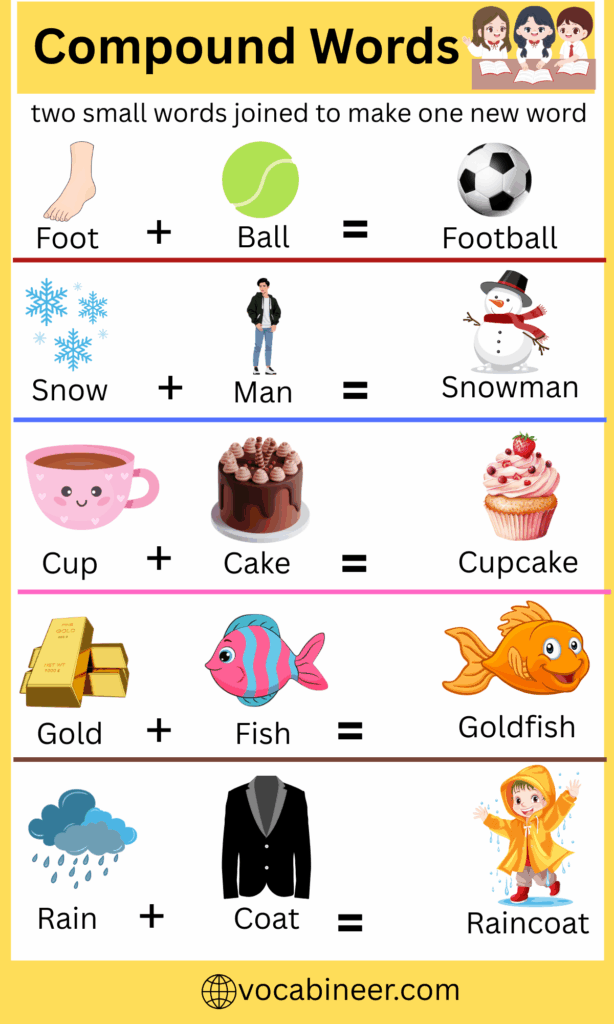
A compound word is made when two small words join together to form one new word. The new word usually has its own simple meaning.
Examples of Compound Words
- sun + flower = sunflower
- rain + bow = rainbow
- foot + ball = football
- snow + man = snowman
- tooth + brush = toothbrush
Types of Compound Words in English
Compound words come in three main types. The difference is in how they are written. Some are joined, some stay apart, and some use a hyphen.
Closed Compound Words
Closed compounds are written as one word without spaces.
- notebook
- toothpaste
- sunflower
- basketball
- airport
- cupcake
- raincoat
- snowman
- football
- bedroom
Open Compound Words
Open compounds have a space between the two words, but together they mean one idea.
- ice cream
- bus stop
- living room
- high school
- post office
- coffee table
- full moon
- hot dog
- swimming pool
- real estate
Hyphenated Compound Words
Hyphenated compounds use a hyphen to join the parts. They are common in adjectives before nouns.
- mother-in-law
- part-time
- well-known
- user-friendly
- hard-working
- long-term
- up-to-date
- high-speed
- full-length
- state-of-the-art
Spelling and Hyphen Rules in Compound Words
Learning how to spell compound words can be tricky because sometimes they are written as one word, sometimes with a space, and sometimes with a hyphen. Here are some simple rules to help:
- Closed compound words are written as one word.
Example: notebook, sunflower, toothbrush - Open compound words are written as two separate words.
Example: ice cream, post office, full moon - Hyphenated compound words use a hyphen (-) to connect the parts.
Example: mother-in-law, well-known, six-pack - Hyphens are often used when the meaning might be confusing without them.
Example: re-cover (cover again) vs recover (get better). - Some hyphenated forms may change to closed words over time as they become common.
Example: e-mail is now often written as email.
100 Examples of Compound Words with Meanings
Compound words are formed when two smaller words join together to make a new word with a different meaning. This list of 100+ common compound words with meanings will help you read, write, and speak better English.
Home and Daily Life
- bedroom – a room for sleeping
- bathroom – a room for bathing
- kitchenware – tools for cooking
- bookshelf – a shelf for books
- hairbrush – a brush for hair
- toothbrush – a brush for teeth
- wallpaper – paper for walls
- doorbell – a bell at the door
- doormat – a mat at the door
- backyard – the yard behind a house
- sunlight – light from the sun
- moonlight – light from the moon
- firewood – wood used for fire
- teacup – a small cup for tea
- housework – work done in the house
- dishcloth – cloth for cleaning dishes
- bedsheet – cloth for covering a bed
- washing machine – machine for washing clothes
- laptop – a portable computer
- cupboard – a small storage cabinet
School and Learning
- classroom – a room for learning
- blackboard – a board for writing with chalk
- textbook – a book for study
- notebook – a book for notes
- homework – schoolwork done at home
- schoolbag – a bag for books
- playground – ground for playing
- pencil case – a case for pencils
- workbook – a book with exercises
- chalkboard – another word for blackboard
- daycare – care for children during the day
- lunchbox – a box for carrying lunch
- whiteboard – a board for markers
- ballpen – a type of pen
- spelling book – book for spelling practice
Food and Drinks
- cupcake – small cake in a cup
- milkshake – sweet drink with milk and ice cream
- pancake – flat round cake cooked on a pan
- popcorn – popped corn snack
- breakfast – morning meal
- watermelon – a large juicy fruit
- hotdog – bread with sausage inside
- seafood – food from the sea
- birthday cake – cake for birthdays
- apple pie – pie with apple filling
- teapot – pot for tea
- coffee cup – cup for coffee
- sugarcane – plant that gives sugar
- ice cream – frozen sweet food
- peanut butter – spread made of peanuts
Nature and Weather
- sunflower – tall plant with yellow flower
- rainbow – colorful arch in the sky
- snowfall – snow falling down
- raindrop – a drop of rain
- snowflake – a tiny piece of snow
- earthquake – shaking of the earth
- sandstorm – storm of blowing sand
- thunderstorm – storm with thunder and lightning
- seawater – water from the sea
- starlight – light from stars
- treetop – the top of a tree
- firefly – insect that glows at night
- moonrise – when the moon comes up
- waterfall – falling water from a height
- greenhouse – house made for growing plants
- hillside – side of a hill
- seashore – land near the sea
- raincoat – coat for rainy days
- windmill – machine moved by the wind
- daylight – light of the day
People and Jobs
- policeman – a man who keeps law and order
- fireman – a person who fights fires
- postman – a person who delivers letters
- fisherman – a person who catches fish
- shopkeeper – a person who keeps a shop
- housewife – a woman managing a home
- babysitter – a person who looks after babies
- milkman – a man who delivers milk
- businessman – a man who does business
- watchman – a person who guards a place
Sports and Games
- football – a game played with a ball
- basketball – a game with a basket and ball
- baseball – a bat-and-ball game
- playground – ground for playing games
- swimming pool – pool for swimming
- racecar – a car for racing
- skateboard – a board for skating
- snowball – a ball of snow
- volleyball – a game played with a ball
- handball – a ball game played with hands
Travel and Places
- airport – place for airplanes
- railway – track for trains
- bus stop – a place to wait for a bus
- highway – a main road
- crosswalk – place for people to cross a road
- railway station – place for trains to stop
- seaport – port for ships
- runway – track for airplanes to take off
- car park – place for parking cars
- traffic light – lights that control traffic
List of Common Compound Words for Kids
Learning compound words is easy when we break them into two smaller words. Kids can see how each part adds to the meaning of the new word. Below are some easy and common examples that children can understand quickly.
- snow + man = snowman
- cup + cake = cupcake
- foot + ball = football
- sun + light = sunlight
- tooth + brush = toothbrush
- rain + bow = rainbow
- star + fish = starfish
- butter + fly = butterfly
- dog + house = doghouse
- milk + shake = milkshake
- pan + cake = pancake
- play + ground = playground
- base + ball = baseball
- note + book = notebook
- bed + room = bedroom
- bath + room = bathroom
- black + board = blackboard
- home + work = homework
- pop + corn = popcorn
- sand + box = sandbox
- ice + cream = ice cream
- fire + man = fireman
- police + man = policeman
- lady + bug = ladybug
- gold + fish = goldfish
Examples of Compound Words in Sentences
Using compound words in sentences helps you see how they work in daily English. Here are some easy examples:
- I put my books on the bookshelf.
- The kids are playing in the playground.
- She brushed her teeth with a toothbrush.
- We ate ice cream in the sunlight.
- He packed his clothes in the suitcase.
- The fireman saved the cat from the tree.
- My sister wants a cupcake for dessert.
- We saw a bright rainbow after the rain.
- The snowman melted in the sun.
- Dad fixed the broken doorbell.
Blend Words vs Compound Words
| Feature | Compound Words | Blend Words |
|---|---|---|
| How they form | Two complete words join together | Parts of two words are blended |
| Example 1 | sun + flower = sunflower | smoke + fog = smog |
| Example 2 | tooth + brush = toothbrush | breakfast + lunch = brunch |
| Example 3 | rain + bow = rainbow | motor + hotel = motel |
| Key point | Both words stay whole | Parts of words are shortened |
Conclusion
Compound words are an important part of English because they combine two smaller words to create a new and useful meaning. They appear in daily reading, writing, and speaking, which makes them easy to practice. By learning different types of compound words and seeing them in sentences, learners can quickly grow their vocabulary. The more you notice them, the easier it becomes to understand and use English with confidence.
FAQs about Compound Words
A compound word is made when two smaller words join together to make one new word, like toothbrush.
There are three types: closed (notebook), open (ice cream), and hyphenated (mother-in-law).
Compound words use whole words, while blend words mix parts, like brunch from breakfast + lunch.
Yes, some compound words can join three words, like mother-in-law.
They make reading and writing easier because many common words in English are compound words.
Read More
