

Internet acronyms are short forms created from the first letters of words and are widely used in online communication. These acronyms appear frequently in text messages, social media posts, gaming chats, forums, and comment sections, where quick replies are common. They replace longer phrases and help users communicate faster in digital spaces.
Learning internet acronyms with meanings helps readers understand online messages clearly and avoid confusion while reading chats or posts. It also makes it easier to follow digital conversations, respond appropriately, and recognize the tone or intent behind short online expressions.
In This Page
What Are Internet Acronyms?
Internet acronyms are abbreviations created using the first letters of words in a phrase. Most acronyms stand for complete sentences or commonly repeated expressions. They are typed in uppercase or lowercase and are understood based on context. Unlike full sentences, acronyms rely on shared online knowledge.
Many internet acronyms have been in use for decades, while others appear as new platforms and trends emerge.
Why Internet Acronyms Are Used Online?
Internet acronyms are used to communicate faster and reduce typing effort. They help users respond quickly in chats and keep conversations flowing. Acronyms also match the informal tone of online spaces, where short and direct language is preferred.
In fast-moving environments like gaming or group chats, acronyms make communication more efficient.
Common Internet Acronyms
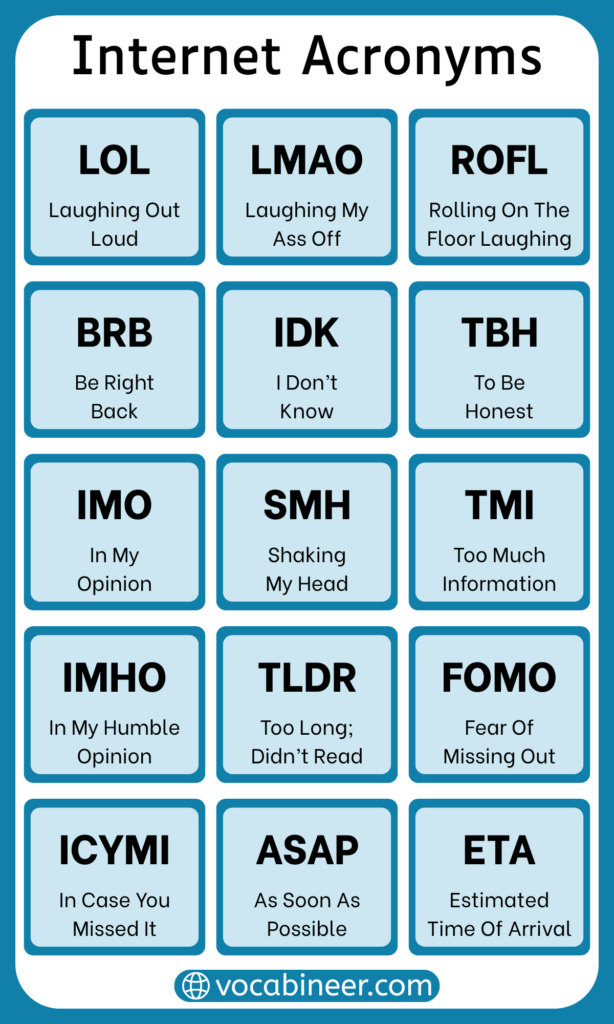
These internet acronyms are widely understood across platforms and age groups. They appear frequently in everyday online communication.
- LOL: Laughing out loud
- BRB: Be right back
- IDK: I don’t know
- BTW: By the way
- IMO: In my opinion
- FYI: For your information
- ASAP: As soon as possible
- NVM: Never mind
- TBH: To be honest
- TTYL: Talk to you later
- IRL: In real life
- OMG: Oh my God
- BFF: Best friends forever
- AFK: Away from keyboard
- DM: Direct message
- FOMO: Fear of missing out
- ICYMI: In case you missed it
- TLDR: Too long didn’t read
- NSFW: Not safe for work
- JK: Just kidding
- ETA: Estimated time of arrival
- RN: Right now
- IDC: I don’t care
- IKR: I know, right
- SMTH: Something
- GG: Good game
- EZ: Easy
- FTW: For the win
- FML: Frustrated expression meaning “my life”
- ROFL: Rolling on the floor laughing
Internet Acronyms Used in Text Messages
Text message acronyms are designed for quick replies and short conversations. These are common in SMS and private chats.
- WYD: What are you doing
- HBU: How about you
- LMK: Let me know
- GTG: Got to go
- ILY: I love you
- ILYSM: I love you so much
- OMW: On my way
- IDTS: I don’t think so
- PLZ: Please
- THX: Thanks
- CU: See you
- K: Okay
- JK: Just kidding
- BBL: Be back later
- G2G: Got to go
- NP: No problem
- TY: Thank you
- YW: You’re welcome
- IMY: I miss you
- ATM: At the moment
Internet Acronyms Used on Social Media
These acronyms are commonly used in posts, captions, and comments across social platforms.
- DM: Direct message
- AMA: Ask me anything
- POV: Point of view
- RT: Retweet
- ICYMI: In case you missed it
- OOTD: Outfit of the day
- QOTD: Quote of the day
- SMH: Shaking my head
- TBT: Throwback Thursday
- FB: Facebook
- IG: Instagram
- YT: YouTube
- OP: Original post
- OC: Original content
- PSA: Public service announcement
- IYKYK: If you know, you know
- NGL: Not gonna lie
- HBD: Happy birthday
- L4L: Like for like
- F4F: Follow for follow
Internet Acronyms Used on Instagram and TikTok
These acronyms are tied closely to short-form video content and creator language.
- FYP: For you page
- POV: Point of view
- GRWM: Get ready with me
- IRL: In real life
- OOTD: Outfit of the day
- AMA: Ask me anything
- DM: Direct message
- TBT: Throwback Thursday
- QOTD: Quote of the day
- NGL: Not gonna lie
- IYKYK: If you know, you know
- SFW: Safe for work
- NSFW: Not safe for work
- OP: Original post
- OC: Original content
Internet Acronyms Used in Online Gaming
Gaming acronyms are used during gameplay, live chats, and multiplayer coordination. These acronyms help players communicate quickly in fast situations where typing full sentences is not practical.
- GG: Good game
- AFK: Away from keyboard
- OP: Overpowered
- RNG: Random number generation
- FPS: Frames per second or first-person shooter
- NPC: Non-player character
- EZ: Easy
- GLHF: Good luck have fun
- GGWP: Good game well played
- KDA: Kill death assist ratio
- DPS: Damage per second
- HP: Health points
- MP: Mana points
- XP: Experience points
- AoE: Area of effect
- PvP: Player versus player
- PvE: Player versus environment
- MMO: Massively multiplayer online
- LFG: Looking for group
- DC: Disconnected
Internet Acronyms Used in Online Chats
Online chat acronyms appear in forums, group chats, and comment threads. They help keep discussions short and informal.
- IMO: In my opinion
- IMHO: In my humble opinion
- TBH: To be honest
- FYI: For your information
- ASAP: As soon as possible
- NVM: Never mind
- BTW: By the way
- IRL: In real life
- SMH: Shaking my head
- ROFL: Rolling on the floor laughing
- LMAO: Laughing hard
- IKR: I know, right
- IDC: I don’t care
- TMI: Too much information
- ETA: Estimated time of arrival
- JK: Just kidding
- NP: No problem
- TY: Thank you
- YW: You’re welcome
- BBL: Be back later
Internet Acronyms for Reactions and Emotions
These acronyms are used to show laughter, shock, frustration, or excitement in online messages.
- LOL: Laughing out loud
- LMAO: Laughing hard
- ROFL: Rolling on the floor laughing
- OMG: Oh my God
- WTF: Strong surprise or confusion
- FTW: For the win
- FML: Expression of frustration
- IKR: I know, right
- AF: Very or extremely
- RIP: Used jokingly for failure
- OOF: Reaction to pain or loss
- SMH: Shaking my head
- BRUH: Disbelief reaction
- YIKES: Awkward reaction
- IDK: I don’t know
Internet Acronyms for Opinions and Responses
These acronyms help users share views, agreement, or disagreement quickly.
- IMO: In my opinion
- IMHO: In my humble opinion
- TBH: To be honest
- FWIW: For what it’s worth
- ICYMI: In case you missed it
- NGL: Not gonna lie
- IYKYK: If you know, you know
- IDC: I don’t care
- IKR: I know, right
- TBF: To be fair
Internet Acronyms Popular Among Teens
These acronyms are commonly used by younger users in chats, comments, and social media posts. They reflect casual tone, quick reactions, and peer communication.
- OMG: Oh my God
- LOL: Laughing out loud
- IDK: I don’t know
- TBH: To be honest
- IKR: I know, right
- AF: Very or extremely
- BRUH: Expression of disbelief
- YOLO: You only live once
- FOMO: Fear of missing out
- BFF: Best friends forever
- IRL: In real life
- SMH: Shaking my head
- NGL: Not gonna lie
- IDC: I don’t care
- JK: Just kidding
- TMI: Too much information
- RIP: Used jokingly for failure
- OOF: Reaction to discomfort
- GRWM: Get ready with me
- POV: Point of view
Internet Acronyms Used in Memes
Meme acronyms appear in viral posts, joke formats, and image captions. They often rely on shared internet culture for meaning.
- NPC: Non-player character
- OP: Original post or overpowered
- OC: Original content
- POV: Point of view
- IRL: In real life
- AF: Very or extremely
- LOL: Laughing out loud
- LMAO: Laughing hard
- ROFL: Rolling on the floor laughing
- BRUH: Disbelief reaction
- SMH: Shaking my head
- RIP: Joke failure reference
- OOF: Sudden pain reaction
- TBH: To be honest
- IDK: I don’t know
- IYKYK: If you know, you know
- NGL: Not gonna lie
- TFW: That feeling when
- MFW: My face when
- TIL: Today I learned
Internet Acronyms Used in Online Arguments
These acronyms are common in debates, disagreements, and heated discussions online.
- OP: Original poster
- IMO: In my opinion
- IMHO: In my humble opinion
- TLDR: Too long didn’t read
- SMH: Shaking my head
- WTF: Strong confusion or anger
- IDC: I don’t care
- IKR: I know, right
- TBH: To be honest
- FWIW: For what it’s worth
- NGL: Not gonna lie
- ETA: Edited to add
- IRL: In real life
- AF: Very or extremely
- BRUH: Disbelief reaction
- RIP: Mock failure
- LMAO: Laughing reaction
- ROFL: Strong laughter
- JK: Just kidding
- FYI: For your information
Old Internet Acronyms Still Used Today
These acronyms originated in early internet chat rooms and forums but are still widely used.
- ASL: Age, sex, location
- BRB: Be right back
- LOL: Laughing out loud
- TTYL: Talk to you later
- FYI: For your information
- OMG: Oh my God
- IDK: I don’t know
- BTW: By the way
- IMHO: In my humble opinion
- ROFL: Rolling on the floor laughing
- LMAO: Laughing hard
- AFK: Away from keyboard
- IRL: In real life
- JK: Just kidding
- NP: No problem
- TY: Thank you
- YW: You’re welcome
- BBL: Be back later
- GTG: Got to go
- TMI: Too much information
Confusing Internet Acronyms
These acronyms often confuse learners because their meanings change with context.
- NSFW: Not safe for work
- SFW: Safe for work
- ETA: Estimated time of arrival or edited to add
- IRL: In real life
- AFK: Away from keyboard
- OP: Original poster or overpowered
- OC: Original content
- NPC: Non-player character
- TIL: Today I learned
- IYKYK: If you know, you know
- NGL: Not gonna lie
- FWIW: For what it’s worth
- TBF: To be fair
- IDC: I don’t care
- IKR: I know, right
- SMH: Shaking my head
- RIP: Used jokingly
- OOF: Reaction sound
- ATM: At the moment
- RN: Right now
Internet Acronyms Used Worldwide
These acronyms are widely understood across countries and platforms.
- LOL: Laughing out loud
- OMG: Oh my God
- IDK: I don’t know
- BRB: Be right back
- AFK: Away from keyboard
- GG: Good game
- IRL: In real life
- BTW: By the way
- TBH: To be honest
- FYI: For your information
- ASAP: As soon as possible
- NVM: Never mind
- TTYL: Talk to you later
- SMH: Shaking my head
- FOMO: Fear of missing out
Internet Acronyms vs Internet Slangs
Internet acronyms and internet slangs are often used together in online communication, but they serve different purposes. Both appear in chats, comments, and social media posts, which is why they are sometimes confused. Understanding how they differ helps readers choose the right form of language for casual conversations and avoid misuse in formal situations.
| Aspect | Internet Acronyms | Internet Slangs |
|---|---|---|
| Basic meaning | Short forms made from first letters | Informal words or phrases used online |
| How they are formed | Created from initials of words | Can be words, phrases, or acronyms |
| Purpose | Save typing time | Express tone, emotion, or culture |
| Structure | Usually capital letters | Words, phrases, or mixed forms |
| Examples | LOL, BRB, IDK, FYI | cringe, sus, vibe, ghosting |
| Use in formal writing | Generally avoided | Not used |
| Dependence on context | Low, meanings are fixed | High, meanings change by context |
When to Use Internet Acronyms?
Internet acronyms are best used in casual online communication. They fit naturally in text messages, social media comments, gaming chats, and informal group conversations. In these spaces, short forms help keep communication quick and relaxed.
Internet acronyms should be avoided in formal writing, professional emails, academic work, or official communication. In such cases, using full words and complete sentences helps maintain clarity and a professional tone.
FAQs About Internet Acronyms
Internet acronyms are shortened forms made from the first letters of words in a phrase. They are used in online communication to replace longer expressions and save time while typing.
Internet acronyms are formed from initials, such as LOL or BRB, while internet slangs include acronyms along with words and phrases that have special meanings online.
Internet acronyms are commonly used in text messages, social media posts, online chats, gaming conversations, and informal digital communication.
Yes, some internet acronyms become outdated while new ones appear as online platforms and communication styles evolve.
Internet acronyms should usually be avoided in formal writing, academic work, or professional communication unless the context clearly allows informal language.
Conclusion
Internet acronyms are a core part of modern online communication. They help people share ideas, reactions, and information quickly across chats, social media, gaming platforms, and online communities. Because these acronyms are short and widely recognized, they make digital conversations faster and more efficient.
Understanding internet acronyms allows readers to follow online messages with confidence and avoid confusion. As digital language continues to evolve, knowing these commonly used acronyms helps people communicate clearly and choose the right words for different online situations.
Read More
