

Internet slang words are informal expressions commonly used in online communication to keep messages short and expressive. These words appear frequently in text messages, social media posts, comments, forums, and online chats, where casual language is expected. They often replace longer phrases or add emotion, humor, or emphasis to digital conversations.
Learning internet slang words with meanings helps readers understand digital conversations clearly and avoid confusion while reading online content. It also makes it easier to follow what people are saying, recognize tone and intent, and respond naturally in everyday online communication.
In This Page
Meaning of Internet Slangs
Internet slangs are non-formal expressions created and used mainly online. They include abbreviations, shortened words, phrases, and creative spellings. These slangs often replace longer sentences and help show emotion, opinion, or reaction in text-based communication. Many internet slangs become popular because they are quick to type and easy to remember.
Some internet slangs are shortened forms of full sentences, while others are words with new meanings online. Their usage depends on context, platform, and audience.
Purpose of Internet Slangs
Internet slangs are used to save time, show emotion, and match the informal tone of online spaces. They help people respond quickly and keep conversations flowing naturally. Slangs also help users fit into online communities by using shared language.
Many slangs are used to show humor, agreement, sarcasm, or surprise. Others help express reactions that are hard to show through plain text.
Common Internet Slangs
Common internet slangs are widely used across chats, comments, social media posts, and online conversations. These slangs are understood by most internet users and appear frequently in everyday digital communication. Learning them helps readers quickly understand online messages without confusion.
- LOL: Laughing out loud, used to show amusement or laughter.
- BRB: Be right back, used when leaving a conversation briefly.
- IDK: I don’t know, used to express uncertainty.
- BTW: By the way, used to add extra information.
- IMO: In my opinion, used before sharing a personal view.
- FYI: For your information, used to share helpful details.
- ASAP: As soon as possible, used to show urgency.
- NVM: Never mind, used to cancel or ignore a previous message.
- TBH: To be honest, used before honest statements.
- TTYL: Talk to you later, used to end a conversation.
- OMG: Oh my God, used to show surprise.
- BFF: Best friends forever, used for close friends.
- AFK: Away from keyboard, used when temporarily inactive.
- DM: Direct message, used for private conversations.
- FOMO: Fear of missing out, used when feeling left out.
- SMH: Shaking my head, used to show disappointment.
- ICYMI: In case you missed it, used when resharing content.
- IRL: In real life, used to separate online and offline contexts.
- NSFW: Not safe for work, used as a content warning.
- TLDR: Too long didn’t read, used to summarize long content.
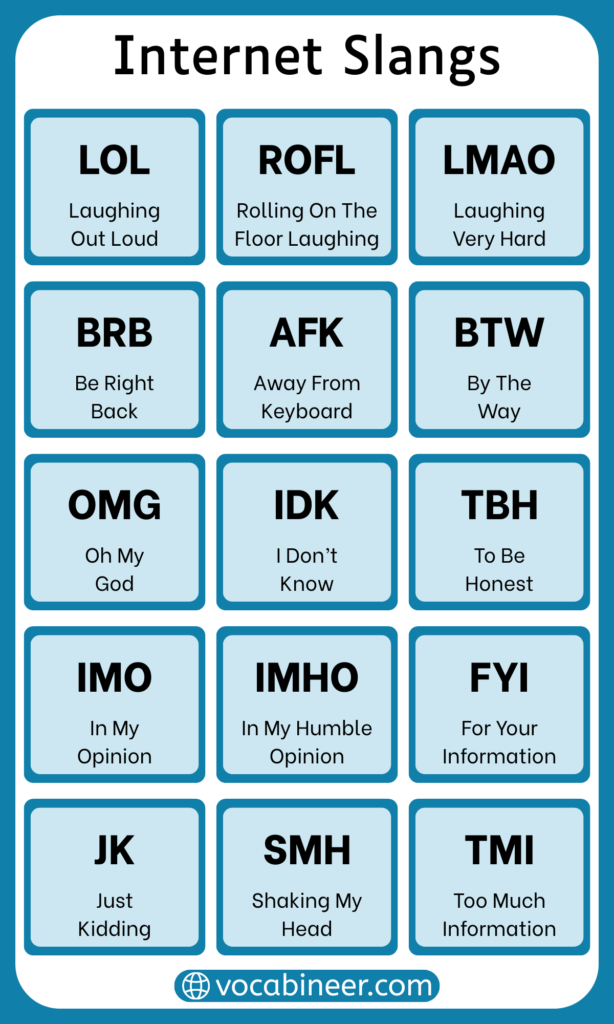
Text Message Slangs
Text message slangs are short forms commonly used in SMS and private chats to save time and typing effort. These slangs help keep conversations fast and informal, especially when replying quickly.
- OMG: Oh my God, used to show surprise.
- WYD: What are you doing, used to ask about current activity.
- HBU: How about you, used when returning a question.
- LMK: Let me know, used when waiting for a response.
- GTG: Got to go, used before leaving a chat.
- ILY: I love you, used to express affection.
- ILYSM: I love you so much, a stronger form of affection.
- OMW: On my way, used when traveling to a place.
- IDTS: I don’t think so, used to express doubt.
- BRUH: Used to show disbelief or surprise.
- THX: Thanks, a casual way to say thank you.
- PLZ: Please, shortened for quick typing.
- CU: See you, used when ending a conversation.
- K: Okay, a very short reply.
- JK: Just kidding, used to show a message was a joke.
Social Media Slangs
Social media slangs are words and short forms commonly used on platforms like Facebook, Instagram, X, and comments sections. These slangs relate to posting, sharing, reactions, and online interaction. Learning them helps readers understand how people communicate on social platforms.
- DM: Direct message, used for private conversations.
- FOMO: Fear of missing out, used when feeling left out.
- ICYMI: In case you missed it, used when resharing posts.
- SMH: Shaking my head, used to show disappointment.
- TLDR: Too long didn’t read, used to summarize content.
- RT: Retweet, used on X to reshare posts.
- AMA: Ask me anything, used for question sessions.
- POV: Point of view, used in captions and videos.
- Handle: A user’s name on social platforms.
- Bio: A short profile description.
- Pinned: Content fixed at the top of a profile.
- Verified: Account confirmed as authentic.
- Alt: An alternate account.
- Main: A primary or main account.
- Tag: Mentioning another user in a post.
- Hashtag: A keyword used to group content.
- Feed: Stream of posts shown to users.
- Algorithm: System that decides content visibility.
- Reach: Number of people who see a post.
- Engagement: Likes, comments, and shares.
Instagram and TikTok Slangs
Instagram and TikTok slangs are commonly used in short videos, captions, comments, and creator communities. These slangs describe trends, content style, audience reactions, and platform features. Understanding them helps readers follow what creators and viewers mean in fast-moving content spaces.
- Aesthetic: A specific visual style or overall look.
- Vibe: The feeling or mood something gives.
- Flex: Showing off something proudly.
- POV: Point of view, used to frame content perspective.
- Ratio: When comments outnumber likes on a post.
- Shadowban: Reduced content reach without notice.
- Reel: Short video format on Instagram.
- FYP: For You Page, TikTok’s main feed.
- Soft launch: Subtle sharing of personal news.
- Hard launch: Clear public announcement.
- Trending audio: Popular sound used in many videos.
- Hook: The opening part meant to grab attention.
- Duet: Responding with a side-by-side video.
- Stitch: Adding a clip of another video.
- CapCut: Popular video editing tool reference.
- Drafts: Saved but unpublished videos.
- Low effort: Simple content with minimal editing.
- High effort: Highly edited or planned content.
- Green screen: Background effect feature.
- Watch time: How long viewers stay on a video.
Gaming and Streaming Slangs
Gaming and streaming slangs are used in online games, live streams, and chat rooms. These terms help players and viewers communicate quickly during fast-paced situations. Many of these slangs are shared across different games and streaming platforms.
- GG: Good game, used to show sportsmanship after a match.
- AFK: Away from keyboard, used when a player is temporarily inactive.
- OP: Overpowered, used to describe something very strong in a game.
- Noob: A beginner player with little experience.
- Lag: Delay caused by slow internet connection.
- Nerf: To weaken a character or item in a game update.
- Buff: To strengthen a character or item.
- Clutch: A critical play that leads to success.
- Spawn: The place where players appear in a game.
- Camp: Staying in one spot to gain advantage.
Reaction and Emotion Slangs
Reaction and emotion slangs express feelings like laughter, shock, embarrassment, or excitement. These slangs are often used in comments and quick replies.
- Cringe: Something embarrassing or awkward.
- Mood: Something relatable to one’s feelings.
- Dead: Used to show extreme laughter.
- I can’t: Used when overwhelmed or amused.
- Savage: Bold or sharply honest behavior.
- Shook: Feeling surprised or shocked.
- Wheezing: Laughing very hard.
- Crying: Used to show laughing or emotional reaction.
- Speechless: Unable to react due to shock.
- Yikes: Used to react to something uncomfortable.
Opinion and Response Slangs
These slangs are used to share agreement, disagreement, or strong opinions in online discussions.
- FR: For real, used to agree strongly.
- Cap: A lie or false statement.
- No cap: Telling the truth.
- Facts: Strong agreement with a statement.
- Based: Confident or unapologetic opinion.
- Mid: Average or unimpressive.
- W: A win or positive outcome.
- L: A loss or negative outcome.
- Valid: Reasonable or acceptable opinion.
- Say less: Agreement without needing more explanation.
Gen Z Internet Slangs
Gen Z slangs are popular among younger users and spread quickly through social media and video platforms. These slangs often change rapidly.
- Slay: Doing something very well.
- Bet: Agreement or confirmation.
- Sus: Suspicious behavior.
- Lowkey: Slightly or quietly.
- Highkey: Strongly or openly.
- Rizz: Charm or attraction skills.
- Delulu: Unrealistic thinking.
- Main character: Acting confident and central.
- It’s giving: Describing a vibe.
- Period: Emphasizing a statement.
Meme Slangs
Meme slangs come from viral images, videos, and repeated online jokes. These slangs often carry humor, exaggeration, or shared cultural meaning. They are commonly used in comments, captions, and replies to react quickly or add humor to a situation.
- NPC: A person acting without original thought, like a background character.
- Starter pack: A set of common traits linked to a person or trend.
- Canon: Something officially accepted within a story or joke.
- Core: A theme or identity style linked to aesthetics.
- Side quest: A small or unrelated task outside the main focus.
- Touch grass: Telling someone to take a break from the internet.
- Based: Showing confidence or an unapologetic opinion.
- Mid: Average or unimpressive.
- Unhinged: Wild or unpredictable behavior.
- Brain rot: Feeling mentally drained from too much content.
- Lore: Background story behind a situation or person.
- Main character energy: Acting confident and central to attention.
- This ain’t it: Disapproval of something.
- Peak: Extremely good or funny.
- I’m dead: Reacting to something very funny.
Online Behavior Slangs
These slangs describe how people act or behave online.
- Ghosting: Suddenly stopping communication.
- Lurking: Reading content without interacting.
- Doomscrolling: Endless scrolling of negative news.
- Spam: Repeated unwanted messages.
- Blocked: Prevented from contacting someone.
- Muted: Silenced notifications.
- Seen: Message read but not replied.
- Receipts: Proof or screenshots.
- Cancelled: Facing backlash.
- Soft block: Removing interaction without full blocking.
Argument and Debate Slangs
These slangs are used during online disagreements and debates.
- Ratio: When replies exceed likes.
- Cope: Struggling to accept reality.
- Seethe: Showing anger silently.
- Dragged: Heavily criticized.
- Called out: Publicly criticized.
- Receipts: Evidence used in arguments.
- Strawman: Misrepresenting an argument.
- Gaslighting: Making someone doubt reality.
- Clapped back: Responded sharply.
- Mid take: Weak opinion.
Trend and Aesthetic Slangs
Trend and aesthetic slangs are used to describe styles, phases, and popular looks online. These terms appear often in fashion content, lifestyle posts, and short videos. They help users describe how something looks or feels in a cultural sense.
- Glow up: A noticeable improvement in appearance or confidence.
- Era: A phase or period in someone’s life.
- Core aesthetic: A specific visual or lifestyle theme.
- Clean girl: A simple and polished style.
- That girl: A confident and aspirational persona.
- Soft girl: A gentle and cute aesthetic style.
- Dark academia: A moody academic-inspired aesthetic.
- Cottagecore: A rural and nature-focused aesthetic.
- Minimal core: Clean and simple design style.
- Vintage vibe: Style inspired by past decades.
Friendship and Social Slangs
Friendship and social slangs are used to describe relationships, closeness, and social circles. These words are common in chats and comments between friends.
- Bestie: A very close friend.
- Mutuals: People who follow each other online.
- Fam: Close friends treated like family.
- Ride or die: A loyal and dependable friend.
- Close friends: Trusted inner circle.
- Circle: A group of friends.
- Inner squad: Small trusted group.
- Plus one: A friend invited along.
- Link up: Meet or hang out.
- Tag along: Join someone casually.
Humor and Sarcasm Slangs
These slangs express jokes, exaggeration, or playful sarcasm. They are often used in comments and replies to lighten conversations.
- Unhinged: Wild or over-the-top behavior.
- Send help: Used jokingly when overwhelmed.
- I’m weak: Laughing hard at something.
- Dead inside: Joking emotional exhaustion.
- Living rent free: Something constantly on the mind.
- This sent me: Something very funny.
- I can’t even: Speechless from humor.
- Crying screaming: Extreme reaction.
- Help: Used humorously.
- Peak comedy: Something very funny.
Old Internet Slangs
Old internet slangs are early online terms that are still used today. Many of these came from early chat rooms and forums.
- LOL: Laughing out loud.
- BRB: Be right back.
- FYI: For your information.
- TMI: Too much information.
- JK: Just kidding.
- ASL: Age, sex, location.
- ROFL: Rolling on the floor laughing.
- TTYL: Talk to you later.
- IDK: I don’t know.
- OMG: Oh my God.
Confusing Internet Slangs
Some internet slangs are confusing because their meanings depend heavily on context. These terms are often misunderstood by learners.
- Shade: Subtle insult.
- Mid: Average quality.
- Spam: Repeated messages.
- Lurk: Stay silent while reading.
- Ratio: More replies than likes.
- Soft launch: Subtle announcement.
- Hard launch: Clear announcement.
- Canon: Officially accepted.
- NPC: Lacking originality.
- Based: Confident opinion.
Internet Slangs vs Formal English
Internet slangs and formal English differ mainly in tone, structure, and usage. Online slangs sound informal and conversational, often breaking standard grammar rules. Formal English, however, follows complete sentence structure and accepted grammar. Slangs appear mostly in casual chats and comments, while formal English is expected in academic, professional, and official communication.
Internet slangs often shorten full expressions to save time, while formal English uses clear and complete wording.
| Internet Slang | Meaning in Slang Use | Formal English Equivalent |
|---|---|---|
| LOL | Shows laughter or amusement | That is funny |
| BRB | Leaving briefly | I will be back shortly |
| IDK | Not knowing something | I do not know |
| IMO | Giving a personal view | In my opinion |
| FYI | Sharing information | For your information |
| TBH | Speaking honestly | To be honest |
| ASAP | Urgent timing | As soon as possible |
| NVM | Canceling a point | Never mind |
| DM | Private message | Send a private message |
| AFK | Temporarily away | Away from the keyboard |
| BFF | Close friend | Best friend |
| OMG | Showing surprise | Oh my goodness |
| TTYL | Ending conversation | Talk to you later |
| FOMO | Feeling left out | Fear of missing out |
| BTW | Adding information | By the way |
When to Use Internet Slangs?
Internet slangs are best used in casual and informal online settings. They fit naturally in chats with friends, comment sections, social media posts, and gaming conversations where relaxed language is expected. In these spaces, slangs help express emotion, tone, and quick reactions.
Internet slangs should be avoided in formal situations such as school assignments, professional emails, official documents, or job communication. In these cases, using complete sentences and standard English helps maintain clarity and professionalism.
Global Internet Slangs
Some internet slangs are understood worldwide due to global platforms. These slangs are commonly used across countries.
- LOL: Laughing reaction.
- AFK: Away from keyboard.
- GG: Good game.
- BRB: Short absence.
- FOMO: Fear of missing out.
- DM: Private message.
- IDK: I don’t know.
- TBH: To be honest.
- BTW: By the way.
- IMO: In my opinion.
FAQs About Internet Slangs
Internet slangs are informal words, abbreviations, or phrases commonly used in online communication. They help people express ideas, reactions, or emotions quickly in chats, comments, and posts.
People use internet slangs to save time, keep conversations casual, and show tone or emotion that plain text may not clearly express.
Some internet slangs are used everywhere, but others are more common on specific platforms like social media, gaming, or messaging apps.
Yes, many internet slangs fade out while new ones appear as online trends, communities, and platforms change.
Internet slangs should generally be avoided in formal writing, school work, or professional communication unless the context clearly allows informal language.
Conclusion
Internet slangs have become a natural part of online communication across chats, social media, gaming, and digital content. These informal words and expressions help people share reactions, opinions, and emotions quickly while matching the casual tone of online spaces. As new platforms and trends appear, internet slangs continue to change and grow.
Understanding internet slangs makes it easier to follow online conversations and recognize what people mean in different contexts. Learning these terms helps readers stay aware of common digital language and use it appropriately in everyday online interactions.
Read More
