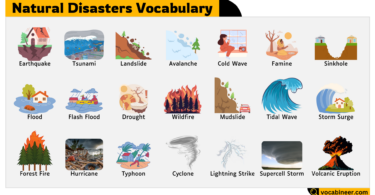
Understanding nature vocabulary words with meaning helps describe the world around us accurately and clearly. These words let you talk about landscapes, weather, animals, plants, and natural phenomena in school, travel, and daily observations. They are essential for writing reports, participating in discussions, or simply explaining what you see outside.
Learning these terms also improves your ability to communicate in science, geography, and outdoor activities. By familiarizing yourself with nature vocabulary, you can describe forests, rivers, mountains, and animals confidently while reading or speaking. Using the words correctly in sentences strengthens understanding and everyday use.
In This Page
Daily-Life Nature Vocabulary
Some daily-life nature vocabulary includes words you encounter in your surroundings, gardens, parks, and local areas. Knowing these words helps you describe places, share experiences, and recognize natural features.
- Garden: A cultivated area with flowers, vegetables, or trees for beauty or food.
- Park: Public space with greenery, benches, and pathways for relaxation or exercise.
- Forest: Large area filled with trees, plants, and wildlife.
- Meadow: Open grassy land, often covered with wildflowers.
- Riverbank: Land alongside a river, commonly used for walking or fishing.
- Beach: Sandy or pebbly area along the shore of a sea, lake, or river.
- Hillside: Slope or side of a hill, sometimes used for farming or hiking.
- Valley: Low area between hills or mountains, often with a stream or river.
- Trail: Path through forests, hills, or mountains for walking or hiking.
- Pond: Small body of still water, home to fish, frogs, or plants.
- Island: Land surrounded by water, often smaller than a continent.
- Cliff: Steep rock face, often near the sea or mountains.
- Canyon: Deep valley with steep sides, usually carved by a river.
- Dune: Hill of sand formed by wind near deserts or beaches.
- Plateau: Elevated flat land higher than surrounding areas.
Flora Vocabulary
Nature vocabulary related to plants helps describe forests, gardens, and green areas. Learning flora vocabulary words with meaning allows better discussion about trees, flowers, shrubs, and plants you encounter outdoors.
Some common flora words include:
- Oak: A strong tree with hard wood and lobed leaves.
- Pine: Evergreen tree with needle-like leaves and cones.
- Bamboo: Tall, fast-growing grass used for construction and decoration.
- Rose: Flower with fragrant petals and thorny stems.
- Sunflower: Tall plant with bright yellow flowers that follow the sun.
- Fern: Non-flowering plant with feathery green leaves, often in forests.
- Moss: Small green plant that grows on rocks, trees, and soil.
- Ivy: Climbing plant often covering walls or trees.
- Cactus: Desert plant with thick stems that store water.
- Lily: Flower with large petals and strong fragrance, often in gardens.
- Shrub: Small bushy plant, usually less than 3 meters tall.
- Vine: Climbing plant that uses structures to grow upward.
Fauna Vocabulary
Some common fauna vocabulary words help describe the animals found in forests, farms, and wild areas. Knowing these words makes it easier to talk about wildlife, pets, and birds in daily conversation or school projects.
- Elephant: Large land mammal with a trunk and tusks, found in forests and savannas.
- Fox: Small wild mammal with a bushy tail and sharp features.
- Butterfly: Insect with colorful wings that flies during the day.
- Frog: Amphibian that lives near water and croaks loudly at night.
- Hawk: Bird of prey with sharp eyes and strong talons.
- Deer: Forest-dwelling mammal with antlers in males.
- Salmon: Fish that swims upstream to lay eggs.
- Rabbit: Small mammal with long ears and a fluffy tail.
- Snake: Legless reptile that slithers on the ground.
- Bee: Flying insect that makes honey and pollinates flowers.
- Owl: Nocturnal bird with large eyes and silent flight.
- Bear: Large mammal, strong and mostly omnivorous, living in forests.
- Wolf: Wild carnivore known for living in packs.
- Swan: Large water bird with a long neck and white feathers.
Bodies of Water Vocabulary
Some bodies of water vocabulary words are used to describe rivers, lakes, oceans, and other water features. These words help learners talk about water-related landscapes accurately.
- Lake: A large body of freshwater surrounded by land.
- River: Flowing water that moves toward a sea or ocean.
- Stream: Small flowing water, usually a branch of a river.
- Creek: Narrow water channel smaller than a river.
- Pond: Small, calm water body, often found in gardens or parks.
- Lagoon: Shallow body of water separated from the sea by sand or coral.
- Waterfall: Water falling from a height into a pool below.
- Bay: Part of a sea or lake partly enclosed by land.
- Estuary: Area where a river meets the sea.
- Glacier: Slow-moving mass of ice found in mountains or polar regions.
- Ocean: Vast body of saltwater covering most of the Earth.
- Pool: Small collection of water, often natural or artificial.
Landforms Vocabulary
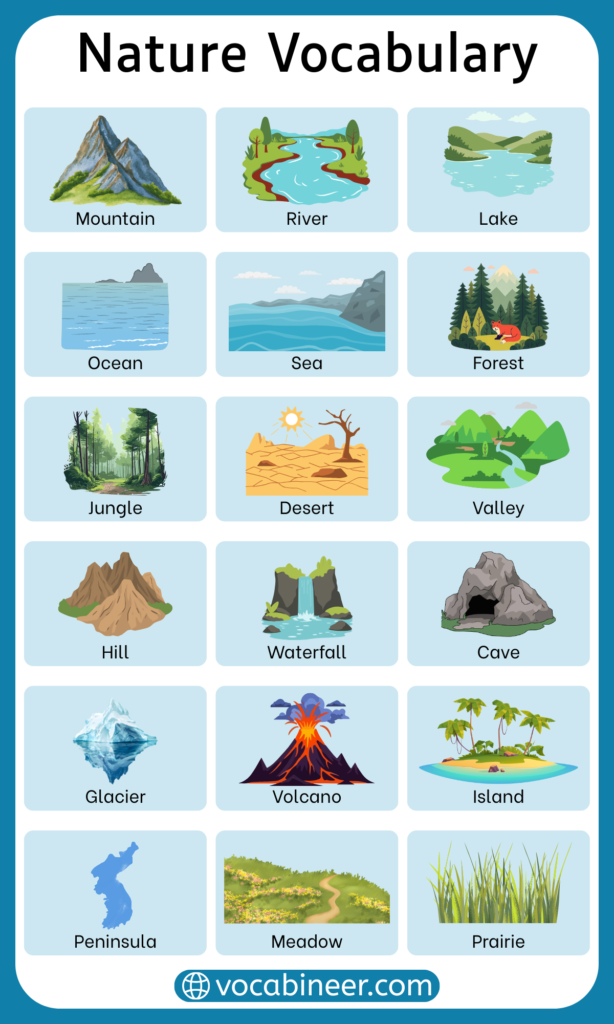
Some landform vocabulary words describe the shapes of the Earth’s surface. Using these words improves your ability to talk about mountains, hills, and other natural features.
- Hill: Raised area of land, smaller than a mountain.
- Mountain: Large natural elevation of the Earth’s surface.
- Valley: Low area between hills or mountains, often with a river.
- Plateau: Elevated flat land higher than surrounding areas.
- Cliff: Steep rock face, usually near the sea or mountains.
- Canyon: Deep, narrow valley with steep sides, carved by a river.
- Dune: Hill of sand formed by wind near deserts or beaches.
- Volcano: Mountain that can erupt lava, ash, and gases.
- Island: Land completely surrounded by water.
- Peninsula: Land surrounded by water on three sides.
- Foothills: Low hills at the base of a mountain range.
- Glacier: Large mass of slowly moving ice shaping the land.
Natural Resources Vocabulary
Some natural resources vocabulary words describe materials found in the Earth used by humans. Learning these words helps you talk about minerals, energy, and environmental topics accurately.
- Coal: Black rock burned as fuel for energy production.
- Oil: Liquid fossil fuel used for energy and manufacturing.
- Gas: Fossil fuel in gaseous form used for heating or cooking.
- Iron: Strong metal extracted from rocks for construction and tools.
- Gold: Precious yellow metal used in jewelry and currency.
- Silver: Valuable shiny metal often used for coins and jewelry.
- Copper: Red-brown metal used in electrical wiring and plumbing.
- Wood: Material from trees used for building, furniture, and fuel.
- Water: Essential resource for drinking, farming, and industry.
- Soil: Earth material that supports plant growth and agriculture.
- Sand: Small grains of rock used in construction and glass-making.
- Salt: Mineral used for seasoning and preservation.
Weather Vocabulary
Some weather vocabulary words describe conditions in the sky and atmosphere. Knowing these terms helps in discussing climate, forecasts, and natural events.
- Rain: Water droplets falling from clouds.
- Snow: Frozen water crystals falling in winter.
- Hail: Small ice balls falling from the sky during storms.
- Fog: Thick mist reducing visibility near the ground.
- Storm: Severe weather with rain, wind, or lightning.
- Thunder: Loud sound following lightning.
- Lightning: Sudden bright flash of electricity in the sky.
- Wind: Moving air that can be strong or gentle.
- Cloud: Visible water vapor floating in the sky.
- Sunshine: Light and warmth from the sun.
- Drizzle: Light rain with small droplets.
- Hurricane: Strong tropical storm with high winds and rain.
Descriptive Nature Words
Some descriptive nature words are used to express characteristics of natural objects, landscapes, and phenomena. These words make descriptions more vivid and accurate.
- Dense: Thick, crowded, or closely packed, like a forest.
- Sparse: Thinly scattered, with lots of open space.
- Rocky: Covered with or made of rocks.
- Windy: Strong movement of air in an area.
- Calm: Still, peaceful, and quiet conditions, often for water.
- Flowing: Moving gently, usually describing rivers or streams.
- Steep: Rising or falling sharply, like a mountain slope.
- Shallow: Not deep, often describing water or land.
- Barren: Empty or unable to support much plant life.
- Lush: Healthy, green, and full of growth.
- Frozen: Turned solid due to low temperature.
- Sunny: Bright with direct sunlight.
Practical Usage of Nature Vocabulary
Some practical usage tips for nature vocabulary help learners apply these words in conversations, essays, and observations. Using them correctly makes descriptions clear and meaningful.
- Observe surroundings and label objects like trees, rivers, or hills.
- Describe weather using words like rainy, snowy, or sunny.
- Talk about animals with fauna vocabulary such as fox, deer, or owl.
- Explain landforms using terms like canyon, plateau, or cliff.
- Use descriptive words to express characteristics like dense, lush, or rocky.
- Include natural resources in discussions, like coal, water, or iron.
- Combine words in sentences to describe experiences outdoors or nature trips.
Quick Tips for Learning Nature Vocabulary
Learning nature vocabulary becomes easier when you use simple, practical methods daily. Try labeling plants, animals, and landforms while observing the outdoors. Make flashcards with words and short meanings, and practice using them in sentences. Watching nature videos and describing what you see also helps remember terms quickly. These tips let you use nature vocabulary words confidently in school, projects, and daily conversations.
Common FAQs about Nature Vocabulary
The most important words include animals, plants, landforms, water bodies, weather terms, and natural resources that describe the environment accurately.
You can describe weather, landscapes, outdoor activities, and animals in conversations, essays, or school projects.
Flora means all types of plants and trees, while fauna means all animals and wildlife.
Common words include mountain, hill, plateau, valley, river, lake, stream, and ocean.
Practice by observing nature, using flashcards, labeling objects, writing sentences, and watching nature videos regularly.
Conclusion
Learning nature vocabulary words helps students and learners accurately describe the environment, animals, weather, and landscapes. Understanding these words improves communication in school, travel, and daily life.
By practicing these terms regularly, observing nature, and using them in sentences, you’ll notice your confidence in describing the world around you increases. Using nature vocabulary words correctly allows better storytelling, clearer explanations, and richer conversations about the natural world.
Read More