

Synonyms for start help you talk about beginnings in a more exact way. Sometimes start means to begin an action. Sometimes it means to begin a plan, event, or journey. Using different words for start keeps your writing fresh and helps you match the right tone for each situation.
In This Page
What Does Start Mean In English?
Start means to begin something. It can be the first step of an action, like starting homework, or the first moment of an event, like starting a match. Start can also mean the point where something begins, such as the start of a story. In every case, it shows the beginning of doing, happening, or moving.
How Start Is Used In Daily English
People use start for everyday actions and bigger changes. You can start a task, start a class, or start working out. You can start a trip, start a new job, or start a new habit. Because this word is used so often, choosing a synonym can make your sentence more exact and less repetitive.
Common Start Synonyms With Meanings
Below is a list of common synonyms for start with easy meanings.
- Begin: To start doing something.
- Commence: A formal word for start, often for events.
- Initiate: To begin something planned or organized.
- Launch: To start something in a big or official way.
- Open: To start an event or program officially.
- Kick Off: To start something with energy, often a game or meeting.
- Undertake: To begin a task that needs effort.
- Establish: To start something that will continue, like a rule or system.
- Set Off: To start a trip or movement.
- Set Out: To begin a journey or goal.
- Get Started: To begin an action.
- Start Up: To begin operating, often for machines or projects.
- Spark: To begin something suddenly, like an idea or feeling.
- Trigger: To cause something else to start.
- Activate: To start something by switching it on.
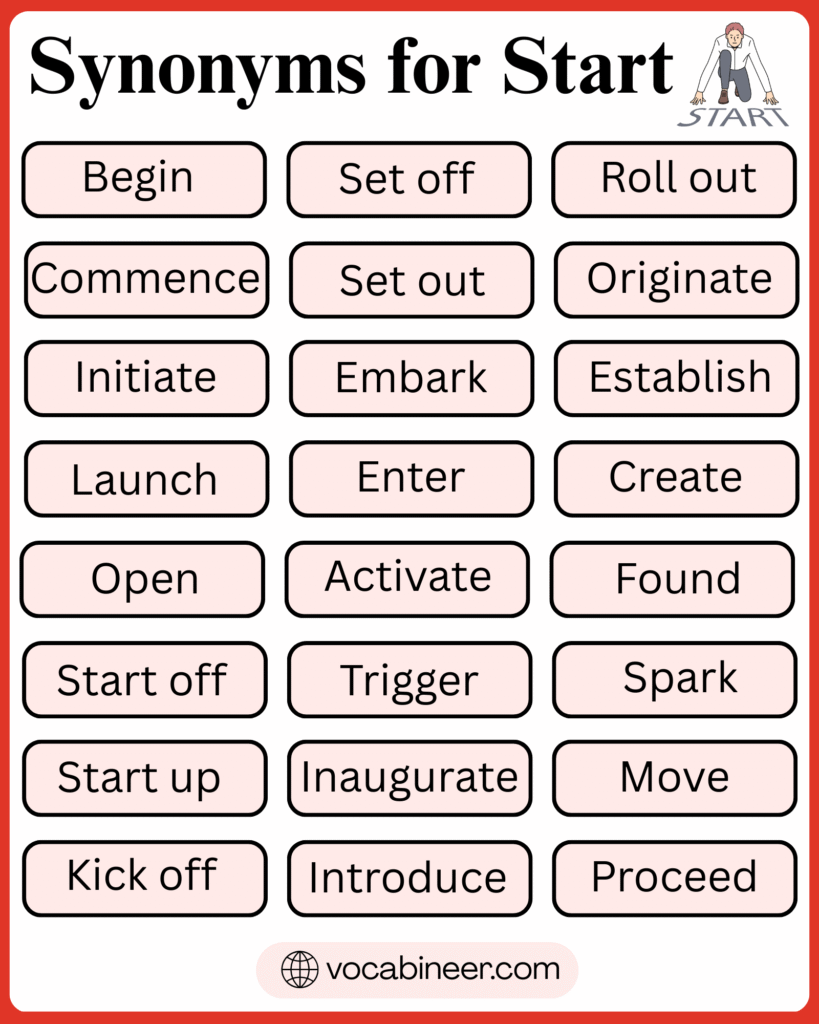
Different Types Of Words For Start
Start synonyms fall into types based on how the beginning happens. Learning the types helps you pick a word that fits your meaning.
Beginning An Action
These fit when you start doing something yourself.
- Begin
- Get Started
- Start Up
- Set About
- Undertake
- Take On
- Get Going
Starting Something New
These fit when you begin a new project, habit, rule, or plan.
- Initiate
- Launch
- Establish
- Set Up
- Found
- Start Up
- Begin
Opening An Event Or Program
These fit when a planned event begins.
- Commence
- Open
- Kick Off
- Launch
- Begin
Setting Out On A Journey
These fit travel, movement, or leaving for a place.
- Set Off
- Set Out
- Depart
- Head Out
- Begin A Trip
- Take Off
Causing Something To Begin
These fit when one thing makes another thing start.
- Spark
- Trigger
- Activate
- Bring About
- Set In Motion
- Prompt
Start Words By Strength
Some words sound normal and everyday, while others feel formal or big. Strength helps you choose a natural word.
Everyday Start Words
- Begin
- Get Started
- Get Going
- Start Up
- Set Off
Formal Or Serious Start Words
- Commence
- Initiate
- Undertake
- Establish
Big Or Official Start Words
- Launch
- Kick Off
- Open
- Set In Motion
Start In Different Contexts
Start can mean different things depending on the situation. These words fit common contexts in English.
Start Words For School And Study
Use these for lessons, homework, and learning topics.
- Begin
- Get Started
- Start Working
- Undertake
- Take On
- Get Going
Start Words For Projects And Plans
Use these for organized tasks or goals.
- Initiate
- Launch
- Set Up
- Establish
- Begin
Start Words For A Business Or Group
Use these for new organizations or systems.
- Found
- Establish
- Launch
- Set Up
- Start Up
Start Words For Travel And Movement
Use these when leaving or moving from one place.
- Set Off
- Set Out
- Depart
- Head Out
- Take Off
Start Words For Habits And Routines
Use these for new daily actions.
- Begin
- Get Started
- Take On
- Commit To
- Start Up
Start Words For Sudden Change
Use these when something begins because of a cause.
- Trigger
- Spark
- Prompt
- Set In Motion
- Activate
Start Vs Similar Words
Some words are close to start but not exactly the same. Knowing the difference helps you avoid mistakes.
Start Vs Begin
Both mean to do the first part of something. Begin sounds a little more formal and is common in writing. Start is more casual and common in speech. Most of the time, you can use either one without changing meaning.
Start Vs Commence
Commence is a formal synonym for start. It is used for ceremonies, meetings, or official rules. People say, “The show will commence at noon.” Start works in all cases, but commence fits formal situations better.
Start Vs Launch
Launch means starting something in a big, planned, or public way. You launch a product, a program, or a campaign. Start can be small or private, like starting homework. Launch adds the idea of an important beginning.
Start Vs Initiate
Initiate means starting something by taking the first organized step. It often suggests planning or control, like initiating a project or initiating change. Start is broader and can be casual, while initiate is more structured.
Start Vs Set Off
Set off focuses on leaving or beginning a journey. You set off for school or set off on a trip. Start can mean any kind of beginning, not only travel. So set off fits movement, while start fits everything.
Start Vs Trigger
Trigger means causing something else to start, often suddenly. A mistake can trigger an argument. Start is the action of beginning itself. Trigger is the cause of the beginning.
Exact And Near Start Synonyms
Some words replace start directly. Others stay close but need the right context.
Exact Synonyms Of Start
- Begin
- Commence
- Get Started
- Start Up
- Kick Off
Near Synonyms Of Start
- Launch
- Initiate
- Set Off
- Establish
- Spark
- Trigger
How To Choose The Right Start Synonym
First, think about what you are starting. For a simple action, begin or get started fits well. For formal events, commence or open sounds natural. When the beginning is big and planned, launch or kick off works better. If travel is involved, set off or set out is the right choice. When one thing causes another to begin, spark or trigger fits best. Matching the word to the situation makes your English more accurate.
FAQs About Start Synonyms
Not always. Some are formal, some are for travel, and some mean causing a beginning, so only one may fit well.
Launch, initiate, or commence can feel stronger because they suggest a planned or official beginning.
Yes. Begin is one of the closest words and works in most sentences.
Yes. You can start a meeting, start a class, or start a program. Commence and kick off also fit in these cases.
Begin, commence, initiate, and launch work well in school sentences, depending on context.
Conclusion
Start is a useful word, but it is broad. Learning synonyms for start helps you show the exact kind of beginning you mean. Some words fit daily actions, some fit formal events, and others fit big launches or travel. When your synonym matches the situation, your English sounds natural and more precise.
Read More
