
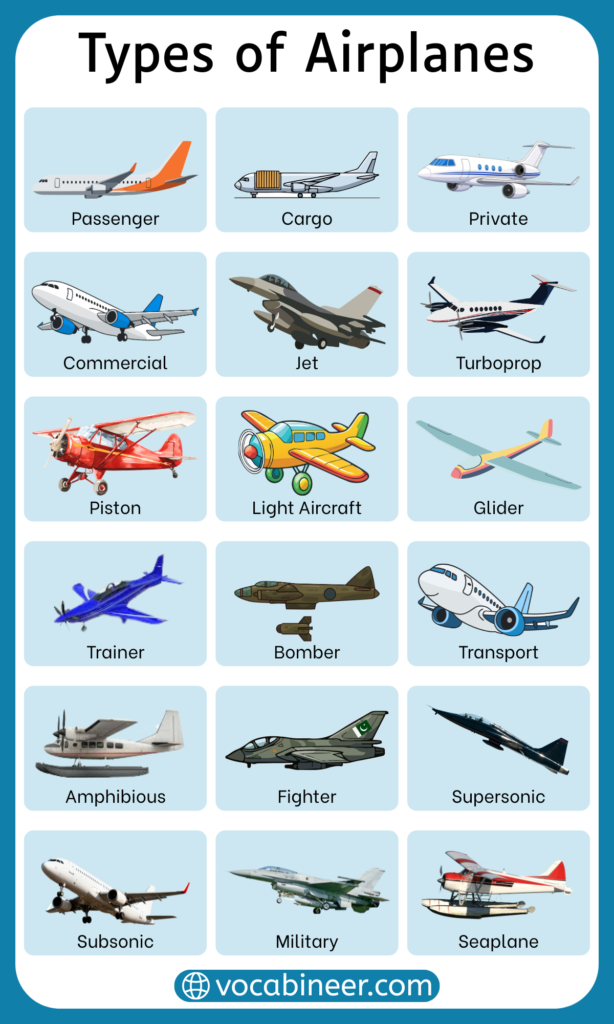
Airplanes are flying machines designed to carry people, goods, and equipment through the air using wings and engines. Different types of airplanes are built for travel, transport, defense, training, rescue, and special tasks. Learning types of airplanes in English with pictures helps readers understand aircraft names, purposes, and differences clearly, making aviation concepts easier to recognize and remember.
By studying types of airplanes, readers learn aircraft categories, real-world uses, and design variations, helping them understand flight systems and airplane functions in daily learning, education, and general knowledge.
In This Page
What Is an Airplane?
An airplane is a powered flying vehicle with fixed wings that generate lift, allowing it to move through the air. Airplanes travel using engines that push air backward, helping the aircraft move forward and stay airborne.
Common features of an airplane include:
- Wings: Create lift to support the aircraft during flight
- Fuselage: The main body that holds passengers, cargo, and controls
- Engines: Provide thrust to move the airplane forward
- Tail section: Maintains balance and direction
- Landing gear: Supports the airplane during takeoff and landing
Main Types of Airplanes
Airplanes are designed for different purposes, and their main types are grouped according to how they support travel, transport, defense, training, research, and special operations. This classification helps readers understand airplane functions, real-world uses, and operational roles more clearly.
- Passenger airplanes: Carry people safely across short, medium, and long distances for domestic and international travel
- Cargo airplanes: Transport goods, packages, machinery, and essential supplies across regions and countries
- Military airplanes: Support defense missions, air combat, troop transport, training, and surveillance
- Private airplanes: Provide personal travel with flexible routes and private scheduling
- Business airplanes: Serve corporate travel needs with onboard workspaces and long-range comfort
- Charter airplanes: Offer rented flight services for customized travel plans
- Training airplanes: Help student pilots learn basic and advanced flying skills
- Light airplanes: Support recreational flying, touring, and pilot practice
- Utility airplanes: Perform short-range transport, emergency tasks, and remote-area operations
- Special-purpose airplanes: Carry out rescue, firefighting, medical transport, agricultural spraying, and survey missions
- Experimental airplanes: Test new aircraft designs, materials, and flight technologies
- Research airplanes: Conduct weather studies, climate monitoring, and scientific experiments
Types of Passenger Airplanes
Passenger airplanes are built to carry people safely and comfortably across short, medium, and long distances. These airplanes vary in size, seating capacity, flight range, and cabin design, allowing airlines to serve local routes, regional travel, and international journeys efficiently.
- Narrow-body airplanes: Feature a single aisle and carry fewer passengers, making them suitable for short and medium-distance flights
- Wide-body airplanes: Use two aisles and larger cabins to transport many passengers on long-distance international routes
- Regional airplanes: Serve short routes between nearby cities with smaller seating capacity and compact design
- Short-haul airplanes: Operate frequent flights over short distances with quick boarding and turnaround times
- Long-haul airplanes: Travel across continents, offering extended comfort, larger cabins, and advanced onboard systems
Types of Military Airplanes
Military airplanes are specially designed for defense, combat, transport, training, and surveillance missions. These aircraft combine speed, strength, and advanced technology to protect airspace and support military operations worldwide.
- Fighter jets: Perform air combat, interception, and rapid-response defense missions
- Bomber aircraft: Carry heavy payloads for long-range strike operations
- Transport aircraft: Move troops, vehicles, weapons, and supplies
- Surveillance aircraft: Monitor airspace and gather intelligence using advanced sensors
- Refueling aircraft: Supply fuel to other airplanes during flight, extending mission range
- Trainer aircraft: Prepare pilots for advanced military flying skills
Types of Cargo Airplanes
Cargo airplanes transport goods, machinery, medical supplies, and commercial shipments across long distances. Their strong structure and wide cargo holds allow safe movement of heavy and oversized items.
- Heavy cargo aircraft: Carry extremely large and heavy shipments, including vehicles and industrial equipment
- Medium cargo aircraft: Transport standard commercial goods and packaged freight
- Light cargo aircraft: Deliver small loads, mail, and emergency supplies to short-distance locations
Types of Private and Business Airplanes
Private and business airplanes support personal, corporate, and charter travel by offering flexibility, comfort, and direct route access. These airplanes allow faster travel schedules, privacy, and customized flight planning.
- Private jets: Provide fast, comfortable personal travel with flexible schedules
- Business jets: Serve corporate travel needs with onboard workspaces and extended range
- Charter aircraft: Offer rented flight services for short-term and customized journeys
- Personal aircraft: Support individual ownership for recreational and personal flying
Types of Small Airplanes
Small airplanes are designed for short-distance flights, pilot training, recreation, and light transport. Their compact size and simple controls make them suitable for learning, touring, and hobby flying.
- Single-engine airplanes: Use one engine and are commonly used for training and private flying
- Multi-engine airplanes: Feature two or more engines for added power and reliability
- Light aircraft: Combine simple structure and low operating cost for recreational aviation
Types of Special-Purpose Airplanes
Special-purpose airplanes perform focused tasks such as rescue missions, medical transport, firefighting, and agricultural spraying. These aircraft are built to operate in demanding environments and emergency situations.
- Rescue aircraft: Assist in search, rescue, and disaster relief operations
- Firefighting aircraft: Drop water or fire retardant to control wildfires
- Agricultural aircraft: Spray crops for farming and pest control
- Medical transport aircraft: Carry patients and emergency medical equipment
- Aerial survey aircraft: Collect mapping, weather, and environmental data
Types of Airplanes Based on Engine
Airplanes are also classified by the type of engine they use, which affects speed, fuel efficiency, flight range, and operating cost. Engine type plays a key role in how an airplane performs in different flying conditions.
- Jet airplanes: Use jet engines to provide high speed and long-distance travel, commonly seen in commercial and military aviation
- Propeller airplanes: Use rotating propellers for short flights, training, and small-scale transport
- Turboprop airplanes: Combine jet engine technology with propellers, offering efficient performance for regional and medium-range travel
Types of Airplanes Based on Takeoff and Landing
Airplanes differ in how they take off and land, depending on runway length, terrain, and mission requirements. This classification helps explain how aircraft operate in varied environments.
- Conventional takeoff airplanes: Require standard runways for normal takeoff and landing operations
- Short takeoff and landing aircraft: Designed to operate on short runways and remote airstrips
- Vertical takeoff and landing aircraft: Capable of lifting straight upward, useful in limited space and special missions
Types of Airplanes Based on Wing Design
Wing design influences lift, speed, stability, and fuel efficiency. Different wing structures help airplanes perform better in specific flight conditions.
- Fixed-wing aircraft: Use rigid wings to generate lift, forming the basic structure of most airplanes
- Swept-wing aircraft: Feature angled wings that support high-speed and long-distance travel
- Delta-wing aircraft: Use triangular wings that improve stability and performance at high speeds
Main Parts of an Airplane and Their Functions
Every airplane is built from essential parts that work together to create lift, movement, control, and balance. Understanding these main airplane parts helps readers recognize aircraft structure and basic flight operation.
- Wings: Generate lift by controlling airflow and supporting the airplane in flight
- Fuselage: Forms the main body that holds passengers, cargo, and cockpit controls
- Engines: Produce thrust to move the airplane forward
- Cockpit: Contains flight instruments and pilot controls
- Landing gear: Supports safe takeoff, landing, and ground movement
- Tail section: Maintains stability and controls direction
Uses of Different Types of Airplanes
Different types of airplanes serve specific purposes in transportation, defense, emergency response, farming, and scientific research. Each category supports unique roles in everyday life and specialized operations.
- Passenger transport: Moves people safely across short and long distances
- Cargo delivery: Transfers goods, equipment, and essential supplies
- Military defense: Protects airspace and supports national security missions
- Medical transport: Transfers patients and emergency equipment quickly
- Rescue missions: Assists in disaster relief and emergency evacuations
- Agricultural operations: Supports farming through spraying and crop treatment
- Scientific research: Conducts weather monitoring and environmental studies
Difference Between Airplanes and Helicopters
Airplanes and helicopters both provide air travel, but their design, movement, and flight abilities differ significantly. Understanding these differences helps learners recognize how each aircraft operates.
| Feature | Airplanes | Helicopters |
|---|---|---|
| Wing structure | Fixed wings | Rotating blades |
| Takeoff style | Requires runway | Vertical takeoff |
| Flight speed | Faster travel | Slower speed |
| Hover ability | Cannot hover | Can hover |
| Best use | Long-distance travel | Rescue and short-range missions |
Common FAQs About Types of Airplanes
The main types of airplanes include passenger airplanes, cargo airplanes, military airplanes, private and business airplanes, training airplanes, and special-purpose airplanes, each designed for specific travel and operational needs.
Wide-body passenger airplanes and long-haul aircraft are commonly used for long-distance international travel because of their large fuel capacity and passenger comfort features.
Passenger airplanes carry people, while cargo airplanes transport goods, equipment, and supplies using large storage compartments instead of seating areas.
Fighter jets, bomber aircraft, transport planes, surveillance aircraft, and refueling aircraft are used for military missions, defense operations, and training purposes.
Small single-engine airplanes and trainer aircraft are ideal for pilot training because of their simple controls, stable flight behavior, and lower operating costs.
Conclusion
Airplanes play an essential role in transportation, defense, emergency response, agriculture, and scientific research. Learning types of airplanes in English with pictures helps readers understand aircraft categories, flight purposes, and structural differences more clearly. By exploring airplane types, engine systems, wing designs, and usage roles, readers develop stronger aviation knowledge, making it easier to recognize aircraft functions and understand how airplanes support daily life and global travel.
Read More