
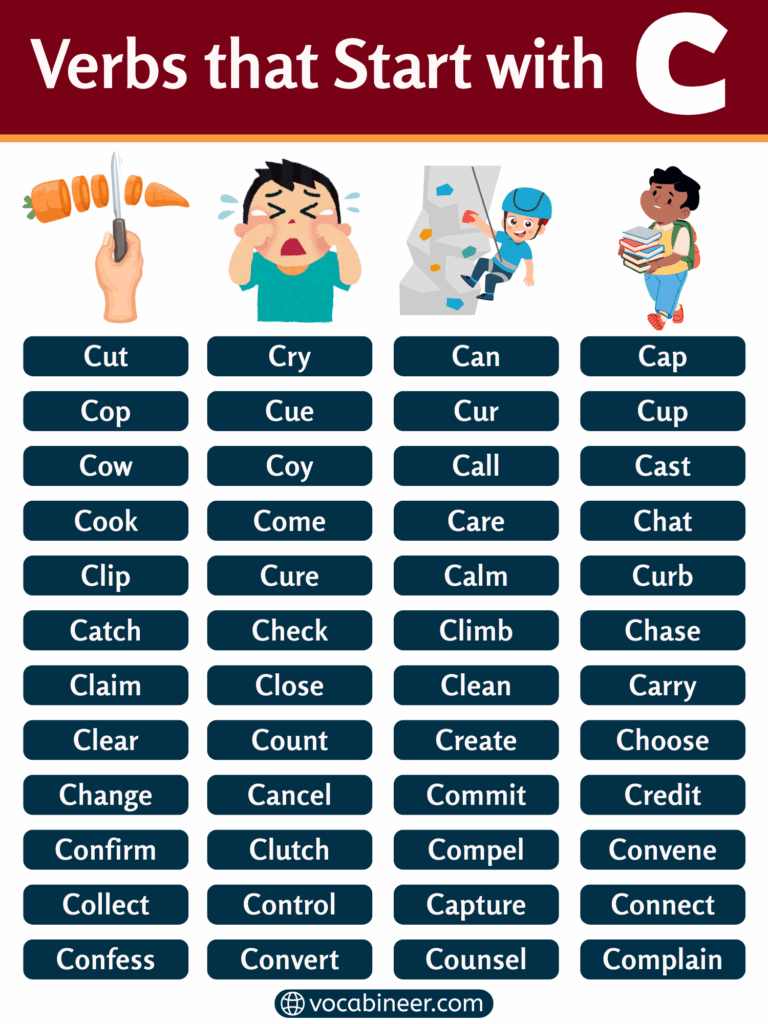
Verbs that begin with C are useful in daily English because they can describe actions, choices, movement, communication, and change. Some of these words are very common in simple speaking and writing, while others are more useful in formal, academic, or descriptive English.
In this article, you’ll find a clear list of verbs that start with C with meanings and examples. You’ll also explore common C verbs, action verbs starting with C, positive verbs, and more, so the article stays easy to scan and simple to use.
In This Page
Common Verbs That Begin With C
This section includes common verbs that begin with C. These C verbs are useful because they appear often in everyday English.
- Call: to speak to someone or phone someone
- Carry: to hold and take something
- Catch: to stop and hold something moving
- Change: to make or become different
- Choose: to pick one thing from others
- Clean: to make something tidy
- Climb: to go upward
- Close: to shut something
- Come: to move toward a place
- Cook: to prepare food
- Copy: to make something like another thing
- Count: to say numbers in order
- Create: to make something new
- Cry: to weep
- Cut: to divide with something sharp
- Care: to feel concern for someone or something
- Cancel: to stop something from happening
- Check: to look at something carefully
- Cheer: to shout with happiness or support
- Collect: to gather things together
- Compare: to look at similarities and differences
- Complete: to finish something
- Continue: to keep going
- Control: to direct or manage something
- Cover: to put something over another thing
- Crack: to break slightly
- Crash: to hit hard
- Crawl: to move on hands and knees
- Cross: to go from one side to another
- Cure: to make someone or something better
- Camp: to stay in a tent
- Care for: to look after someone or something
- Charge: to ask a price or rush forward
- Chat: to talk in a friendly way
- Clap: to hit hands together
- Clear: to remove things or make easy to understand
- Click: to press a button or make a short sound
- Comb: to smooth hair
- Connect: to join together
- Consider: to think about carefully
Action Verbs Starting With C
Action verbs starting with C show what someone or something does. These verbs are helpful because they describe clear actions in simple and direct English.
- Call: to speak to someone or phone someone
- Camp: to stay in a tent
- Carry: to hold and take something
- Carve: to cut into shape
- Catch: to stop and hold something moving
- Celebrate: to do something special for an event
- Change: to make or become different
- Charge: to rush forward or ask a price
- Chase: to run after someone or something
- Chat: to talk in a friendly way
- Check: to look at something carefully
- Cheer: to shout with support or joy
- Chew: to crush food with the teeth
- Choose: to pick one thing from others
- Chop: to cut into pieces
- Clap: to hit hands together
- Clean: to make something tidy
- Clear: to remove things away
- Climb: to go upward
- Clip: to cut or fasten
- Close: to shut something
- Collect: to gather things together
- Comb: to smooth hair
- Come: to move toward a place
- Compare: to look at similarities and differences
- Complete: to finish something
- Connect: to join together
- Continue: to keep going
- Cook: to prepare food
- Copy: to make something like another thing
- Count: to say numbers in order
- Cover: to put something over another thing
- Crack: to break slightly
- Crash: to hit hard
- Crawl: to move on hands and knees
- Create: to make something new
- Cross: to go from one side to another
- Cry: to weep
- Cut: to divide with something sharp
- Cycle: to ride a bicycle
Positive Verbs That Start With C
Positive verbs that start with C are useful when you want to show growth, kindness, success, support, or improvement. These verbs work well in writing, speaking, and daily English.
- Care: to show concern or kindness
- Celebrate: to enjoy a happy event
- Cheer: to support with joy
- Cherish: to love deeply
- Choose: to make a good decision
- Clarify: to make something easier to understand
- Clean: to make tidy
- Comfort: to make someone feel better
- Commend: to praise
- Communicate: to share ideas clearly
- Compare: to understand by looking at differences and similarities
- Complete: to finish successfully
- Compliment: to say something nice
- Connect: to join or build a relationship
- Contribute: to give help or support
- Cooperate: to work well with others
- Correct: to make something right
- Create: to make something new
- Care for: to look after kindly
- Cultivate: to grow or develop something
- Coach: to guide and help improve
- Confirm: to make something certain
- Console: to comfort someone
- Convince: to help someone believe something
- Crown: to honor or reward
C Verbs for Everyday English
These C verbs are useful in daily speaking and writing. They are simple, practical, and easy to use in common sentences.
- Call: to speak to someone or phone someone
- Carry: to hold and take something
- Catch: to stop and hold something moving
- Change: to make or become different
- Choose: to pick one thing from others
- Clean: to make something tidy
- Climb: to go upward
- Close: to shut something
- Come: to move toward a place
- Cook: to prepare food
- Copy: to make something like another thing
- Count: to say numbers in order
- Create: to make something new
- Cry: to weep
- Cut: to divide with something sharp
- Care: to feel concern
- Cancel: to stop something
- Check: to look at something carefully
- Collect: to gather things
- Compare: to look at differences and similarities
- Complete: to finish something
- Continue: to keep going
- Control: to direct or manage
- Cover: to put something over another thing
- Camp: to stay in a tent
- Charge: to ask a price or rush forward
- Chat: to talk in a friendly way
- Cheer: to shout with support
- Clear: to remove things or make easy to understand
- Connect: to join together
Easy Verbs That Start With C for Kids and Beginners
These C verbs are simple and easy to learn. They are useful for kids, students, and beginners because the meanings are clear and easy to remember.
- Call: to speak to someone
- Carry: to hold and take something
- Catch: to stop and hold
- Clap: to hit hands together
- Clean: to make tidy
- Climb: to go upward
- Close: to shut
- Come: to move toward
- Cook: to prepare food
- Count: to say numbers in order
- Crawl: to move on hands and knees
- Cry: to weep
- Cut: to divide with something sharp
- Camp: to stay in a tent
- Care: to look after or feel concern
- Check: to look at carefully
- Cheer: to shout with joy
- Chew: to crush food with the teeth
- Choose: to pick one
- Color: to fill with color
Phrasal Verbs That Start With C
Phrasal verbs that start with C are verb phrases made with a main verb and another word. They are common in daily English and often appear in speaking.
- Call back: to return a phone call
- Call for: to need or require
- Call off: to cancel something
- Call on: to visit or ask someone to speak
- Call out: to shout or speak loudly
- Call up: to phone someone
- Carry on: to continue
- Carry out: to complete or perform
- Catch on: to become popular or understand
- Catch up: to reach the same level or speed
- Check in: to arrive and register
- Check out: to leave a place or examine something
- Cheer up: to become happier
- Clear away: to remove things
- Clear out: to empty or leave a place
- Come across: to find by chance
- Come along: to arrive or improve
- Come back: to return
- Come from: to have an origin
- Come in: to enter
- Come off: to happen successfully or become detached
- Come on: to begin or encourage someone
- Come out: to become known or available
- Come over: to visit someone’s home
- Come through: to succeed or survive
- Come up: to arise or happen
- Cut back: to reduce
- Cut down: to reduce or chop
- Cut off: to remove or stop
- Cut out: to remove by cutting or stop doing
Complete List of Verbs That Start With C
This section includes a longer list of verbs that start with C. These C verbs are useful for building vocabulary and making the article more complete.
- Cab
- Cage
- Calculate
- Call
- Calm
- Camp
- Cancel
- Capture
- Care
- Carry
- Carve
- Cast
- Catch
- Cause
- Celebrate
- Challenge
- Change
- Charge
- Chase
- Chat
- Check
- Cheer
- Cherish
- Chew
- Choose
- Chop
- Claim
- Clap
- Clarify
- Clean
- Clear
- Climb
- Clip
- Close
- Coach
- Collect
- Color
- Comb
- Come
- Comfort
- Command
- Comment
- Communicate
- Compare
- Compete
- Complain
- Complete
- Concentrate
- Concern
- Confess
- Confuse
- Connect
- Consider
- Consist
- Contain
- Continue
- Control
- Cook
- Cool
- Copy
- Correct
- Cough
- Count
- Cover
- Crack
- Crash
- Crawl
- Create
- Creep
- Cross
- Cry
- Cure
- Curl
- Curve
- Cut
- Cycle
FAQs
Verbs that start with C are verbs that begin with the letter C. These words can show an action, a state, or something that happens. Examples include call, carry, catch, choose, and create.
Some common verbs that start with C are call, carry, catch, change, choose, clean, close, come, cook, and create. These verbs appear often in daily English, so they are useful for speaking, writing, and vocabulary building.
No, not all verbs that start with C are action verbs. Many C verbs show clear actions, such as carry, climb, and cut, while others can be used in different ways depending on the sentence and meaning.
Some positive verbs that start with C are care, celebrate, cherish, clarify, comfort, compliment, connect, contribute, cooperate, and create. These verbs often show support, improvement, kindness, or success.
You can learn them by starting with the most common C verbs first. Then, read short lists, use them in simple sentences, and practice them often in speaking and writing. This helps you remember them more naturally.
Summary
Verbs that start with C are useful in daily English because they help describe actions, choices, movement, communication, and change. In this article, you explored common C verbs, action verbs starting with C, positive verbs, everyday verbs, easy verbs for beginners, phrasal verbs, and a complete list of verbs that start with C.
Learning these C verbs step by step can help you grow your vocabulary and use English more clearly in speaking and writing.
Read More