

Verbs that begin with E are useful in daily English because they can describe actions, feelings, movement, effort, and change. Some of these words are common in simple speaking and writing, while others are more useful in formal, academic, or descriptive English.
In this article, you’ll find a clear list of verbs that start with E with meanings and examples. You’ll also explore common E verbs, action verbs beginning with E, positive verbs, and more, so the article stays easy to scan and simple to use.
In This Page
Common Verbs That Begin With E
This section includes common verbs that begin with E. These E verbs are useful because they appear often in everyday English.
- Eat: to take in food
- Earn: to get money for work
- Edit: to make changes to improve something
- Educate: to teach
- Encourage: to give support or confidence
- End: to stop
- Enjoy: to like something or take pleasure in it
- Enter: to go into a place
- Escape: to get free
- Examine: to look at carefully
- Excite: to make someone feel eager or happy
- Exercise: to move the body for health
- Exist: to be real
- Expand: to become larger
- Expect: to think something will happen
- Explain: to make something clear
- Explore: to travel around or study something
- Express: to show a thought or feeling
- Extend: to make longer or larger
- Estimate: to guess the size, cost, or amount
- Establish: to set up something
- Exchange: to give one thing and get another
- Exclude: to leave out
- Excuse: to forgive or allow someone to leave
- Execute: to carry out a plan
- Eliminate: to remove completely
- Elect: to choose by voting
- Employ: to give someone a job
- Empty: to remove what is inside
- Enable: to make something possible
- Enclose: to close in on all sides
- Encounter: to meet unexpectedly
- Endure: to suffer or continue through difficulty
- Engage: to take part in something
- Enrich: to improve the quality of something
- Ensure: to make certain
- Entertain: to amuse or interest
- Envy: to want what someone else has
- Evolve: to develop slowly
- Evaluate: to judge the value or quality of something
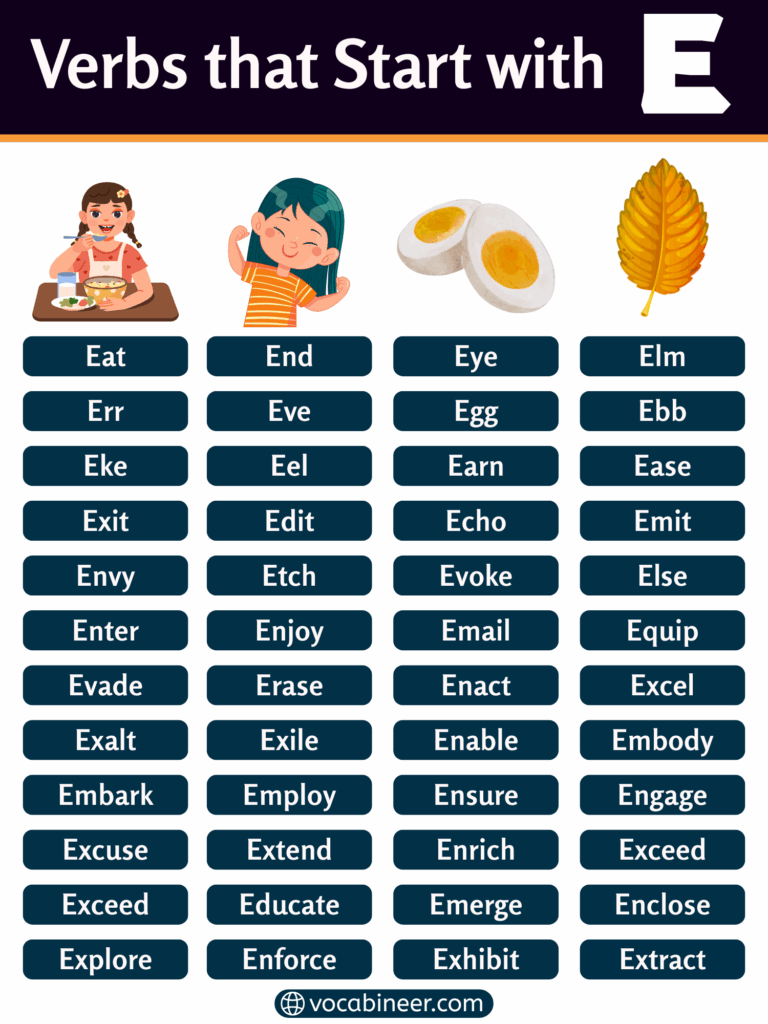
Action Verbs Beginning With E
Action verbs beginning with E show what someone or something does. These verbs are useful because they describe clear actions in simple and direct English.
- Earn: to get money for work
- Eat: to take in food
- Edit: to make changes to improve something
- Educate: to teach
- Encourage: to give support or confidence
- End: to stop
- Enter: to go into a place
- Escape: to get free
- Examine: to look at carefully
- Excite: to make someone feel eager or happy
- Exercise: to move the body for health
- Expand: to become larger
- Expect: to think something will happen
- Explain: to make something clear
- Explore: to travel around or study something
- Express: to show a thought or feeling
- Extend: to make longer or larger
- Estimate: to guess the size, cost, or amount
- Establish: to set up something
- Exchange: to give one thing and get another
- Exclude: to leave out
- Excuse: to forgive or allow someone to leave
- Execute: to carry out a plan
- Eliminate: to remove completely
- Elect: to choose by voting
- Employ: to give someone a job
- Empty: to remove what is inside
- Enable: to make something possible
- Enclose: to close in on all sides
- Encounter: to meet unexpectedly
- Endure: to continue through difficulty
- Engage: to take part in something
- Enrich: to improve the quality of something
- Ensure: to make certain
- Entertain: to amuse or interest
- Erase: to remove writing or marks
- Erupt: to burst out
- Escort: to go with someone for protection or guidance
- Evacuate: to move people from danger
- Evoke: to bring a feeling or memory to mind
Positive Verbs That Start With E
Positive verbs that start with E are useful when you want to show growth, support, kindness, success, or improvement. These verbs work well in writing, speaking, and daily English.
- Encourage: to give support or confidence
- Educate: to teach and improve knowledge
- Enable: to make something possible
- Enrich: to improve the quality of something
- Entertain: to amuse or interest
- Enjoy: to take pleasure in something
- Establish: to set up something successfully
- Engage: to take part with interest
- Elevate: to raise or improve
- Empower: to make someone stronger or more confident
- Embrace: to accept gladly
- Enhance: to improve or increase quality
- Endorse: to support publicly
- Ease: to make something less difficult
- Excite: to create happy interest
- Excel: to do very well
- Expand: to grow larger
- Express: to show thoughts or feelings clearly
- Extend: to offer or make longer
- Encourage on: to support someone forward
- Equip: to provide what is needed
- Enlighten: to give understanding
- Esteem: to respect highly
- Exalt: to raise in praise or honor
- Exemplify: to be a good example of
E Verbs for Everyday English
These E verbs are useful in daily speaking and writing. They are simple, practical, and easy to use in common sentences.
- Eat: to take in food
- Earn: to get money for work
- Edit: to make changes
- End: to stop
- Enjoy: to like something
- Enter: to go into a place
- Escape: to get free
- Examine: to look at carefully
- Excuse: to forgive or allow someone to leave
- Exercise: to move the body for health
- Exist: to be real
- Expect: to think something will happen
- Explain: to make something clear
- Explore: to travel around or study something
- Express: to show a thought or feeling
- Extend: to make longer or larger
- Exchange: to give one thing and get another
- Empty: to remove what is inside
- Encounter: to meet unexpectedly
- Endure: to continue through difficulty
- Engage: to take part in something
- Ensure: to make certain
- Entertain: to amuse or interest
- Envy: to want what someone else has
- Evolve: to develop slowly
- Evaluate: to judge quality or value
- Erase: to remove marks
- Escort: to go with someone
- Email: to send a message electronically
- Exit: to go out
Easy Verbs Starting With E for Kids and Beginners
These E verbs are simple and easy to learn. They are useful for kids, students, and beginners because the meanings are clear and easy to remember.
- Eat: to take in food
- End: to stop
- Enter: to go into a place
- Enjoy: to like something
- Excuse: to forgive or allow
- Exercise: to move the body for health
- Exist: to be real
- Expect: to think something will happen
- Explain: to make something clear
- Explore: to look around and learn
- Express: to show a thought or feeling
- Extend: to make longer
- Empty: to remove what is inside
- Erase: to remove marks
- Escape: to get free
- Email: to send a message electronically
- Exit: to go out
- Echo: to repeat a sound
- Entertain: to amuse
- Encourage: to give support
Phrasal Verbs That Begin With E
Phrasal verbs that begin with E are verb phrases made with a main verb and another word. They are common in daily English and often appear in speaking.
- Eat out: to eat at a restaurant
- Eat up: to finish all the food
- Edge out: to defeat by a small amount
- End up: to finally be in a place or situation
- Enter into: to begin or take part in
- Eke out: to manage with difficulty
- Embark on: to begin something new
- Empty out: to remove everything from inside
- Ease off: to become less strong
- Ease up: to relax or reduce pressure
- Eye up: to look at closely or with interest
Complete List of Verbs That Start With E
This section includes a longer list of verbs that start with E. These E verbs are useful for building vocabulary and making the article more complete.
- Eager
- Earn
- Ease
- Eat
- Echo
- Edit
- Educate
- Effect
- Eliminate
- Embark
- Embarrass
- Embrace
- Emerge
- Emit
- Emphasize
- Employ
- Empower
- Empty
- Enable
- Enact
- Enclose
- Encounter
- Encourage
- End
- Endorse
- Endure
- Engage
- Engineer
- Enhance
- Enjoy
- Enlarge
- Enlist
- Enrich
- Enroll
- Ensure
- Enter
- Entertain
- Enthuse
- Entitle
- Envelop
- Envision
- Equal
- Equip
- Erase
- Erect
- Erode
- Escape
- Escort
- Establish
- Estimate
- Evaluate
- Evaporate
- Even
- Evoke
- Evolve
- Exaggerate
- Examine
- Excel
- Exchange
- Excite
- Exclaim
- Exclude
- Excuse
- Execute
- Exercise
- Exhibit
- Exist
- Expand
- Expect
- Explain
- Explode
- Explore
- Export
- Express
- Extend
- Extract
- Eye
FAQs
Verbs that start with E are verbs that begin with the letter E. These words can show an action, a state, or something that happens. Examples include eat, enjoy, enter, explain, and explore.
Some common verbs that start with E are eat, earn, edit, end, enjoy, enter, escape, explain, explore, and express. These verbs appear often in daily English, so they are useful for speaking, writing, and vocabulary building.
No, not all verbs that start with E are action verbs. Many E verbs show clear actions, such as eat, enter, and explain, while others can be used in different ways depending on the sentence and meaning.
Some positive verbs that start with E are encourage, educate, enable, enrich, entertain, empower, enhance, and excel. These verbs often show support, growth, improvement, or success.
You can learn them by starting with the most common E verbs first. Then, read short lists, use them in simple sentences, and practice them often in speaking and writing. This helps you remember them more naturally.
Summary
Verbs that start with E are useful in daily English because they help describe actions, feelings, movement, effort, and change. In this article, you explored common E verbs, action verbs beginning with E, positive verbs, everyday verbs, easy verbs for beginners, phrasal verbs, and a complete list of verbs that start with E.
Learning these E verbs step by step can help you grow your vocabulary and use English more clearly in speaking and writing.
Read More
