Verbs that start with A are useful in daily English because they can describe actions, feelings, decisions, and changes. Some of them are very common in speaking and writing, while others are more useful in school, work, or formal English.
In this article, you’ll find a clear list of verbs that start with A with meanings and examples. You’ll also explore common A verbs, action verbs, positive verbs, and more, so the list stays easy to scan and simple to use.
In This Page
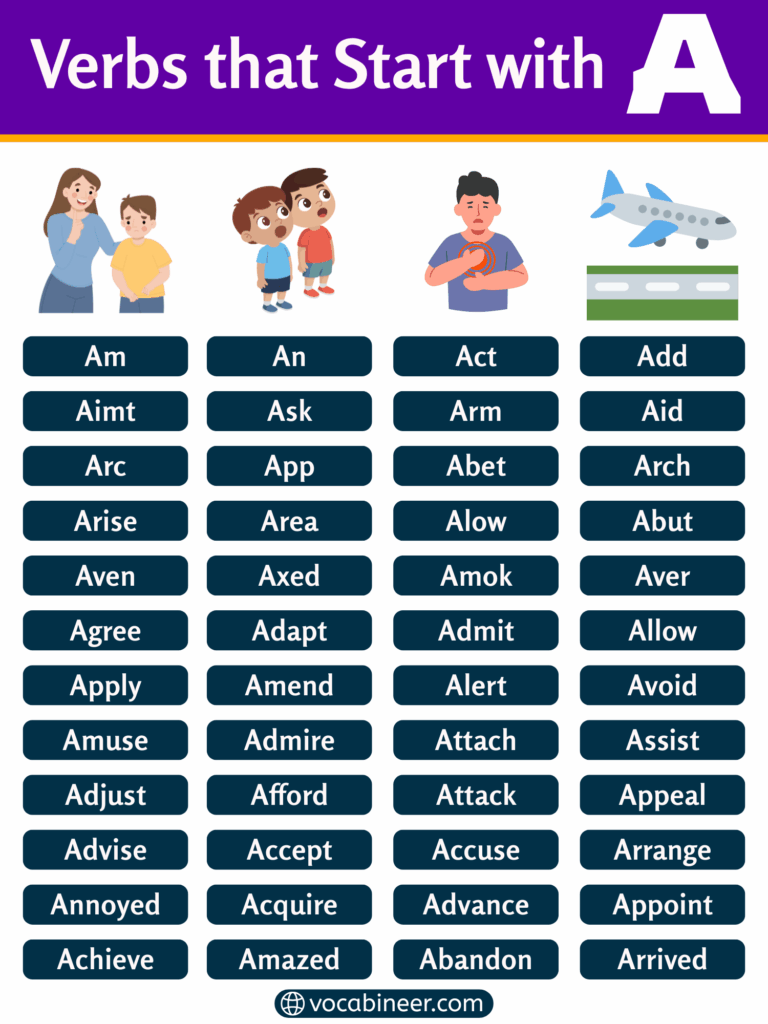
List of Common Verbs That Start With A
This section includes common verbs that start with A. These verbs are useful because they appear often in daily English.
- Accept: to receive or agree to take something
- Achieve: to reach a goal
- Act: to do something
- Add: to put something with another thing
- Admire: to respect or like someone or something
- Admit: to agree that something is true
- Adopt: to take something as your own
- Advise: to give guidance
- Afford: to have enough money for something
- Agree: to have the same opinion
- Allow: to let something happen
- Answer: to reply to a question
- Appear: to come into view
- Apply: to put to use or ask for something
- Approve: to say yes to something officially
- Argue: to speak with disagreement
- Arrange: to put in order
- Arrive: to reach a place
- Ask: to say something to get an answer
- Attack: to try to hurt
- Attempt: to try
- Avoid: to stay away from something
- Awake: to stop sleeping
- Announce: to tell people something publicly
- Assist: to help someone
- Acknowledge: to accept that something is true
- Amuse: to make someone laugh or smile
- Adapt: to change to fit a new situation
- Acquire: to get something
- Ascend: to go up
- Attach: to join one thing to another
- Attract: to draw attention
- Authorize: to give permission
- Appreciate: to value something
- Assume: to think something is true
- Assure: to make someone feel certain
- Advance: to move forward
- Activate: to make something start working
- Anticipate: to expect something
- Analyze: to study something carefully
Action Verbs That Start With A
Action verbs that start with A show what someone or something does. These verbs are useful because they describe clear actions in simple and direct English.
- Accept: to receive something
- Achieve: to reach a goal
- Act: to do something
- Add: to put something in
- Adjust: to change a little
- Admire: to look at with respect or pleasure
- Admit: to agree that something is true
- Adopt: to take as your own
- Advance: to move forward
- Advise: to give guidance
- Affirm: to state strongly that something is true
- Agree: to say yes or have the same opinion
- Alert: to warn someone
- Allow: to let something happen
- Alter: to change
- Amuse: to make someone laugh or smile
- Analyze: to study carefully
- Answer: to reply
- Announce: to make something known
- Anticipate: to expect
- Apologize: to say sorry
- Appeal: to ask strongly or attract interest
- Appear: to come into view
- Applaud: to clap to show approval
- Apply: to ask for or put to use
- Appoint: to choose for a job or role
- Appreciate: to value highly
- Approach: to move closer
- Approve: to accept or support
- Argue: to speak with disagreement
- Arrange: to put in order
- Arrest: to catch by law
- Arrive: to reach a place
- Ascend: to go up
- Ask: to say something to get an answer
- Assemble: to bring together
- Assist: to help
- Assure: to make someone feel certain
- Attach: to join one thing to another
- Attack: to try to hurt
- Attempt: to try
- Attend: to go to or be present
- Attract: to draw attention
- Avoid: to stay away from
- Awaken: to wake up
- Award: to give a prize
Positive Verbs That Start With A
Positive verbs that start with A are useful when you want to show helpful, kind, or successful actions. These verbs work well in writing, speaking, and everyday English.
- Accept: to receive kindly
- Achieve: to reach success
- Admire: to respect or like deeply
- Adore: to love very much
- Advance: to move ahead
- Advise: to guide helpfully
- Affirm: to support or confirm positively
- Aid: to help
- Allow: to let something happen
- Amuse: to make someone happy
- Applaud: to show praise
- Appreciate: to value something
- Approve: to agree with or support
- Assist: to help
- Assure: to give confidence
- Attract: to draw in positively
- Award: to give as praise or honor
- Acclaim: to praise openly
- Accommodate: to provide help or space
- Accredit: to give official approval
- Acknowledge: to recognize properly
- Activate: to make something start working
- Adapt: to adjust well
- Add: to include something useful
- Advocate: to support publicly
- Aggrandize: to increase in power or importance
- Align: to bring into agreement
- Amplify: to increase strength or effect
- Animate: to bring to life or energy
- Ascend: to rise higher
Verbs That Start With A for Everyday English
These A verbs are useful in daily speaking and writing. They are simple, practical, and easy to use in common sentences.
- Accept: to say yes to something
- Add: to put one thing with another
- Agree: to have the same opinion
- Allow: to let something happen
- Answer: to reply to a question
- Appear: to come into view
- Apply: to ask for something
- Arrive: to reach a place
- Ask: to say something to get an answer
- Avoid: to stay away from something
- Act: to do something
- Admit: to agree that something is true
- Advise: to give guidance
- Afford: to have enough money for something
- Announce: to tell people something
- Arrange: to put in order
- Assist: to help
- Attach: to join one thing to another
- Attempt: to try
- Attend: to go to something
- Attract: to draw attention
- Analyze: to study carefully
- Adapt: to change to fit
- Acknowledge: to accept or recognize
- Amuse: to make someone smile
- Approve: to say yes to something
- Apologize: to say sorry
- Approach: to move closer
- Assume: to think something is true
- Assure: to make someone feel certain
Easy Verbs That Start With A for Kids and Beginners
These A verbs are simple and easy to learn. They are useful for kids, students, and beginners because the meanings are clear and easy to remember.
- Act: to do something
- Add: to put one thing with another
- Ask: to say something to get an answer
- Allow: to let something happen
- Answer: to reply
- Arrive: to reach a place
- Agree: to have the same opinion
- Accept: to receive or say yes
- Admire: to like or respect
- Appear: to come into view
- Apply: to ask for something
- Assist: to help
- Attack: to try to hurt
- Avoid: to stay away from
- Awake: to stop sleeping
Phrasal Verbs That Start With A
Phrasal verbs that start with A are verb phrases made with a main verb and another word. They are useful in daily English and often appear in speaking.
- Act as: to perform the role of
- Act on: to take action because of something
- Act out: to express through actions
- Act up: to behave badly or not work properly
- Add in: to include something extra
- Add on: to include as an extra part
- Add up: to make sense or come to a total
- Aim at: to point toward or try to achieve
- Ask about: to ask for information about something
- Ask after: to ask about someone’s health
- Ask around: to ask many people
- Ask for: to request something
- Ask out: to invite someone on a date
- Ask over: to invite someone to your home
- Answer back: to reply rudely
Complete List of Verbs That Start With A
This section includes a larger list of verbs that start with A. It helps make the article more complete and gives you more A verbs to learn and use.
- Abandon
- Abase
- Abash
- Abate
- Abbreviate
- Abdicate
- Abduct
- Aberrate
- Abet
- Abhor
- Abide
- Abjure
- Ablaze
- Abolish
- Abort
- Abound
- Abrade
- Absorb
- Abstain
- Abstract
- Abuse
- Accelerate
- Accent
- Accept
- Access
- Acclaim
- Acclimate
- Accommodate
- Accompany
- Accomplish
- Accord
- Account
- Accredit
- Accumulate
- Accuse
- Ace
- Ache
- Achieve
- Acknowledge
- Acquire
- Act
- Activate
- Adapt
- Add
- Address
- Adhere
- Adjoin
- Adjourn
- Adjust
- Administer
- Admire
- Admit
- Admonish
- Adopt
- Adore
- Adorn
- Advance
- Advertise
- Advise
- Advocate
- Aerate
- Affect
- Affirm
- Affix
- Afflict
- Afford
- Age
- Aggravate
- Aggregate
- Agitate
- Agonize
- Agree
- Aid
- Aim
- Air
- Alarm
- Alert
- Alienate
- Align
- Allege
- Alleviate
- Allocate
- Allot
- Allow
- Alloy
- Allude
- Ally
- Alter
- Alternate
- Amaze
- Ambush
- Amend
- Amuse
- Analyze
- Anchor
- Anger
- Angle
- Animate
- Announce
- Annoy
- Annul
- Answer
- Anticipate
- Apologize
- Appeal
- Appear
- Applaud
- Apply
- Appoint
- Appreciate
- Apprehend
- Approach
- Approve
- Arbitrate
- Argue
- Arise
- Arm
- Arouse
- Arrange
- Arrest
- Arrive
- Ascend
- Ascertain
- Ask
- Assemble
- Assert
- Assess
- Assign
- Assimilate
- Assist
- Associate
- Assume
- Assure
- Astonish
- Attach
- Attack
- Attain
- Attempt
- Attend
- Attract
- Audit
- Augment
- Authorize
- Automate
- Avail
- Avenge
- Average
- Avoid
- Await
- Awaken
- Award
- Awe
- Ax
- Axe
FAQs
Verbs that start with A are verbs that begin with the letter A. These words show an action, a state, or something that happens, such as accept, act, ask, arrive, and agree.
Some of the most common verbs that start with A are accept, act, add, admit, agree, allow, answer, apply, arrive, and ask. These verbs are used often in daily speaking and writing.
No, not all of them are action verbs. Some A verbs show clear actions, like ask and arrive, while others can show a state or meaning in a different way, depending on the sentence.
Some positive verbs that start with A are accept, achieve, admire, adore, affirm, aid, appreciate, and assist. These verbs often show helpful, kind, or successful actions.
You can learn them by starting with the most common A verbs first, then reading short lists and using the verbs in simple sentences. It also helps to practice them again and again in speaking, reading, and writing.
Summary
Verbs that start with A are useful in daily English because they help describe actions, states, and ideas. In this article, you explored common A verbs, action verbs, positive verbs, everyday verbs, easy verbs for beginners, phrasal verbs, and a complete list of verbs that start with A.
By learning these verbs step by step, you can improve your vocabulary and use English more clearly in speaking and writing.
Read More