
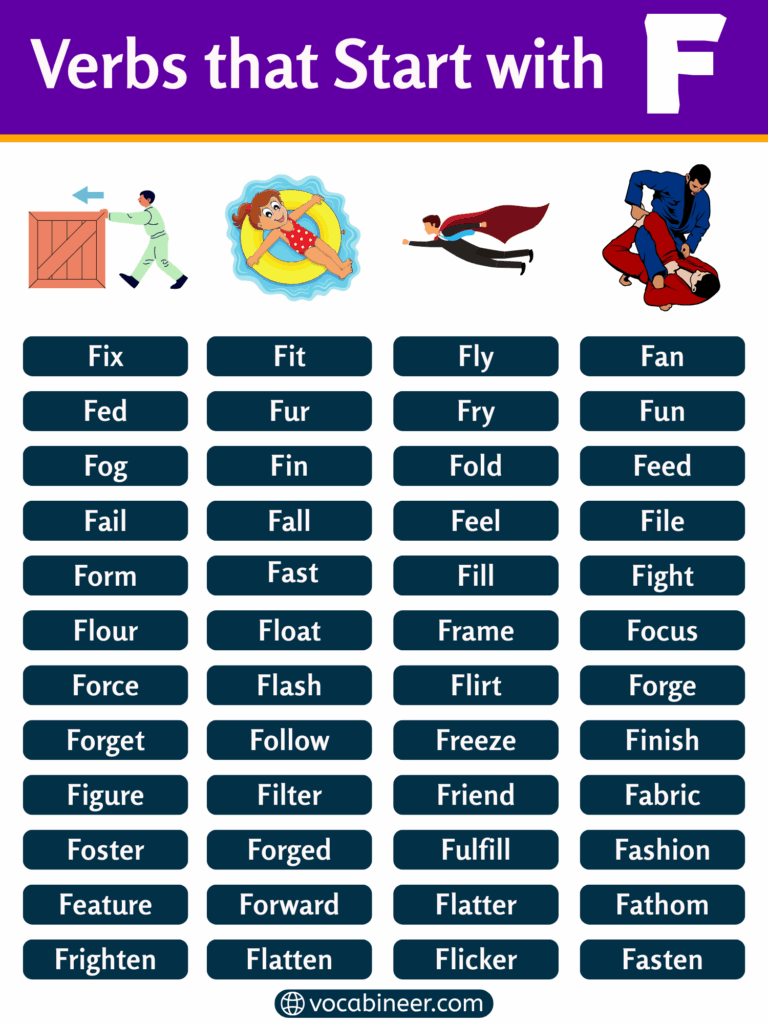
Verbs that start with F are useful in daily English because they can describe actions, feelings, movement, communication, and change. Some of these words are common in simple speaking and writing, while others are more useful in formal, academic, or descriptive English.
In this article, you’ll find a clear list of verbs that start with F with meanings and examples. You’ll also explore common F verbs, action verbs beginning with F, positive verbs, and more, so the article stays easy to scan and simple to use.
In This Page
Common Verbs That Begin With F
This section includes common verbs that begin with F. These F verbs are useful because they appear often in everyday English.
- Face: to look toward or deal with something
- Fade: to lose color, strength, or brightness
- Fail: to not succeed
- Fall: to move downward
- Fasten: to close or attach firmly
- Favor: to support or prefer
- Fear: to feel afraid
- Feed: to give food
- Feel: to sense or experience
- Fight: to use force against someone or something
- Fill: to make full
- Film: to record with a camera
- Find: to discover something
- Finish: to complete something
- Fix: to repair something
- Flash: to shine suddenly
- Float: to stay on water or in air
- Flood: to cover with water
- Flow: to move smoothly
- Fly: to move through the air
- Fold: to bend something over
- Follow: to go behind someone or something
- Force: to make someone do something
- Forecast: to predict
- Forget: to fail to remember
- Forgive: to stop feeling angry
- Form: to make or shape
- Found: to start something officially
- Freeze: to become ice or very cold
- Fry: to cook in hot oil
- Fetch: to go and bring something back
- Focus: to give attention to something
- Function: to work or operate
- Frame: to shape or build around
- Furnish: to provide furniture or equipment
- Frighten: to make someone feel afraid
- Freckle: to mark with small spots
- Freshen: to make fresh again
- Fumble: to handle something in an awkward way
- Fuel: to supply energy or fuel
Action Verbs Beginning With F
Action verbs beginning with F show what someone or something does. These verbs are useful because they describe clear actions in simple and direct English.
- Face: to look toward or deal with something
- Fade: to lose color, strength, or brightness
- Fail: to not succeed
- Fall: to move downward
- Fasten: to close or attach firmly
- Favor: to support or prefer
- Fear: to feel afraid
- Feed: to give food
- Feel: to sense or experience
- Fight: to use force against someone or something
- Fill: to make full
- Film: to record with a camera
- Find: to discover something
- Finish: to complete something
- Fix: to repair something
- Flash: to shine suddenly
- Float: to stay on water or in air
- Flood: to cover with water
- Flow: to move smoothly
- Fly: to move through the air
- Fold: to bend something over
- Follow: to go behind someone or something
- Force: to make someone do something
- Forecast: to predict
- Forget: to fail to remember
- Forgive: to stop feeling angry
- Form: to make or shape
- Found: to start something officially
- Freeze: to become ice or very cold
- Fry: to cook in hot oil
- Fetch: to go and bring something back
- Focus: to give attention to something
- Frame: to shape or build around
- Frighten: to make someone feel afraid
- Freshen: to make fresh again
- Fumble: to handle something in an awkward way
- Fuel: to supply energy or fuel
- File: to arrange papers or smooth a surface
- Flip: to turn over quickly
- Fling: to throw with force
Positive Verbs That Start With F
Positive verbs that start with F are useful when you want to show growth, support, kindness, success, or improvement. These verbs work well in writing, speaking, and daily English.
- Favor: to support or prefer
- Feed: to give food and care
- Feel: to experience emotion or understanding
- Find: to discover something valuable
- Finish: to complete successfully
- Fix: to repair or make better
- Follow: to go after or stay guided by something
- Forgive: to stop feeling angry
- Form: to create or shape
- Found: to start something important
- Focus: to give full attention
- Freshen: to make fresh again
- Fuel: to support with energy or strength
- Foster: to encourage growth
- Free: to release from control
- Fulfill: to complete or achieve
- Flourish: to grow well
- Facilitate: to make something easier
- Fortify: to strengthen
- Friend: to add or treat as a friend
- Feature: to highlight something important
- Flower: to bloom or develop beautifully
- Fashion: to shape or create
- Forward: to send ahead
- Fast-track: to make progress more quickly
F Verbs for Everyday English
These F verbs are useful in daily speaking and writing. They are simple, practical, and easy to use in common sentences.
- Face: to deal with something
- Fail: to not succeed
- Fall: to move downward
- Fasten: to close firmly
- Fear: to feel afraid
- Feed: to give food
- Feel: to sense or experience
- Fight: to use force against
- Fill: to make full
- Find: to discover something
- Finish: to complete something
- Fix: to repair something
- Float: to stay on water or in air
- Fly: to move through the air
- Fold: to bend over
- Follow: to go behind
- Forget: to fail to remember
- Forgive: to stop feeling angry
- Form: to make or shape
- Freeze: to become very cold
- Fry: to cook in hot oil
- Fetch: to go and bring back
- Focus: to give attention
- Frame: to build around or shape
- Fumble: to handle awkwardly
- Fuel: to supply energy
- File: to arrange papers
- Flip: to turn over quickly
- Fling: to throw forcefully
- Function: to work or operate
Easy Verbs Starting With F for Kids and Beginners
These F verbs are simple and easy to learn. They are useful for kids, students, and beginners because the meanings are clear and easy to remember.
- Fall: to move downward
- Feed: to give food
- Feel: to sense or experience
- Fight: to use force against
- Fill: to make full
- Find: to discover something
- Finish: to complete something
- Fix: to repair something
- Flash: to shine suddenly
- Float: to stay on water or in air
- Fly: to move through the air
- Fold: to bend over
- Follow: to go behind
- Freeze: to become very cold
- Fry: to cook in hot oil
- Fetch: to go and bring back
- Flip: to turn over quickly
- Fling: to throw with force
- Face: to deal with something
- File: to arrange papers or smooth a surface
Phrasal Verbs That Begin With F
Phrasal verbs that begin with F are verb phrases made with a main verb and another word. They are common in daily English and often appear in speaking.
- Face up to: to accept and deal with something difficult
- Fall apart: to break into pieces or stop working well
- Fall behind: to fail to stay at the same level
- Fall for: to believe something or fall in love
- Fall off: to drop from something
- Fall out: to argue and stop being friendly
- Figure out: to understand or solve something
- Fill in: to complete information in a form
- Fill out: to write all the needed information
- Fill up: to make something completely full
- Find out: to discover information
- Finish off: to complete the last part of something
- Finish up: to end something
- Follow up: to do something more after the first step
- Fork out: to pay money unwillingly
- Freak out: to become very upset or excited
- Freeze up: to stop working or become unable to move
- Freshen up: to wash and make yourself feel clean
- Fend off: to defend yourself from something
- Fish out: to pull something out with effort
Complete List of Verbs That Start With F
This section includes a longer list of verbs that start with F. These F verbs are useful for building vocabulary and making the article more complete.
- Face
- Fade
- Fail
- Fall
- Fasten
- Favor
- Fear
- Feed
- Feel
- Fight
- Fill
- Film
- Find
- Finish
- Fix
- Flash
- Float
- Flood
- Flow
- Fly
- Fold
- Follow
- Force
- Forecast
- Forget
- Forgive
- Form
- Found
- Freeze
- Fry
- Fetch
- Focus
- Function
- Frame
- Furnish
- Frighten
- Freckle
- Freshen
- Fumble
- Fuel
- Fabricate
- Facilitate
- Fade
- Faint
- Fake
- Familiarize
- Fancy
- Farm
- Fascinate
- Fashion
- Fast-track
- Fault
- Favor
- Feature
- Fence
- Ferment
- Fertilize
- Festoon
- Fester
- Fictionalize
- File
- Filter
- Finance
- Fine
- Finger
- Fire
- Fish
- Fit
- Flap
- Flare
- Flatten
- Flavor
- Flee
- Flick
- Flip
- Fling
- Float
- Flourish
- Fluctuate
- Flush
- Flutter
- Foil
- Fool
- Foot
- Forbid
- Force-feed
- Foresee
- Forge
- Formalize
- Fortify
- Foster
- Foul
- Fractionalize
- Fracture
FAQs
Verbs that start with F are verbs that begin with the letter F. These words can show an action, a state, or something that happens. Examples include fall, feel, find, follow, and finish.
Some common verbs that start with F are face, fail, fall, feed, feel, fight, find, finish, fix, and follow. These verbs appear often in daily English, so they are useful for speaking, writing, and vocabulary building.
No, not all verbs that start with F are action verbs. Many F verbs show clear actions, such as feed, fight, and fix, while others can be used in different ways depending on the sentence and meaning.
Some positive verbs that start with F are favor, forgive, flourish, foster, fulfill, fortify, and facilitate. These verbs often show support, kindness, growth, or improvement.
You can learn them by starting with the most common F verbs first. Then, read short lists, use them in simple sentences, and practice them often in speaking and writing. This helps you remember them more naturally.
Summary
Verbs that start with F are useful in daily English because they help describe actions, feelings, movement, communication, and change. In this article, you explored common F verbs, action verbs beginning with F, positive verbs, everyday verbs, easy verbs for beginners, phrasal verbs, and a complete list of verbs that start with F.
Learning these F verbs step by step can help you grow your vocabulary and use English more clearly in speaking and writing.
Read More