

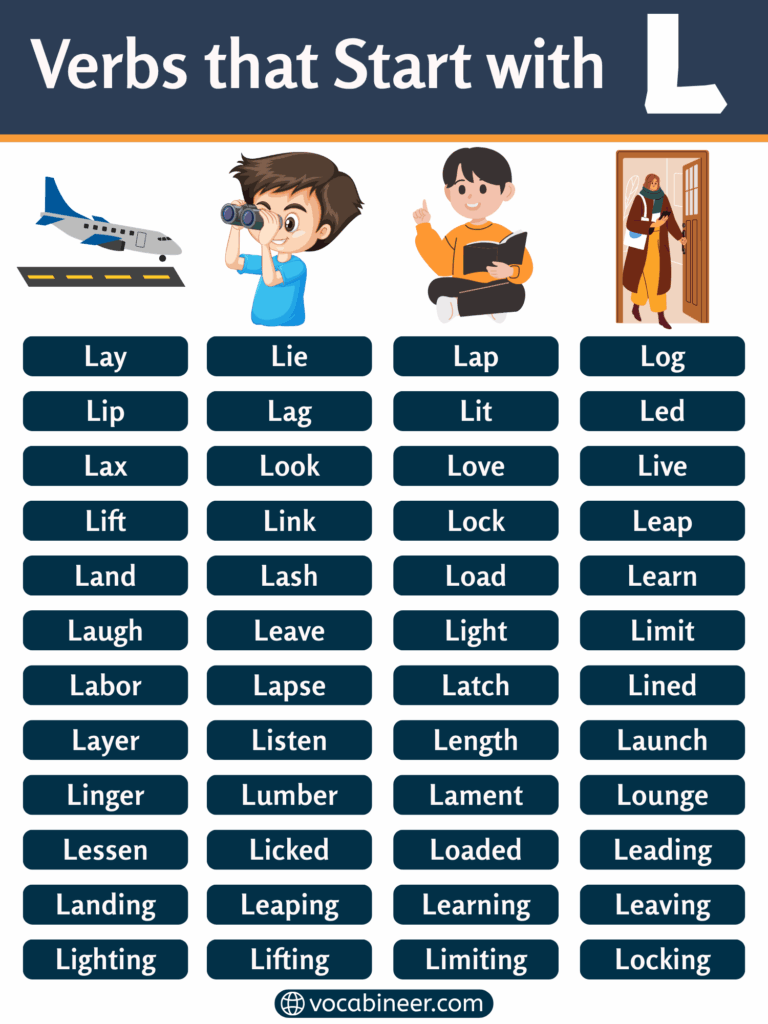
Verbs that start with L are useful in English because they can describe actions, feelings, movement, learning, and daily activities. Some of these words are very common in simple speaking and writing, while others are more useful in formal or descriptive English.
In this article, you’ll find a full list of verbs that start with L with meanings and examples. You’ll also explore common L verbs, action verbs, positive and useful verbs, everyday verbs, and more in a clear and easy-to-scan format.
In This Page
Most Common Verbs That Start With L
This section includes the most common verbs that start with L. These words are useful because they appear often in daily English and simple writing.
- Laugh: to make a happy sound
- Learn: to gain knowledge or skill
- Leave: to go away from a place
- Lend: to give something for a short time
- Let: to allow something
- Level: to make flat or even
- Lie: to rest in a flat position
- Lift: to raise something
- Light: to make bright or start burning
- Like: to enjoy or prefer
- Limit: to keep within bounds
- Line: to cover the inside surface
- Link: to connect
- List: to write items one by one
- Listen: to pay attention to sound
- Live: to stay alive or have a home somewhere
- Load: to put something on or into
- Lock: to close with a key
- Look: to use the eyes
- Lose: to fail to keep or win
- Love: to care deeply
- Lower: to move down
- Launch: to start or send off
- Lead: to guide
- Lean: to bend or rest against
- Leap: to jump high or far
- Label: to put a name on something
- Lack: to not have enough
- Land: to come down to the ground
- Last: to continue for a period of time
- Lay: to put something down carefully
- Locate: to find the place of something
- Loop: to form a curve or circle
- Lure: to attract someone or something
- Litter: to leave trash in a place
- Lodge: to stay somewhere or make an official complaint
- Lessen: to make less
- Loosen: to make less tight
- Lick: to move the tongue over something
- Linger: to stay longer than expected
Action Verbs That Begin With L
Action verbs that begin with L show what someone or something does. These verbs are useful because they describe clear actions in simple and direct English.
- Laugh: to make a happy sound
- Learn: to gain knowledge or skill
- Leave: to go away from a place
- Lend: to give something for a short time
- Let: to allow something
- Level: to make flat or even
- Lift: to raise something
- Light: to make bright or start burning
- Limit: to keep within bounds
- Line: to cover the inside surface
- Link: to connect
- List: to write items one by one
- Listen: to pay attention to sound
- Live: to stay alive or have a home somewhere
- Load: to put something on or into
- Lock: to close with a key
- Look: to use the eyes
- Lose: to fail to keep or win
- Lower: to move down
- Launch: to start or send off
- Lead: to guide
- Lean: to bend or rest against
- Leap: to jump high or far
- Label: to put a name on something
- Land: to come down to the ground
- Lay: to put something down carefully
- Locate: to find the place of something
- Loop: to form a curve or circle
- Lure: to attract someone or something
- Litter: to leave trash in a place
- Lodge: to stay somewhere or make an official complaint
- Lessen: to make less
- Loosen: to make less tight
- Lick: to move the tongue over something
- Linger: to stay longer than expected
- Lob: to throw in a high curve
- Lash: to hit with force
- Lug: to carry something heavy
- Loop back: to return in a curve
- Log: to record information
Positive and Useful Verbs That Start With L
This section includes positive and useful verbs that start with L. These verbs can show support, growth, care, progress, or helpful action in speaking and writing.
- Learn: to gain knowledge or skill
- Lend: to give something for a short time
- Let: to allow something
- Lift: to raise something up
- Light: to brighten or bring light
- Like: to enjoy or prefer
- Link: to connect things together
- Listen: to pay attention carefully
- Live: to stay alive or live well
- Love: to care deeply
- Launch: to start something successfully
- Lead: to guide others
- Lean on: to depend on for support
- Lessen: to make smaller or lighter
- Loosen: to make less tight or easier
- Liberate: to set free
- Liven: to make more active or cheerful
- Log: to record something useful
- Lighten: to make brighter or less heavy
- Leverage: to use something effectively
- Lead on: to guide forward
- Lift up: to encourage or raise
- Link up: to connect with others
- Look after: to take care of
- Learn from: to gain knowledge from experience
Everyday Verbs Starting With L
These L verbs are useful in daily speaking and writing. They are simple, practical, and easy to use in common sentences.
- Laugh: to make a happy sound
- Learn: to gain knowledge or skill
- Leave: to go away from a place
- Lend: to give something for a short time
- Let: to allow something
- Lift: to raise something
- Like: to enjoy or prefer
- Listen: to pay attention to sound
- Live: to stay alive or have a home somewhere
- Load: to put something on or into
- Lock: to close with a key
- Look: to use the eyes
- Lose: to fail to keep or win
- Love: to care deeply
- Lower: to move down
- Lead: to guide
- Lean: to bend or rest against
- Leap: to jump high or far
- Land: to come down to the ground
- Lay: to put something down carefully
- Locate: to find the place of something
- Lessen: to make less
- Loosen: to make less tight
- Lick: to move the tongue over something
- Linger: to stay longer than expected
- Log: to record information
- Lob: to throw in a high curve
- Lash: to hit with force
- Lug: to carry something heavy
- Look after: to take care of
Easy L Verbs for Kids and Beginners
These L verbs are simple and easy to learn. They are useful for kids, students, and beginners because the meanings are short and clear.
- Laugh: to make a happy sound
- Learn: to gain knowledge
- Leave: to go away
- Lend: to give for a short time
- Let: to allow
- Lift: to raise something
- Light: to make bright
- Like: to enjoy
- Listen: to pay attention to sound
- Live: to stay alive or have a home
- Load: to put things on or into something
- Lock: to close with a key
- Look: to use the eyes
- Love: to care deeply
- Lead: to guide
- Lean: to bend or rest against
- Leap: to jump high
- Land: to come down to the ground
- Lick: to move the tongue over something
- Lug: to carry something heavy
Phrasal Verbs with L
Phrasal verbs with L are useful in speaking and everyday English. These verb phrases often appear in common conversations and simple writing.
- Laugh at: to laugh because of someone or something
- Laugh off: to treat something as unimportant with laughter
- Lay aside: to save something for later
- Lay down: to put something down or establish a rule
- Lay off: to stop doing something or stop employing workers
- Lead on: to guide forward or make someone believe something false
- Let down: to disappoint
- Let in: to allow someone to enter
- Let off: to allow someone to avoid punishment or release something
- Let out: to release or make a sound
- Level off: to stop rising or falling
- Live on: to continue to exist or survive using something
- Live through: to experience and survive
- Live up to: to be as good as expected
- Lock away: to put somewhere secure
- Lock in: to keep something fixed or secure
- Lock out: to prevent someone from entering
- Log in: to enter a computer system
- Log out: to leave a computer system
- Look after: to take care of
- Look around: to explore a place
- Look at: to direct your eyes toward something
- Look back: to think about the past
- Look for: to try to find
- Look into: to investigate
- Look on: to watch without taking part
- Look out: to be careful
- Look over: to check quickly
- Look up: to search for information or improve
- Look up to: to admire and respect
Full List of Verbs That Start With L
This section includes a longer list of verbs that start with L. These L verbs help make the article more complete and useful for vocabulary building.
- Laugh
- Learn
- Leave
- Lend
- Let
- Level
- Lie
- Lift
- Light
- Like
- Limit
- Line
- Link
- List
- Listen
- Live
- Load
- Lock
- Look
- Lose
- Love
- Lower
- Launch
- Lead
- Lean
- Leap
- Label
- Lack
- Land
- Last
- Lay
- Locate
- Loop
- Lure
- Litter
- Lodge
- Lessen
- Loosen
- Lick
- Linger
- Lob
- Lash
- Lug
- Log
- Liberate
- Liven
- Lighten
- Leverage
- Loop back
- Laugh at
- Laugh off
- Lay aside
- Lay down
- Lay off
- Lead on
- Lead up to
- Lean on
- Learn from
- Leave behind
- Leave out
- Let down
- Let in
- Let off
- Let out
- Level off
- Light up
- Link up
- Listen in
- Live on
- Live through
- Live up to
- Lock away
- Lock in
- Lock out
- Log in
- Log out
- Look after
- Look around
- Look at
- Look back
- Look for
- Look into
- Look on
- Look out
- Look over
- Look up
- Look up to
FAQs
Verbs that start with L are verbs that begin with the letter L. These words can show an action, a state, or something that happens. Examples include laugh, learn, leave, listen, and live.
Some common verbs that start with L are laugh, learn, leave, lend, let, lift, like, listen, live, and look. These verbs are useful in daily English because they appear often in simple speaking and writing.
No, not all verbs that start with L are used in the same way. Many L verbs show clear actions, such as lift, look, and listen, while others can show a state or a different meaning depending on the sentence.
Some positive verbs that start with L are learn, lend, lift, light, listen, love, lead, and liberate. These verbs can show care, support, guidance, growth, or helpful action.
You can learn them by starting with the most common L verbs first. Then, read short lists, use the verbs in simple sentences, and practice them often in speaking and writing. This makes them easier to remember and use naturally.
Summary
Verbs that start with L are useful in English because they help describe actions, feelings, movement, learning, and daily activities. In this article, you explored common L verbs, action verbs, positive and useful verbs, everyday verbs, easy verbs for kids and beginners, phrasal verbs, and a full list of verbs that start with L.
By learning these L verbs step by step, you can improve your vocabulary and use English more clearly in speaking and writing.
Read More
