
Word stress syllables are the beats of sound where we place extra strength when speaking. Stress tells the listener which part of a word matters most. Without it, speech sounds flat and confusing. In this article, you will learn the rules of word stress, see word lists by syllable type, and practice with real examples. These examples will help you understand how stress works in English conversations, reading, and writing.
In This Page
What Is Word Stress in Syllables?
Word stress is the emphasis placed on one syllable in a word. A syllable is a unit of sound, and one part always sounds stronger than the others. For example, in TAble, the first syllable is stressed, while in reLAX, the second syllable is stressed. Understanding stress makes words clearer, easier to pronounce, and more natural in conversation.
Word Stress Rules in English
English words follow patterns of stress. These rules help you know which syllable is usually stronger.
Stress in Two Syllable Words
- Nouns and adjectives often have stress on the first syllable. Example: TAble, HAPpy
- Verbs and prepositions often have stress on the second syllable. Example: reLAX, aRRIVE
Stress in Three Syllable Words
- Stress often falls on the first syllable if the word is a noun. Example: ANimal, CAm-era
- Stress may fall on the second syllable for verbs and adjectives. Example: deCIDE, aGREEable
- Stress can also appear on the third syllable in some longer words. Example: underSTAND, enterTAIN
Stress in Four Syllable Words
- Often falls on the second syllable. Example: creAtion, inforMAtion
- Sometimes on the third syllable. Example: photoGRAphic, technoLOgical
Stress in Five Syllable Words
- Usually falls on the third syllable. Example: responSIbility, elecTRIcity
- Can also shift depending on word type. Example: commuNIcation, interNAtio-nal-ly
Word Stress Examples in Syllables
Seeing examples makes stress rules much easier to practice. Below are grouped lists.
Examples of Words with Stress on the First Syllable
- TAble
- DOCtor
- MOther
- HAPpy
- STUdent
- CAndle
- WINdow
- MArket
- TEAcher
- GARden
- SISter
- BROther
- CIt-y
- PICnic
- FOOTball
- SUNlight
- MORning
- COver
- DEtail (noun)
- RAinbow
Examples of Words with Stress on the Second Syllable
- aRRIVE
- reLAX
- deCIDE
- reTURN
- beGIN
- forGET
- aLLOW
- enJOY
- unDERstand
- disCUSS
- apPLY
- creATE
- deFEND
- reSULT
- conTAIN
- exPLORE
- deMAND
- inVITE
- comPLETE
- supPORT
Examples of Words with Stress on the Third Syllable
- enterTAIN
- enterPRISE
- underSTAND
- recomMEND
- enterTAINer
- volunTEER
- interRUPTion
- opportuNITY
- introDUCtion
- satisFACtion
- perseveRANCE
- disagreeMENT
- acquisiTION
- immigraTION
- academicIAN
- determinaTION
- economicALLY
- applicaTION
- celebratION
- communicaTION
Stress in Compound Words
Compound words are made by joining two smaller words. In English, stress often falls on one part of the compound, and that changes the way the word sounds. Knowing where to put stress helps you pronounce these words naturally.
Stress on the First Part (common in compound nouns)
- BLACKboard → a board for writing with chalk
- FOOTball → a sport played with a ball and feet
- POSTman → a person who delivers letters
- SUNlight → light coming from the sun
- HAIRcut → the style or act of cutting hair
- RAILway → tracks where trains run
- NOTEbook → a book for writing notes
- KEYboard → typing device connected to a computer
Stress on the Second Part (common in compound verbs/adjectives)
- to underSTAND → to know the meaning of something
- to overCOME → to succeed after a problem
- to begin AGAIN → to start once more
- to outDO → to perform better than others
- to reLAXED → feeling calm, not worried
- to well KNOWN → famous or familiar
- to bad TEMpered → often angry or upset
- to old FASHioned → not modern, from the past
Stress in Compound Adjectives and Numbers
- THIRteen → the number 13
- FOURteen → the number 14
- SIXteen → the number 16
- GREENhouse → a glass house for growing plants
- ICE cream → a cold sweet dessert
- HIGH school → school for teenagers
- FULL moon → when the moon looks round and bright
Word Stress in Sentences
When we speak English, some words sound stronger. This is called stress. Stress makes speech clear and easy to follow.
Important words get stress
Big words like names, action words, and describing words are said louder.
- She LIKES APples.
- My BROther is HUNgry.
- The SUN is SHINing.
Small words don’t get stress
Helper words like “a,” “is,” “to,” or “and” are soft.
- I went to the MARket.
- He is READing a BOOK.
- We are PLAYing in the PARk.
Stress can change meaning
If you stress different words, the sentence can mean different things.
- I didn’t eat the cake. (Maybe someone else did.)
- I didn’t eat the cake. (It’s not true.)
- I didn’t eat the CAKE. (I ate something else.)
Stress for emphasis
Sometimes we stress a word to correct or show importance.
- I said TEA, not COFFEE.
- She wants a CAT, not a DOG.
- We need it NOW, not LATER.
Practice short sentences
Say short sentences and clap when you hear the strong word.
- The TEAcher is SPEAKing.
- We are WAIt-ing for the BUS.
- The CHILdren are SINging.
Word Stress Syllable Practice Tips
Practicing stress helps you speak more naturally. Try these simple methods:
- Clap or tap each time you say a stressed syllable
- Use a word stress dictionary to see which syllable is marked
- Repeat words slowly, then faster, to feel the beat
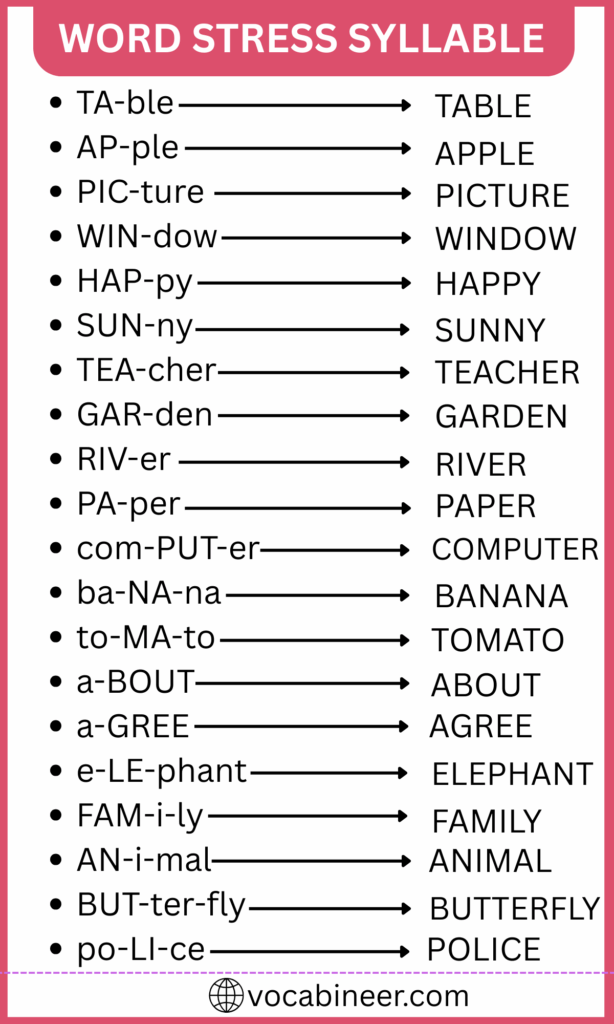
- Write words in syllable parts, capitalizing the stressed one (e.g., TA-ble, re-LAX)
Conclusion
Word stress syllables make English clear and natural. By learning the rules, practicing with examples, and using worksheets or word stress dictionaries, you can master stress patterns. The more you practice, the more confident your English will sound.
FAQs About Word Stress Syllables
Stress is placed on one syllable in every word, making it sound stronger. The position depends on the type and length of the word.
Yes, stress can change a word’s role or meaning. For example, CONtract (noun) vs conTRACT (verb).
Most words have one main stress. Longer words sometimes carry an additional secondary stress to balance pronunciation.
Dictionaries mark stressed syllables with a symbol or bold. Listening to native pronunciation also helps.
Yes, stress can shift slightly in phrases. This keeps spoken English natural and maintains rhythm in sentences.
Read More