

Accept vs Except often creates confusion because the words look and sound similar, yet they carry opposite meanings. One expresses agreement or receiving something, while the other signals exclusion. Their grammar roles also differ, which makes sentence structure tricky.
Understanding Accept vs Except helps you choose the correct word in structured writing, school assignments, and formal communication. This article explains their meaning, grammar role, usage patterns, and key differences so you can apply them accurately.
In This Page
Accept vs Except: Why These Words Get Confused
These two words differ by only two letters. When spoken, they almost sound the same. That similarity leads to hesitation while writing. They also appear in similar sentence positions. However, their meaning and grammar function are completely different. Let’s break them down carefully.
Word Origin and Etymology
The history of Accept vs Except explains why they look related but mean different things. Accept comes from the Latin word acceptare, which means to receive or take willingly. The root idea connects to taking something in. That meaning stayed consistent as the word entered English.
Except comes from the Latin word exceptus, meaning taken out or excluded. It combines the idea of taking with removal. So even though both words share a similar root connected to taking, Accept means to take in, while Except means to take out. That small directional shift explains their opposite meanings today.
What Does Accept Mean?
Accept refers to receiving, agreeing, or approving something. In the Accept vs Except comparison, Accept always shows agreement or willingness.
Definition of Accept
Accept means to receive something willingly or agree to something offered.
It functions only as a verb.
Accept as a Verb
Because Accept is a verb, it must connect to a subject that performs the action.
Examples using Accept:
- I accept your apology.
- She accepts the offer.
- They accepted the invitation.
- We will accept the terms.
- He does not accept unfair rules.
- She accepted responsibility.
- The company accepts online payments.
- I cannot accept this condition.
- He finally accepted defeat.
- They accept applications yearly.
- She accepted the award.
- We gladly accept your support.
- He refused to accept the blame.
- The teacher accepts homework late.
- I accept your decision.
- She accepted the truth.
- They accept change slowly.
- He did not accept the proposal.
- We accept digital transfers.
- She accepted the challenge.
Common Uses and Collocations of Accept
Certain word combinations commonly appear with Accept. These collocations make usage predictable.
Below is a structured list:
- Accept an offer
- Accept responsibility
- Accept an apology
- Accept a gift
- Accept payment
- Accept terms
- Accept a challenge
- Accept the truth
- Accept advice
- Accept a proposal
- Accept defeat
- Accept a request
- Accept conditions
- Accept a position
- Accept an invitation
- Accept a complaint
- Accept support
- Accept credit cards
- Accept evidence
- Accept authority
What Does Except Mean?
Except works in the opposite direction of Accept. Instead of receiving something, it removes something from a group. In the Accept vs Except contrast, Except signals exclusion, limitation, or leaving something out.
You’ll notice that Except does not describe an action like Accept does. Its role is grammatical. It connects parts of a sentence to show what is not included.
Definition of Except
Except means not including or leaving out someone or something.
It introduces an exception to a general statement. When you use Except, you are separating one item from a larger group.
Except as a Preposition
Most commonly, Except functions as a preposition. It comes before a noun or pronoun and shows exclusion.
Typical structure pattern:
All + noun + except + noun
Examples using Except:
- Everyone came except Ali.
- All the books are here except one.
- She ate everything except rice.
- We invited everyone except him.
- All students passed except Sara.
- The shop opens daily except Sunday.
- I like all fruits except mangoes.
- Everyone agreed except the manager.
- The road is open except at night.
- All answers were correct except number five.
- They finished all tasks except one.
- I cleaned every room except the kitchen.
- All lights are working except this one.
- We visited every city except Lahore.
- The team practiced daily except Monday.
- He answered all questions except two.
- Everyone understood except me.
- The store sells everything except alcohol.
- She completed every chapter except the last.
- All rules apply except this one.
Except as a Conjunction
Except can also join clauses. In this role, it introduces a limitation or condition.
Structure pattern:
Statement + except + clause
Examples:
- I would go, except I am busy.
- She would help, except she is unwell.
- He agreed, except he needed more time.
- We planned to travel, except it rained.
- I would accept the offer, except the salary is low.
- They were ready, except the documents were missing.
- She finished early, except she skipped one task.
- I like the plan, except it costs too much.
- He wanted to join, except he had exams.
- We would attend, except the venue changed.
Common Uses and Collocations of Except
When Except appears in sentences, it usually follows predictable patterns. It often connects to words like all, every, everyone, everything, and always creates a sense of exclusion. Paying attention to these patterns makes Accept vs Except easier to manage.
Below is a structured list of common collocations with Except:
- All except
- Everyone except
- Everything except
- Nobody except
- Nothing except
- Anywhere except
- Every day except
- Every student except
- All rules except
- Every room except
- Any time except
- Nowhere except
- No one except
- All items except
- Everything except this
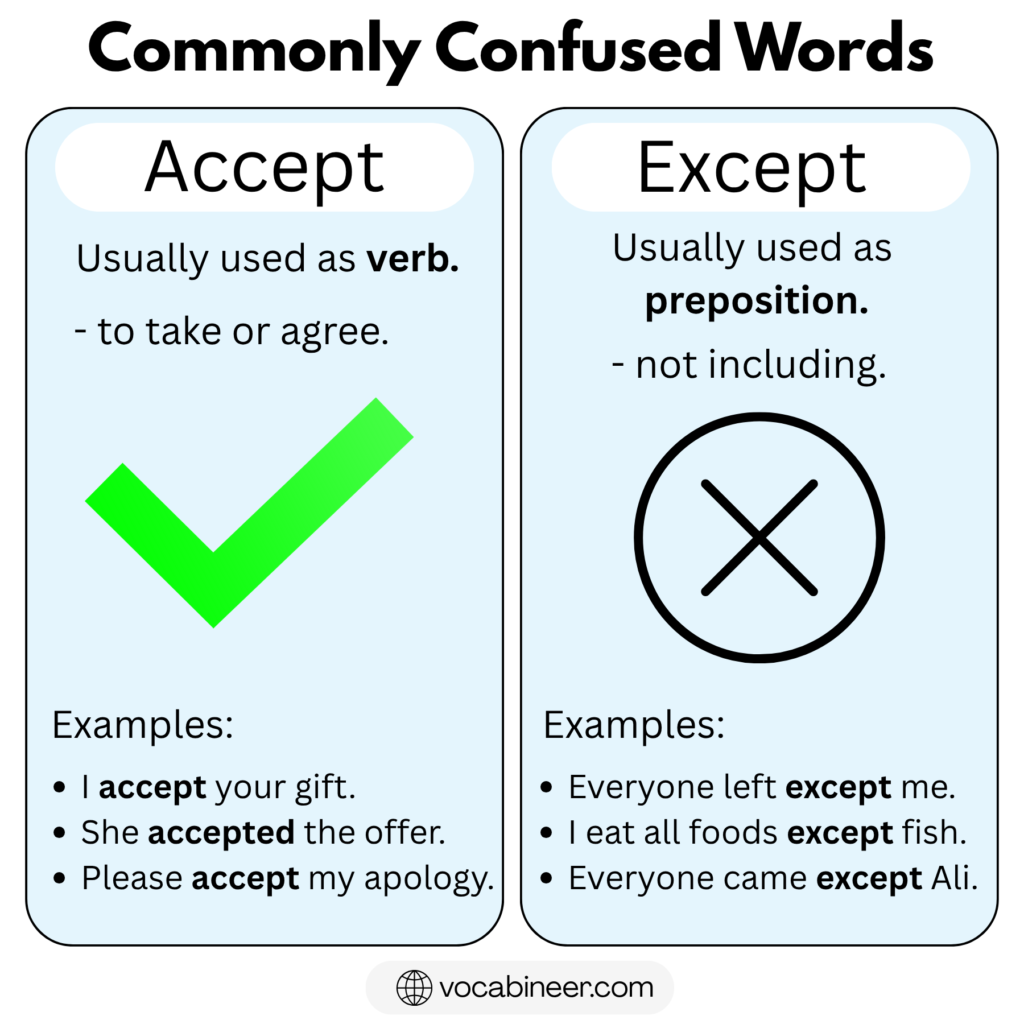
Accept vs Except: Key Difference Explained
When comparing Accept vs Except, the confusion usually comes from sound similarity, not meaning. One word expresses agreement or receiving something. The other removes something from a group. Their grammar roles and sentence behavior are completely different. The table below summarizes the core contrast in a structured way.
| Feature | Accept | Except |
|---|---|---|
| Core Meaning | To receive, agree, or approve something | To exclude or leave something out |
| Main Idea | Agreement or willingness | Exclusion or limitation |
| Grammar Role | Verb | Preposition or conjunction |
| Shows Action? | Yes, someone performs the action | No action, shows removal |
| Sentence Function | Takes an object after it | Introduces an exception |
| Replace With | Receive, agree, approve | Excluding, leaving out |
| Example Sentence | I accept your offer. | Everyone came except Ali. |
| Time Forms | Accept, accepts, accepted | Does not change form |
| Question Test | Am I receiving something? | Am I removing something? |
If the sentence shows receiving or agreeing, use Accept.
If the sentence removes something from a group, use Except.
Sentence Structure Comparison
Sentence structure often reveals the correct choice in Accept vs Except. Once you understand where each word sits in a sentence, the confusion starts to fade. Accept behaves like a normal verb. Except connects ideas by excluding something.
Below is a structure comparison table to make the pattern obvious.
| Structure Type | Accept Pattern | Except Pattern |
|---|---|---|
| Basic Pattern | Subject + accept + object | All + noun + except + noun |
| With Tense | She accepted the gift. | Everyone came except Ali. |
| With Modal | They will accept the offer. | All days are working days except Sunday. |
| Negative Form | He did not accept the terms. | Nobody left except him. |
| Clause Pattern | I accept that you are right. | I would go except I am busy. |
| Plural Subject | We accept responsibility. | All students passed except two. |
Accept vs Except in a Sentence
- I accept your invitation.
- Everyone came except Ali.
When to Use Accept and When to Use Except
Choosing between Accept vs Except becomes easier when you focus on intention. Ask yourself what the sentence is trying to express.
Use Accept when the sentence shows:
- Agreement
- Receiving something
- Approval
- Permission
- Admission
- Taking responsibility
Examples:
- I accept your apology.
- She accepted the job offer.
- They accept online payments.
- We will accept the proposal.
- He refused to accept defeat.
- The school accepts new applications.
- She accepted the award gracefully.
- I cannot accept these conditions.
- They accept responsibility.
- He finally accepted the truth.
Use Except when the sentence shows:
- Exclusion
- Removal from a group
- Limitation
- Condition
Examples:
- Everyone came except Sara.
- All rooms are open except one.
- She likes all fruits except bananas.
- Nobody objected except him.
- The store opens daily except Sunday.
- All answers were correct except number three.
- We visited every city except Islamabad.
- Everything is ready except the report.
- All students passed except two.
- He agreed, except he wanted more time.
Context-Based Usage Guide
Context gives strong clues about the correct word. If you look carefully at surrounding words, the answer usually becomes obvious.
Use Accept in contexts involving:
- Offers
- Invitations
- Apologies
- Responsibility
- Payments
- Conditions
- Proposals
- Awards
- Admission
- Advice
Examples:
- She accepted the scholarship.
- They accept credit cards.
- I accept your apology.
- He accepted the challenge.
- We accept new members yearly.
- She did not accept the explanation.
- The company accepts applications online.
- I gladly accept your help.
- They accepted the settlement.
- He refused to accept the result.
Use Except in contexts involving:
- Everyone
- Everything
- All
- Every
- Nobody
- Nothing
- Each
- Entire group
- Complete list
Examples:
- Everyone agreed except him.
- All students passed except one.
- She cleaned every room except the kitchen.
- Nothing changed except the date.
- Every day is busy except Sunday.
- All options are available except this one.
- Nobody objected except her.
- Everything worked except the printer.
- All members voted except two.
- Every rule applies except this condition.
Memory Trick for Accept vs Except
Think of Accept as “A for Agree.”
Think of Except as “Ex for Exclude.”
Grammar Difference Between Accept and Except
Grammar plays a major role in understanding Accept vs Except. Even if the words sound similar, their grammatical category separates them completely. One behaves like an action word. The other works as a connector that limits meaning.
When you identify the part of speech, the correct choice becomes easier.
Part of Speech
Accept belongs to the verb category. It shows an action performed by a subject.
Except belongs to the preposition or conjunction category. It does not show action. Instead, it connects ideas and signals exclusion.
Below is a comparison table to highlight the grammar difference:
| Grammar Feature | Accept | Except |
|---|---|---|
| Part of Speech | Verb | Preposition / Conjunction |
| Shows Action | Yes | No |
| Changes Form | Accept, accepts, accepted | No tense change |
| Needs Subject | Yes | No |
| Can Stand Alone as Main Verb | Yes | No |
| Connects Ideas | No | Yes |
| Follows Words Like All or Every | No | Yes |
Notice something important. Because Accept is a verb, it changes tense. You can say:
- She accepts the offer.
- She accepted the offer.
- She will accept the offer.
But Except never changes form:
- Everyone came except Ali.
- All rules apply except this one.
- Nobody left except him.
This tense difference is a strong grammatical clue in Accept vs Except.
Verb vs Exclusion Function
To simplify the grammar contrast:
• Accept performs an action.
• Except performs exclusion.
Think of it this way. Accept pulls something in. Except pushes something out.
Examples showing the contrast clearly:
- I accept your request.
- Everyone agreed except him.
- She accepted responsibility.
- All members voted except two.
- They accept online payments.
- Every seat was filled except one.
When a word must act like a verb and show agreement, it must be Accept. When a word must limit or remove something from a group, it must be Except.
Pronunciation Difference Between Accept and Except
Although Accept vs Except look very similar, their pronunciation has a slight stress difference. The sound pattern is close, which is why confusion often begins in speech before it appears in writing.
In spoken English, both words have two syllables. However, the stress and starting sound make them slightly different.
Below is a quick pronunciation contrast table:
| Feature | Accept | Except |
|---|---|---|
| Syllables | 2 | 2 |
| Stress Pattern | ac-CEPT | ex-CEPT |
| First Sound | Soft “uh” sound | Clear “eks” sound |
| Ending Sound | -cept | -cept |
Accept starts with a softer sound, almost like “uh.”
Except begins with a stronger “eks” sound.
Common Mistakes With Accept and Except
Even when learners understand the difference, small sentence habits still cause mistakes. In Accept vs Except confusion, errors usually happen because of sound similarity or rushed writing. Let’s look at the most common problems.
Below is a list of frequent mistakes and corrections:
- Incorrect: I will except your apology.
Correct: I will accept your apology. - Incorrect: Everyone came accept Ali.
Correct: Everyone came except Ali. - Incorrect: She did not except the offer.
Correct: She did not accept the offer. - Incorrect: All students passed accept one.
Correct: All students passed except one. - Incorrect: They refused to except responsibility.
Correct: They refused to accept responsibility. - Incorrect: Everything is ready accept this file.
Correct: Everything is ready except this file. - Incorrect: He will except the award tomorrow.
Correct: He will accept the award tomorrow. - Incorrect: Nobody left accept him.
Correct: Nobody left except him. - Incorrect: We cannot except these conditions.
Correct: We cannot accept these conditions. - Incorrect: All rules apply accept this one.
Correct: All rules apply except this one.
FAQs
No, Accept and Except are not the same. Accept means to receive, agree, or approve something. Except means to exclude or leave something out. Even though they sound alike, their meaning and grammar role are completely different.
Use Accept when someone is receiving something, agreeing to something, or approving something. For example, you might say I accept your apology or She accepted the offer. If the sentence shows agreement or taking something in, Accept is correct.
Use Except when something is being removed from a group. For example, Everyone came except Ali or All items are included except this one. If the sentence shows exclusion or limitation, Except is the correct choice.
No, Except cannot replace Accept because their meanings are opposite. If you say I will except your apology, the sentence becomes incorrect. The correct form is I will accept your apology because the idea is agreement, not exclusion.
The easiest way to remember Accept vs Except is to check the meaning. If you can replace the word with receive or agree, use Accept. If you can replace it with excluding or leaving out, use Except. This quick test helps prevent confusion in most sentences.
Final Summary
Accept vs Except may sound similar, but their meaning and grammar role are entirely different. Accept is a verb that expresses agreement, approval, or receiving something. Except signals exclusion and removes something from a complete group. If the sentence shows action and agreement, choose Accept. If it limits or excludes, choose Except. Understanding this contrast prevents common writing mistakes and strengthens sentence accuracy.
Read More
- Confusing Words in English
- Advice vs Advise in English
- Who’s vs Whose in English
- Breath vs Breathe in English
