

Advice vs Advise often creates confusion because the words look nearly identical yet function differently in grammar. One refers to guidance or a recommendation, while the other describes the act of giving that guidance. Their spelling difference reflects a noun versus verb contrast.
Understanding Advice vs Advise helps you choose the correct form in structured writing, school tasks, and formal communication. This article explains their meaning, grammar roles, usage patterns, pronunciation difference, and common mistakes so you can apply them accurately.
In This Page
Advice vs Advise: Quick Definition
Advice is a noun that means guidance or a suggestion.
Advise is a verb that means to give guidance or recommend something.
The key difference in Advice vs Advise is noun versus verb.
Advice vs Advise Difference in One Sentence
Advice is the suggestion itself.
Advise is the act of giving that suggestion.
Why Advice and Advise Are Often Confused?
Advice and Advise are often confused because they look almost identical and share the same meaning area. In addition, both words relate to guidance, recommendations, and helping someone decide. When spoken, the sound difference is small; therefore, many writers hesitate while choosing the correct spelling.
Moreover, the grammar role creates extra confusion. Advice is a noun, while Advise is a verb. However, learners often focus only on meaning and forget to check sentence structure. As a result, they mix the noun and verb forms. Consequently, this small grammar shift causes most mistakes in Advice vs Advise.
Word Origin and Etymology
The history of Advice vs Advise explains why the words look similar but function differently. Both come from the Latin verb advisare, which means to consider carefully or reflect. Later, the word entered Old French and then Middle English, carrying the idea of guidance and thoughtful recommendation.
Over time, English separated the noun and verb forms by spelling. As a result, Advice became the noun referring to the guidance itself, while Advise remained the verb describing the act of giving that guidance. Therefore, even though the words share the same root and meaning base, their grammar roles developed differently.
What Does Advice Mean?
Advice refers to a suggestion, recommendation, or guidance offered to help someone decide or act. In this word pair, Advice always names the information given, not the action.
Definition of Advice
Advice means guidance or a recommendation given to someone for decision making or action.
It functions as a noun.
Advice as a Noun
Because Advice is a noun, it does not show action. It names the guidance itself.
Examples using Advice:
- She gave me helpful advice.
- I need your advice.
- His advice was practical.
- The teacher offered useful advice.
- Her advice changed my decision.
- They followed the doctor’s advice.
- That was wise advice.
- I appreciate your advice.
- His advice helped me succeed.
- She ignored my advice.
- Good advice prevents mistakes.
- I value your advice.
- Her career advice was clear.
- They asked for professional advice.
- His financial advice was accurate.
- She shared career advice.
- I trust her advice.
- The manager provided strategic advice.
- That advice saved time.
- We received helpful advice.
Notice something important. Advice does not normally take a plural form in standard usage.
Common Uses and Collocations of Advice
Certain phrases commonly appear with Advice. These patterns help you recognize it as a noun.
- Give advice
- Offer advice
- Take advice
- Follow advice
- Ask for advice
- Seek advice
- Provide advice
- Ignore advice
- Professional advice
- Legal advice
- Financial advice
- Medical advice
- Career advice
- Helpful advice
- Sound advice
- Good advice
- Expert advice
- Practical advice
- Personal advice
- Business advice
What Does Advise Mean?
Advise describes the action of giving guidance or making a recommendation. In the Advice vs Advise comparison, Advise always shows what someone does, not the suggestion itself. It focuses on the act of guiding, recommending, or informing someone.
Definition of Advise
Advise means to give guidance, recommend something, or suggest a course of action.
It functions as a verb.
Advise as a Verb
Because Advise is a verb, it connects to a subject that performs the action. It can change tense, take objects, and appear with modal verbs.
Examples using Advise:
- I advise you to wait.
- She advises her clients carefully.
- They advised him to reconsider.
- We will advise the team tomorrow.
- The doctor advised rest.
- I strongly advise caution.
- She advised him against investing.
- The lawyer advised patience.
- They advise students regularly.
- He advised me to study harder.
- We advise checking the details.
- She advised immediate action.
- The teacher advises practice daily.
- I would advise you to think again.
- They advised waiting for approval.
- The consultant advises businesses on strategy.
- He advised her to remain calm.
- We were advised to arrive early.
- She has advised many professionals.
- The manager advised reviewing the plan.
Notice the pattern. Advise changes form depending on tense and subject, because it is a verb.
Common Uses and Collocations of Advise
Certain combinations frequently appear with Advise. These patterns reinforce its verb role.
- Advise someone to
- Advise against
- Strongly advise
- Officially advise
- Advise caution
- Advise patience
- Advise waiting
- Advise action
- Advise clients
- Advise students
- Advise customers
- Advise investors
- Advise reviewing
- Advise checking
- Advise reconsidering
- Advise consulting
- Advise following
- Advise discussing
- Advise reporting
- Advise preparing
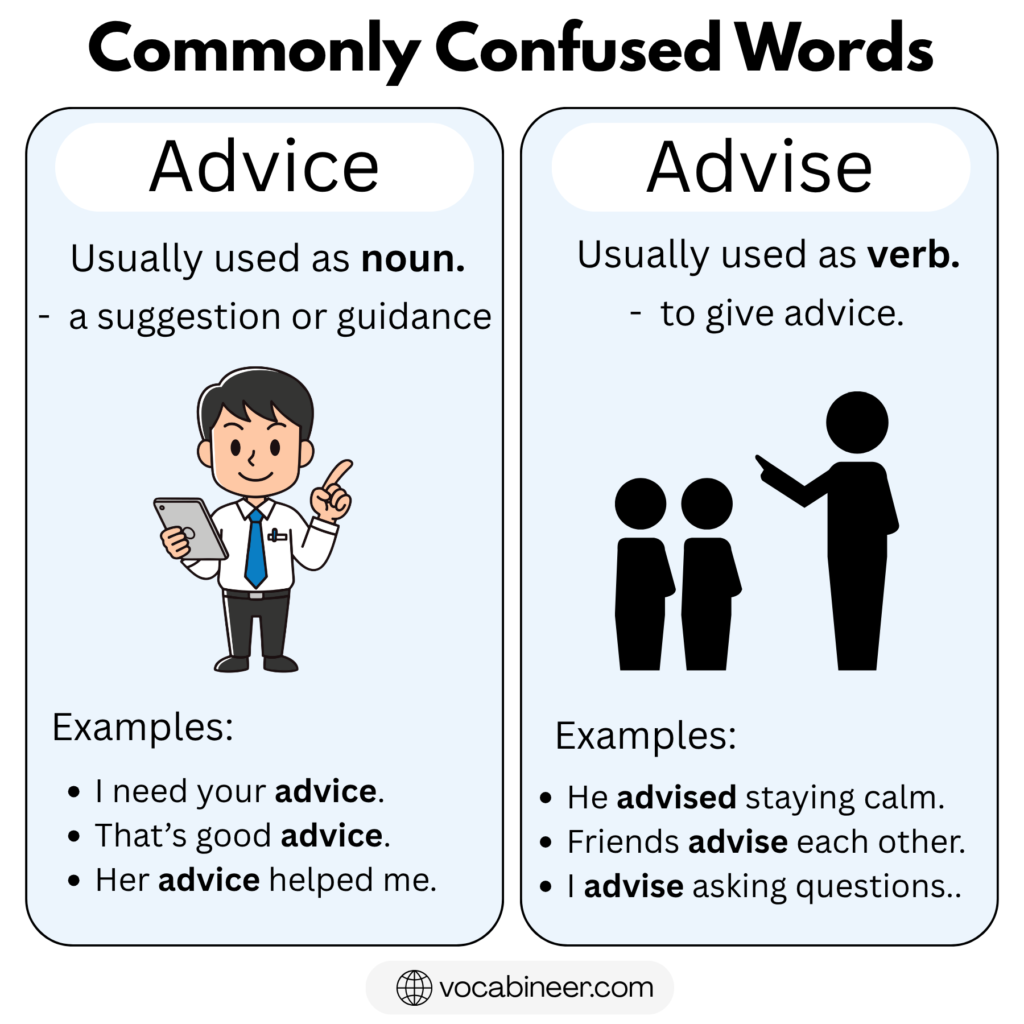
Advice vs Advise: Key Difference Explained
The main difference between Advice vs Advise depends on grammar role. Advice is a noun. Advise is a verb. One names the guidance. The other describes the action of giving that guidance.
If the sentence needs a thing or idea, use Advice.
If the sentence needs an action, use Advise.
Here is the difference in one sentence:
Advice is the suggestion itself.
Advise is the act of giving that suggestion.
Advice vs Advise: Difference in One Look
| Feature | Advice | Advise |
|---|---|---|
| Part of Speech | Noun | Verb |
| Meaning | Suggestion or guidance | To give suggestion or guidance |
| Shows Action | No | Yes |
| Changes Form | No plural form in standard usage | Changes tense |
| Replace With | Suggestion | Recommend |
Notice something important. Because Advise is a verb, it changes form. Advice does not.
Advice vs Advise: Side by Side Sentence Contrast
- She gave me good advice.
- She advised me to wait.
- His advice was helpful.
- He advised caution.
- I need your advice.
- I advise you to stay calm.
In each pair, Advice names the suggestion. Advise shows the action of recommending.
Advice vs Advise: Sentence Structure Comparison
Understanding sentence structure makes the difference easier.
| Structure Type | Advice Pattern | Advise Pattern |
|---|---|---|
| Basic Pattern | Subject + verb + advice | Subject + advise + object |
| With Modal | I need your advice | I will advise you |
| With Tense | Her advice was helpful | She advised him |
| Passive Form | Advice was given | He was advised to wait |
| Object Pattern | Give advice | Advise someone to do something |
When to Use Advice and When to Use Advise
Choosing between Advice vs Advise becomes simple when you focus on grammar role. Ask yourself whether the sentence needs a noun or a verb.
Choose Advice when the sentence names the guidance or recommendation itself.
Select Advise when the sentence shows someone giving that guidance or making the recommendation.
Use Advice when the sentence shows:
- Guidance
- Recommendation
- Suggestion
- Opinion given
- Professional input
Examples:
- I appreciate your advice.
- Her advice helped me decide.
- They followed expert advice.
- Good advice saves time.
- We received legal advice.
- His financial advice was accurate.
- She ignored my advice.
- I need career advice.
- The manager offered practical advice.
- That was sound advice.
Use Advise when the sentence shows:
- Giving guidance
- Recommending action
- Suggesting something
- Informing someone
- Warning someone
Examples:
- I advise you to reconsider.
- She advised patience.
- They advise checking the details.
- The doctor advised rest.
- We were advised to wait.
- He advised caution.
- The consultant advises businesses.
- I would advise thinking carefully.
- She advised him against borrowing money.
- The lawyer advised reviewing the contract.
If the word needs tense change or action, choose Advise. If it names the suggestion itself, choose Advice.
Context Based Usage Guide
Context provides strong clues in Advice vs Advise decisions. Certain surrounding words usually signal the correct choice.
Advice often appears after verbs such as:
- Give
- Offer
- Take
- Seek
- Follow
- Ignore
- Provide
- Share
- Receive
- Appreciate
Examples:
- She gave helpful advice.
- I will take your advice.
- They sought professional advice.
- He ignored my advice.
- We received medical advice.
Advise often appears before patterns such as:
- Advise someone to
- Advise against
- Strongly advise
- Officially advise
- Advise caution
Examples:
- I advise you to wait.
- She advised him to apply.
- They strongly advise caution.
- The officer advised against travel.
- We were advised to remain calm.
You might notice something useful. If you see “to” after the word, it is usually Advise, not Advice.
Grammar Difference Between Advice and Advise
The grammar difference between Advice vs Advise is direct and structural.
Advice is a noun.
Advise is a verb.
Advice does not change form for tense.
Advise changes tense depending on subject and time.
Examples of tense change with Advise:
- She advises clients daily.
- She advised him yesterday.
- She will advise the team tomorrow.
- She has advised many students.
Advice remains the same:
- Her advice was helpful.
- I value your advice.
- That advice changed everything.
If the sentence requires a verb that shows action, the correct choice is Advise. If the sentence requires a noun that names guidance, the correct choice is Advice.
Pronunciation Difference Between Advice and Advise
Although Advice vs Advise look similar, their pronunciation helps separate them. The difference lies in the final sound.
Advice ends with an “s” sound.
Advise ends with a “z” sound.
Below is a quick pronunciation comparison:
| Feature | Advice | Advise |
|---|---|---|
| Part of Speech | Noun | Verb |
| Final Sound | Soft “s” sound | “z” sound |
| Stress Pattern | ad-VICE | ad-VISE |
| Changes Form | No | Yes |
Common Mistakes With Advice and Advise
Most errors in Advice vs Advise happen because writers confuse the noun and verb forms. Since both words relate to guidance, the spelling often gets mixed up. Always check whether your sentence needs a noun or an action verb.
Below are the most common mistakes with corrections.
- Incorrect: She gave me good advise.
Correct: She gave me good advice. - Incorrect: I need your advise.
Correct: I need your advice. - Incorrect: He gave me an advice.
Correct: He gave me advice. - Incorrect: She advice me to wait.
Correct: She advised me to wait. - Incorrect: They advice checking the report.
Correct: They advise checking the report. - Incorrect: The teacher gave useful advise.
Correct: The teacher gave useful advice. - Incorrect: I will advice you tomorrow.
Correct: I will advise you tomorrow. - Incorrect: We received helpful advise.
Correct: We received helpful advice. - Incorrect: She adviced him carefully.
Correct: She advised him carefully. - Incorrect: He took my advise seriously.
Correct: He took my advice seriously. - Incorrect: I am going to advice him.
Correct: I am going to advise him. - Incorrect: That was a helpful advise.
Correct: That was helpful advice.
FAQs
The difference in Advice vs Advise is grammar role. Advice is a noun that means guidance or suggestion. Advise is a verb that means to give guidance or recommend something. One names the idea. The other shows the action.
No, Advice is not a verb. Advice is always a noun. It refers to the suggestion itself. For example, I value your advice uses Advice as a thing, not an action.
No, Advise is not a noun. Advise is a verb. It describes the act of giving guidance. For example, She advised me to wait shows the action of recommending.
No, Advice is an uncountable noun in standard English. You cannot say an advice. Instead, say some advice or a piece of advice.
Check the sentence structure. If you need a noun, use Advice. If the word must change tense or show action, use Advise. This simple grammar test prevents most mistakes.
Final Summary
Advice vs Advise may look almost identical, but their grammar roles are completely different. Advice is a noun that refers to guidance or recommendation. Advise is a verb that describes the act of giving that guidance. If the sentence names the suggestion, use Advice. If the sentence shows the action of recommending, use Advise. Understanding this noun versus verb contrast prevents common writing errors and strengthens sentence accuracy.
Read More
- Confusing Words in English
- Accept vs Except in English
- Who’s vs Whose in English
- Breath vs Breathe in English
