

Afterward vs Afterwards often confuses learners because both words mean the same thing and sound almost identical. However, the difference lies in regional spelling preference. One form is more common in American English, while the other is preferred in British English.
Understanding Afterward vs Afterwards helps you maintain consistency in formal writing and exams. Therefore, this guide explains their meaning, usage, grammar role, and spelling differences so you can choose the correct form confidently.
In This Page
Afterward vs Afterwards: Quick Definition
Afterward means at a later time.
Afterwards also means at a later time.
In simple terms, both words describe something that happens later.
Afterward vs Afterwards Difference in One Sentence
Afterward and Afterwards both mean later.
The only difference is spelling preference based on region.
Why Afterward and Afterwards Are Often Confused?
Afterward and Afterwards are often confused because both spellings are correct and both carry the same meaning. In addition, they are pronounced the same in speech. As a result, many learners think one form must be wrong, even though both are accepted.
However, the difference depends mainly on regional usage. American English generally prefers Afterward, while British English more commonly uses Afterwards. Therefore, confusion usually arises from spelling variation rather than meaning.
Word Origin and Etymology
Afterward comes from Middle English, combining “after” with the suffix “-ward,” which means direction or time. Over time, it developed into an adverb meaning “at a later time.” Therefore, its meaning connects directly to sequence and timing.
Afterwards developed as a variant form with an added “-s,” which is common in British English adverbs such as towards and forwards. Although both forms share the same origin and meaning, spelling conventions evolved differently across regions.
Meaning of Afterward
Afterward means at a later time or following a particular event. It shows sequence in time. Therefore, it is often used to describe what happens next in a story, plan, or conversation.
In addition, Afterward functions as an adverb. As a result, it modifies verbs by explaining when something happens.
Definition of Afterward
Afterward means later or after something else has happened.
In simple terms, it indicates what happens next.
Afterward as Part of Speech
Afterward functions as an adverb.
Examples:
- We went out for dinner, and afterward we watched a movie.
- She finished her work and rested afterward.
- He apologized and felt better afterward.
- The meeting ended, and they talked afterward.
- They left early and called afterward.
- She studied hard and relaxed afterward.
- The show ended, and the audience applauded afterward.
- He explained everything and left afterward.
- We cleaned the room and locked it afterward.
- She completed the test and reviewed her answers afterward.
- The team trained in the morning and met afterward.
- He signed the document and filed it afterward.
- They argued but laughed afterward.
- She made the announcement and answered questions afterward.
- The ceremony finished, and guests mingled afterward.
- He submitted the form and checked afterward.
- We visited the museum and shopped afterward.
- She presented her idea and discussed feedback afterward.
- The class ended, and students stayed afterward.
- He completed the task and reported back afterward.
Common Uses and Collocations of Afterward
Common patterns include:
- Shortly afterward
- Soon afterward
- Immediately afterward
- Not long afterward
- Soon afterward, we left
- Afterward, they agreed
These combinations show that Afterward typically appears in time-sequence contexts.
Meaning of Afterwards
Afterwards also means at a later time or following a specific event. Like Afterward, it shows sequence and timing. Therefore, it appears frequently in storytelling, narration, and everyday conversation.
In addition, Afterwards functions as an adverb. As a result, it modifies verbs by indicating when something happens.
Definition of Afterwards
Afterwards means later or at a time following an event.
In simple terms, it describes what happens next.
Afterwards as Part of Speech
Afterwards functions as an adverb.
Examples:
- We had lunch and talked afterwards.
- She finished the meeting and relaxed afterwards.
- He apologized and left afterwards.
- The match ended, and fans celebrated afterwards.
- They met in the morning and traveled afterwards.
- She completed the task and checked it afterwards.
- The film ended, and everyone discussed it afterwards.
- He explained the plan and confirmed details afterwards.
- We attended the event and socialized afterwards.
- She submitted her work and reflected afterwards.
- The ceremony concluded, and guests mingled afterwards.
- He signed the contract and reviewed it afterwards.
- They argued but spoke calmly afterwards.
- The presentation finished, and questions followed afterwards.
- She made the call and waited afterwards.
- The class ended, and students chatted afterwards.
- He completed the interview and called afterwards.
- They visited the gallery and dined afterwards.
- She gave instructions and clarified doubts afterwards.
- The event closed, and people left afterwards.
Common Uses and Collocations of Afterwards
Common patterns include:
- Shortly afterwards
- Soon afterwards
- Immediately afterwards
- Not long afterwards
- Afterwards, they agreed
- Shortly afterwards, he left
These patterns show that Afterwards functions exactly like Afterward but follows British spelling preference.
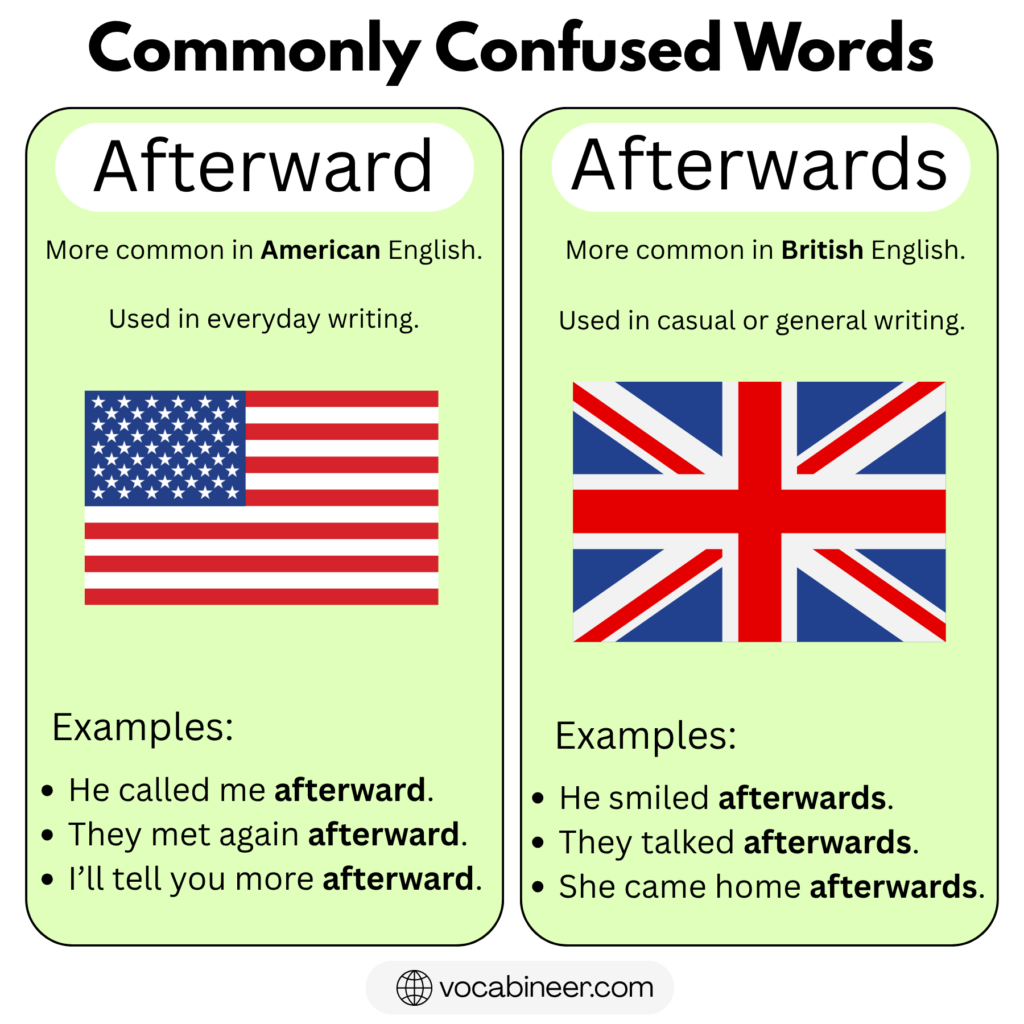
Afterward vs Afterwards: Key Difference Explained
Although Afterward and Afterwards share the same meaning, the difference lies in spelling preference rather than definition. The form Afterward is more common in American English. In contrast, Afterwards is generally preferred in British English and other varieties of English outside the United States.
Regional usage explains the variation. American English often drops the final “-s” in adverbs such as toward, forward, and afterward. However, British English typically keeps the “-s,” forming towards, forwards, and afterwards. In short, both words mean the same thing, yet spelling depends on location and style.
Afterward vs Afterwards: Difference in One Look (Table)
| Feature | Afterward | Afterwards |
|---|---|---|
| Meaning | At a later time | At a later time |
| Part of Speech | Adverb | Adverb |
| Pronunciation | Same | Same |
| Regional Preference | American English | British English |
| Used In | U.S. writing | U.K. and international writing |
| Interchangeable in Meaning? | Yes | Yes |
This table shows that the difference is stylistic rather than grammatical.
Afterward vs Afterwards: Side by Side Sentence Contrast
Since both words carry the same meaning, the difference appears only in spelling. Therefore, comparing similar sentences shows that usage changes by region, not by meaning.
- We went to dinner, and afterward we watched a movie.
- We went to dinner, and afterwards we watched a movie.
- She finished her work and rested afterward.
- She finished her work and rested afterwards.
- He explained the plan and left afterward.
- He explained the plan and left afterwards.
- The meeting ended, and they talked afterward.
- The meeting ended, and they talked afterwards.
In each pair, the meaning remains identical. Only the spelling changes based on regional preference.
Afterward vs Afterwards: Sentence Structure Comparison
Because both words function as adverbs, their sentence structure is exactly the same.
Common patterns:
- Verb + afterward/afterwards
- Shortly afterward/afterwards
- Soon afterward/afterwards
- Immediately afterward/afterwards
- Afterward/Afterwards, they agreed
Therefore, both words appear in the same grammatical positions. The only difference lies in spelling style, not structure.
When to Use Afterward and Afterwards
Choosing between Afterward and Afterwards depends mainly on regional spelling preference. If you are writing in American English, Afterward is generally preferred. Therefore, most U.S. publications and style guides recommend this form.
However, if you are writing in British English or following international standards, Afterwards is more commonly used. Thus, the correct choice depends on your audience and style guide rather than meaning.
In short, both words mean “later,” but spelling depends on region.
Context Based Usage Guide
If your document follows American English spelling, use Afterward. For example:
- We met again afterward.
- She called him afterward.
- The event ended, and we talked afterward.
- He explained the details and left afterward.
- They reviewed the plan afterward.
On the other hand, if your writing follows British English conventions, use Afterwards. For instance:
- We met again afterwards.
- She called him afterwards.
- The event ended, and we talked afterwards.
- He explained the details and left afterwards.
- They reviewed the plan afterwards.
Therefore, maintain consistency throughout your document once you choose one form.
Grammar Difference Between Afterward and Afterwards
Although Afterward and Afterwards look slightly different, their grammatical function is identical. Both words are adverbs and both describe time sequence. Therefore, the difference is purely stylistic and regional, not grammatical.
| Grammar Feature | Afterward | Afterwards |
|---|---|---|
| Part of Speech | Adverb | Adverb |
| Meaning | At a later time | At a later time |
| Sentence Position | Beginning or end of clause | Beginning or end of clause |
| Modifies | Verbs / Clauses | Verbs / Clauses |
| Used With | Shortly afterward | Shortly afterwards |
| Regional Preference | American English | British English |
| Plural Form? | Not applicable | Not applicable |
| Interchangeable in Meaning? | Yes | Yes |
This table shows that both forms behave exactly the same in sentences. The only distinction lies in spelling preference.
Pronunciation Difference Between Afterward and Afterwards
Afterward and Afterwards are pronounced the same in everyday speech. Therefore, pronunciation does not help distinguish between them. Both follow the same stress pattern.
As a result, the difference appears only in writing. Writers must choose based on regional spelling standards rather than sound.
Common Mistakes With Afterward and Afterwards
Afterward vs Afterwards mistakes usually happen when writers mix regional spelling within the same document. However, the issue is not meaning but consistency.
- Incorrect: We went home afterward, and they visited us afterwards in the same essay.
Correct: Choose either afterward or afterwards and use it consistently. - Incorrect: Afterwards is wrong in American English.
Correct: Afterwards is understood, but afterward is preferred in American English. - Incorrect: Afterward is incorrect in British English.
Correct: Afterward is accepted, but afterwards is traditionally preferred in British English. - Incorrect: She said she would call afterwords.
Correct: She said she would call afterward/afterwards. - Incorrect: The event ended and afterwards, we left.
Correct: The event ended, and afterwards we left.
Therefore, the main rule is consistency. Select the spelling based on your regional style and use it throughout your writing.
Afterward vs Afterwards: Frequently Asked Questions
Afterward vs Afterwards often raises spelling questions rather than meaning questions. Below are the five most common ones.
Both spellings are correct and accepted in standard English. They have the same meaning and both mean “at a later time.” Therefore, neither form is wrong. The choice depends on the variety of English you are using.
Afterward is more commonly used in American English. In fact, most American style guides and publications prefer this form. Therefore, if you are writing for a U.S. audience, Afterward is usually the safer choice.
Afterwards is traditionally preferred in British English and in many international contexts. In addition, British English often keeps the “-s” in similar adverbs such as towards and forwards. As a result, Afterwards fits standard UK spelling conventions.
No, they do not. Both words mean exactly the same thing and can appear in the same sentence positions. The difference is purely stylistic and regional, not grammatical or semantic.
No, it is not recommended. Mixing both spellings in one document creates inconsistency and may look unprofessional. Therefore, choose one form based on your audience or style guide and use it consistently throughout your writing.
Final Summary
Afterward and Afterwards both mean “at a later time.” The difference lies only in spelling preference. Afterward is more common in American English, while Afterwards is preferred in British English. Therefore, select the form that matches your regional style and maintain consistency throughout your writing.
Read More
- Confusing Words in English
- American vs British Words
- Desert vs Dessert in English
- Capital vs Capitol in English
