

Ageing vs Aging often confuses writers because both spellings are correct and both refer to the process of growing older. However, the difference lies in regional spelling preference rather than meaning.
Understanding Ageing vs Aging helps you maintain consistency in academic, medical, and general writing. Therefore, this guide explains their definitions, usage patterns, grammar roles, and regional differences so you can choose the correct spelling confidently.
In This Page
Ageing vs Aging: Quick Definition
Ageing means the process of growing older (British spelling).
Aging means the process of growing older (American spelling).
In simple terms, both words describe the same process of becoming older over time.
Ageing vs Aging Difference in One Sentence
Ageing and Aging both refer to the process of growing older.
The difference lies only in spelling preference based on region.
Why Ageing and Aging Are Often Confused?
Ageing and Aging are often confused because both spellings are correct and both carry the same meaning. In addition, they are pronounced the same in speech. As a result, many writers assume one must be incorrect, even though both forms are accepted in standard English.
However, the variation depends mainly on regional spelling conventions. British English typically uses Ageing, while American English prefers Aging. Therefore, confusion usually arises from differences in spelling systems rather than meaning or grammar.
Word Origin and Etymology
Ageing and Aging both come from the verb “age,” which means to grow older. When adding the “-ing” suffix, British English often keeps the extra “e,” forming Ageing. In contrast, American English usually drops the “e,” forming Aging.
Over time, these spelling conventions became standardized within their respective regions. Although the forms look slightly different, their origin and meaning remain identical.
Meaning of Ageing
Ageing refers to the process of growing older over time. It can describe people, animals, objects, or even systems. Therefore, it is commonly used in health, science, and social discussions.
In addition, Ageing functions as both a noun and an adjective in British English contexts. As a result, it can describe a process or modify another noun.
Definition of Ageing
Ageing means the natural process of becoming older.
In simple terms, it describes the gradual change that happens with time.
Ageing as Part of Speech
Ageing functions mainly as a noun and adjective in British English.
As a noun:
- Ageing affects everyone differently.
- Scientists study human ageing.
- Healthy habits can slow ageing.
- The process of ageing is natural.
- Society must prepare for population ageing.
- Research focuses on brain ageing.
- Nutrition influences healthy ageing.
- Doctors examine signs of ageing.
- The topic of ageing interests researchers.
- Policies address issues of ageing.
As an adjective:
- An ageing population
- An ageing society
- An ageing workforce
- An ageing building
- An ageing athlete
- An ageing system
- An ageing infrastructure
- An ageing leader
- An ageing parent
- An ageing vehicle
Common Uses and Collocations of Ageing
Common patterns include:
- Ageing population
- Healthy ageing
- Ageing process
- Ageing workforce
- Ageing society
- Signs of ageing
- Effects of ageing
- Ageing research
These combinations show that Ageing appears frequently in British English, especially in formal and academic writing.
Meaning of Aging
Aging refers to the process of growing older over time. Like Ageing, it applies to people, animals, objects, and systems. Therefore, it appears frequently in health, scientific, and general discussions.
In addition, Aging functions as both a noun and an adjective in American English contexts. As a result, it can describe the process itself or modify another noun.
Definition of Aging
Aging means the natural process of becoming older.
In simple terms, it describes gradual change over time due to age.
Aging as Part of Speech
Aging functions mainly as a noun and adjective in American English.
As a noun:
- Aging affects every individual differently.
- Researchers study brain aging.
- Exercise may slow aging.
- The science of aging is expanding.
- Society faces challenges related to aging.
- Doctors examine signs of aging.
- Nutrition supports healthy aging.
- Policies address population aging.
- Experts focus on cellular aging.
- Lifestyle influences aging.
As an adjective:
- An aging population
- An aging society
- An aging athlete
- An aging building
- An aging workforce
- An aging system
- An aging infrastructure
- An aging parent
- An aging vehicle
- An aging leader
Common Uses and Collocations of Aging
Common patterns include:
- Aging population
- Healthy aging
- Aging process
- Aging workforce
- Signs of aging
- Effects of aging
- Aging research
- Aging society
These patterns show that Aging is the preferred spelling in American English but carries the same meaning as Ageing.
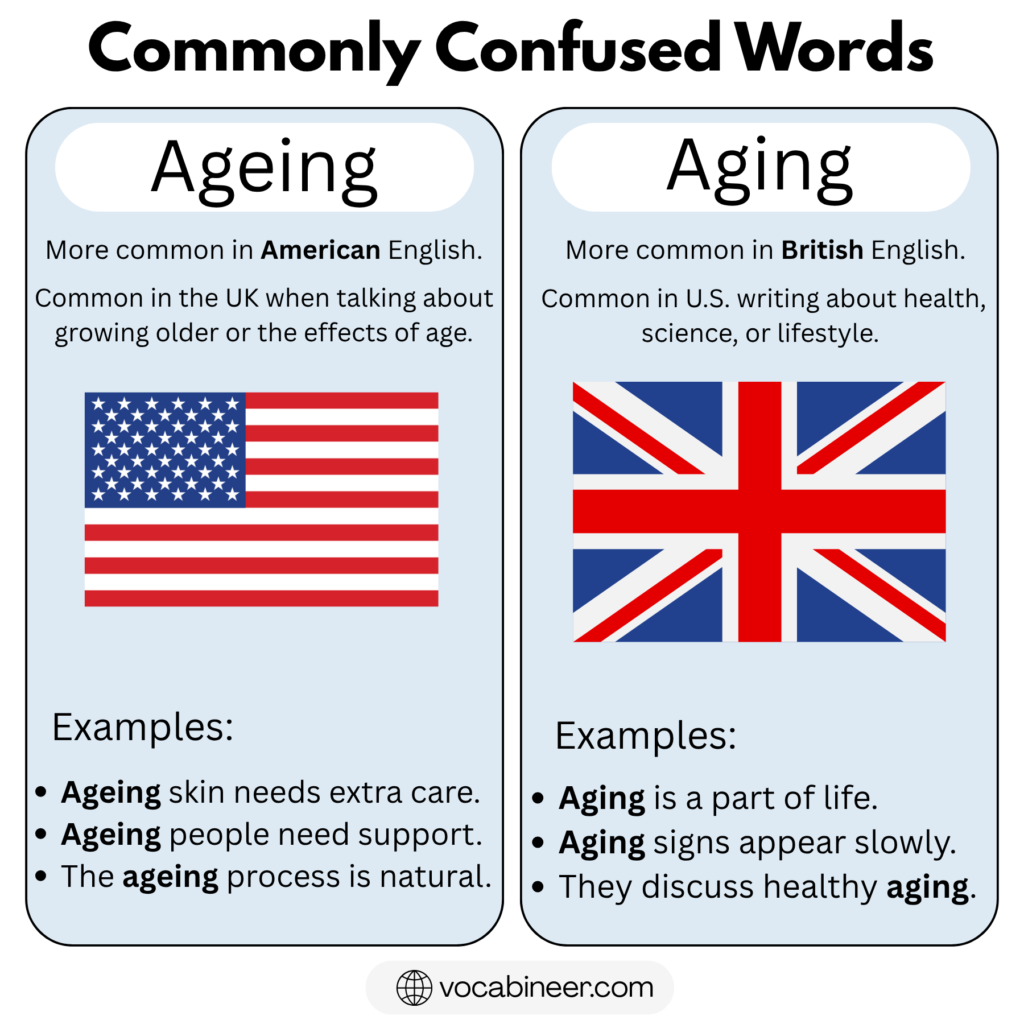
Ageing vs Aging: Key Difference Explained
Although Ageing and Aging look slightly different, their meaning remains exactly the same. The variation is purely a spelling difference based on regional conventions. British English typically uses Ageing, while American English prefers Aging.
Spelling rules explain this distinction. In British English, the silent “e” in “age” is usually kept before adding “-ing,” forming Ageing. However, American English commonly drops the “e,” forming Aging. In short, both words describe the same process, yet the correct form depends on your audience and writing style.
Ageing vs Aging: Difference in One Look
| Feature | Ageing | Aging |
|---|---|---|
| Meaning | Process of growing older | Process of growing older |
| Part of Speech | Noun / Adjective | Noun / Adjective |
| Pronunciation | Same | Same |
| Regional Preference | British English | American English |
| Used In | UK, Australia, International contexts | United States |
| Interchangeable in Meaning? | Yes | Yes |
This comparison shows that the difference is stylistic rather than grammatical.
Ageing vs Aging: Side by Side Sentence Contrast
Since both spellings carry the same meaning, the difference appears only in regional spelling. Therefore, comparing similar sentences helps you see how usage changes by audience rather than meaning.
- An ageing population requires better healthcare.
- An aging population requires better healthcare.
- Scientists study brain ageing.
- Scientists study brain aging.
- Healthy habits support graceful ageing.
- Healthy habits support healthy aging.
- The company updated its ageing infrastructure.
- The company updated its aging infrastructure.
In each pair, the meaning remains identical. Only the spelling differs based on regional preference.
Ageing vs Aging: Sentence Structure Comparison
Because both words function as nouns and adjectives, their grammatical structure is the same.
Common patterns:
- Ageing/Aging population
- Healthy ageing/aging
- Signs of ageing/aging
- Effects of ageing/aging
- The process of ageing/aging
Therefore, both forms appear in the same positions within sentences. The only distinction lies in spelling style, not structure.
When to Use Ageing and Aging
Choosing between Ageing and Aging depends mainly on regional spelling conventions. If you are writing in British English, Ageing is generally preferred. Therefore, publications in the United Kingdom, Australia, and other Commonwealth countries often use this form.
However, if you are writing in American English, Aging is the standard spelling. Thus, most U.S. academic journals, media outlets, and official documents prefer Aging. In short, both words mean the same thing, but the correct choice depends on your audience and style guide.
Context Based Usage Guide
If your document follows British English spelling, use Ageing. For example:
- The government studied population ageing.
- Researchers focus on healthy ageing.
- An ageing workforce needs support.
- The report examined brain ageing.
- The city addressed its ageing infrastructure.
On the other hand, if your writing follows American English conventions, use Aging. For instance:
- The country faces rapid population aging.
- Scientists study cellular aging.
- An aging athlete retired this year.
- The company repaired its aging systems.
- Doctors research healthy aging methods.
Therefore, maintain consistency in spelling throughout your document once you choose one form.
Grammar Difference Between Ageing and Aging
Although Ageing and Aging look different, their grammatical function is identical. Both forms can act as nouns and adjectives. Therefore, the difference is not grammatical but regional. The choice depends on whether you follow British or American spelling conventions.
| Grammar Feature | Ageing | Aging |
|---|---|---|
| Part of Speech | Noun / Adjective | Noun / Adjective |
| Meaning | Process of growing older | Process of growing older |
| Used Before Nouns | Ageing population | Aging population |
| Used After “of” | Process of ageing | Process of aging |
| Sentence Role | Subject or modifier | Subject or modifier |
| Regional Preference | British English | American English |
| Pronunciation | Same | Same |
| Interchangeable in Meaning? | Yes | Yes |
This table shows that both words behave the same in sentences. The only difference lies in spelling style.
Pronunciation Difference Between Ageing and Aging
Ageing and Aging are pronounced the same in standard English. Therefore, pronunciation does not help distinguish them. Both follow the same stress pattern and sound identical in speech.
As a result, the distinction appears only in writing. Writers must choose the spelling that matches their regional style and remain consistent throughout the document.
Common Mistakes With Ageing and Aging
Ageing vs Aging mistakes usually happen when writers mix spelling styles in the same document. However, the meaning remains the same. The main issue is consistency, not correctness.
- Incorrect: The country faces population ageing, and experts study rapid aging in the same article.
Correct: Choose either ageing or aging and use it consistently. - Incorrect: Aging is wrong in British English.
Correct: Aging is understood, but ageing is preferred in British English. - Incorrect: Ageing is incorrect in American English.
Correct: Ageing is understood, but aging is standard in American English. - Incorrect: The process of ageng affects everyone.
Correct: The process of ageing/aging affects everyone. - Incorrect: An aging population is a problem in a UK academic paper.
Correct: An ageing population is a problem (if following British spelling).
Therefore, always match the spelling to your regional style guide and remain consistent throughout your writing.
Ageing vs Aging: Frequently Asked Questions
Ageing vs Aging often creates spelling confusion rather than meaning confusion. Since both forms mean the same thing, most questions relate to regional preference and writing consistency. Below are the five most common questions.
Is Ageing or Aging correct?
Both spellings are correct. They have the same meaning and refer to the process of growing older.
Which spelling is used in American English?
Aging is the standard spelling in American English and is commonly used in U.S. publications and academic writing.
Which spelling is preferred in British English?
Ageing is traditionally preferred in British English and is widely used in UK-based writing.
Do Ageing and Aging have different meanings?
No, they do not. The difference is only in spelling, not in meaning or grammar.
Can I use both spellings in the same document?
No. Choose one spelling based on your audience or style guide and use it consistently throughout your writing.
Final Summary
Ageing and Aging both describe the process of growing older. The difference lies only in spelling preference. Ageing is used in British English, while Aging is standard in American English. Therefore, select the form that matches your audience and maintain consistency throughout your writing.
Read More
- Confusing Words in English
- American vs British Words
- Ensure vs Insure in English
- Advisor vs Adviser in English
