

Altogether vs All Together often confuses learners because both expressions look similar and sound almost the same. However, their meanings are different. One means completely or in total, while the other refers to people or things being in the same place or acting as a group.
Understanding Altogether vs All Together helps you avoid common writing mistakes. Therefore, this guide explains their definitions, grammar roles, usage patterns, sentence structures, and common errors so you can use both forms correctly.
In This Page
Altogether vs All Together: Quick Definition
Altogether means completely or in total.
All together means everyone or everything in the same place or acting at the same time.
In simple words, Altogether shows degree or total amount, whereas All Together shows unity or grouping.
Altogether vs All Together Difference in One Sentence
Altogether means entirely or in total.
All together means in a group or in one place.
In other words, Altogether expresses completeness, while All Together describes people or things acting as one group.
Why Altogether and All Together Are Often Confused?
Altogether and All Together are often confused because they sound identical in speech. In addition, the only visible difference in writing is the space between the words. As a result, many writers treat them as interchangeable, even though their meanings are not the same.
However, Altogether functions as an adverb that shows degree or total amount. In contrast, All Together works as a phrase that emphasizes unity or grouping. Therefore, confusion usually happens when writers do not check whether the sentence talks about completeness or about people and things acting as one group.
Word Origin and Etymology
Altogether developed as a single word over time, combining “all” and “together” to express the idea of totality or completeness. Eventually, it became a fixed adverb meaning entirely or in total. Therefore, it no longer refers to physical grouping.
On the other hand, All Together remains a literal phrase. It keeps its original meaning of people or things being in the same place or acting at the same time. Although the expressions look similar, their historical development explains why one became an adverb while the other stayed a descriptive phrase.
Meaning of Altogether
Altogether means completely, entirely, or in total. It shows degree or total amount. Therefore, it often appears in sentences about cost, opinion, or overall judgment.
In addition, Altogether functions only as an adverb. As a result, it modifies verbs, adjectives, or entire sentences rather than naming people or objects.
Definition of Altogether
Altogether means fully, entirely, or when everything is added together.
In simple terms, it shows completeness or total amount.
Altogether as Part of Speech
Altogether functions as an adverb.
Examples:
- The project was altogether successful.
- The trip cost $500 altogether.
- I am not altogether sure.
- The idea is altogether different.
- The plan was altogether practical.
- The event was altogether amazing.
- She felt altogether relaxed.
- The design is altogether modern.
- The results were altogether surprising.
- He stopped working altogether.
- The movie was altogether disappointing.
- The experience was altogether new.
- The answer is not altogether correct.
- The decision was altogether reasonable.
- They were altogether satisfied.
- The house cost $200,000 altogether.
- It was altogether unexpected.
- The system failed altogether.
- The meeting was altogether productive.
- She quit the job altogether.
Common Uses and Collocations of Altogether
Common patterns include:
- Altogether different
- Altogether new
- Altogether unexpected
- Not altogether sure
- Stop altogether
- Altogether successful
- Altogether wrong
- Altogether correct
Meaning of All Together
All Together means everyone or everything in the same place or acting at the same time. It emphasizes unity, grouping, or collective action. Therefore, it usually appears when people gather, sing, work, or move as one group.
Unlike Altogether, which is a single adverb, All Together is a phrase made of two separate words. As a result, it keeps the literal meaning of “all” and “together.”
Definition of All Together
All Together means in a group, in one place, or at the same time.
In simple words, it describes people or things acting as one unit.
All Together as Part of Speech
All Together functions as a phrase, not a single word. It usually acts as an adverbial phrase.
Examples:
- The family sat all together.
- Let’s sing all together.
- The students worked all together.
- They arrived all together.
- We stood all together on stage.
- The team practiced all together.
- The children played all together.
- The guests gathered all together.
- They shouted all together.
- We solved the problem all together.
- The friends traveled all together.
- Everyone clapped all together.
- The class moved all together.
- The workers met all together.
- They started the race all together.
- The singers performed all together.
- The family ate dinner all together.
- The players celebrated all together.
- We stood all together for the photo.
- The group decided all together.
Common Uses and Collocations of All Together
Common patterns include:
- Sit all together
- Work all together
- Sing all together
- Stand all together
- Gather all together
- Come all together
- Play all together
- Travel all together
Altogether vs All Together: Key Difference Explained
Altogether and All Together differ in both meaning and structure. Altogether is a single word and functions as an adverb. It expresses total amount, degree, or completeness. In contrast, All Together is a two-word phrase that emphasizes unity, grouping, or shared action.
The key distinction lies in context. If the sentence can be replaced with “completely” or “in total,” then Altogether is correct. However, if the sentence refers to people or things being in one place or acting as a group, then All Together is the right choice. Thus, one focuses on totality, while the other focuses on togetherness.
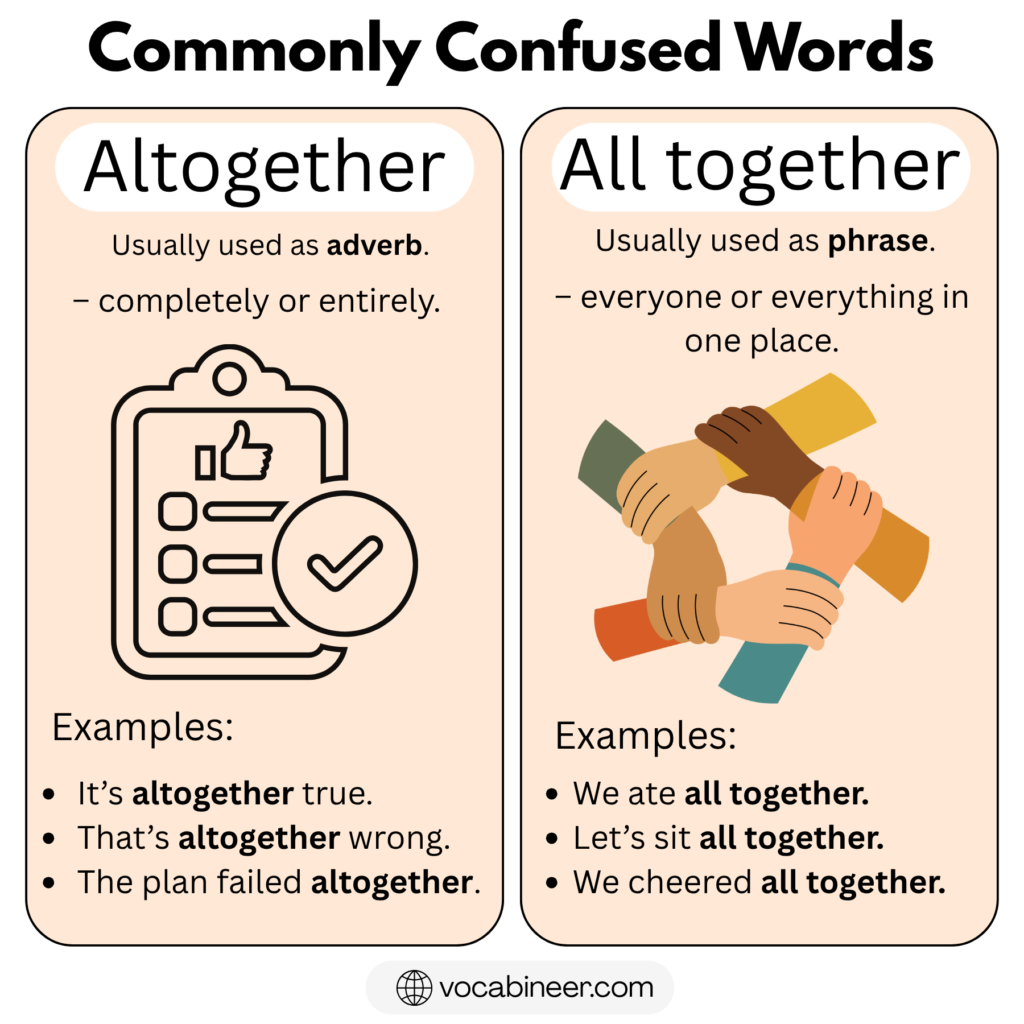
Altogether vs All Together: Difference in One Look
Altogether and All Together differ in both meaning and structure. Altogether is a single word and functions as an adverb. It expresses total amount, degree, or completeness. In contrast, All Together is a two-word phrase that emphasizes unity, grouping, or shared action.
The key distinction lies in context. If the sentence can be replaced with “completely” or “in total,” then Altogether is correct. However, if the sentence refers to people or things being in one place or acting as a group, then All Together is the right choice. Thus, one focuses on totality, while the other focuses on togetherness.
| Feature | Altogether | All Together |
|---|---|---|
| Form | One word | Two words |
| Part of Speech | Adverb | Phrase |
| Meaning | Completely / In total | In a group / In one place |
| Focus | Degree or amount | Unity or grouping |
| Replace With | Entirely / Totally | As a group |
This comparison shows that Altogether describes completeness, whereas All Together describes collective action.
Altogether vs All Together: Side by Side Sentence Contrast
Comparing both forms in similar sentences makes the difference clearer. Therefore, notice how meaning changes even though pronunciation stays the same.
- The event was altogether unforgettable.
- The guests sat all together.
- The trip cost $800 altogether.
- The students stood all together on stage.
- I am not altogether convinced.
- The family gathered all together for dinner.
- The idea is altogether different.
- The team practiced all together before the match.
- She stopped working altogether.
- The children sang all together.
In each pair, Altogether shows total degree or completeness, whereas All Together shows unity or shared action.
Altogether vs All Together: Sentence Structure Comparison
Although both forms may appear at the end of a sentence, their grammar patterns differ.
Altogether patterns:
- Cost … altogether
- Not … altogether sure
- Altogether different
- Stop … altogether
- Altogether successful
All Together patterns:
- Sit all together
- Work all together
- Stand all together
- Sing all together
- Gather all together
Therefore, Altogether usually modifies a verb, adjective, or entire idea, while All Together describes how people or things act as a group.
When to Use Altogether and When to Use All Together
Use Altogether when the sentence expresses completeness, total amount, or degree. If you can replace the word with “completely,” “entirely,” or “in total,” then Altogether is correct. Therefore, it often appears in opinions, cost statements, and final judgments.
However, use All Together when the sentence describes people or things acting in unity or being in the same place. If the focus is on grouping, shared action, or physical togetherness, then All Together is the right choice. Thus, context clearly determines the correct form.
Context Based Usage Guide
If the sentence discusses total cost, overall opinion, or complete change, choose Altogether. For example:
- The repairs cost $1,000 altogether.
- I am not altogether satisfied.
- The result was altogether surprising.
- The system failed altogether.
- The experience was altogether different.
On the other hand, if the sentence involves families, teams, students, or groups acting as one, choose All Together. For instance:
- The family sat all together.
- The team practiced all together.
- The children played all together.
- We stood all together for the photo.
- Everyone shouted all together.
Therefore, always check whether the sentence shows totality or togetherness before choosing the correct form.
Grammar Difference Between Altogether and All Together
Although both expressions sound identical, their grammar roles are different. Altogether is a single adverb. Therefore, it modifies verbs, adjectives, or entire clauses. In contrast, All Together is a phrase made of a determiner and an adverb. As a result, it describes how people or things act in unity.
| Grammar Feature | Altogether | All Together |
|---|---|---|
| Word Form | One word | Two separate words |
| Part of Speech | Adverb | Phrase (determiner + adverb) |
| Function | Modifies verbs, adjectives, or whole clauses | Describes group action or unity |
| Meaning Focus | Degree, completeness, total amount | Togetherness, shared action |
| Sentence Role | Shows how completely something happens | Shows people/things acting as one |
| Replace With | Completely / Entirely / In total | As a group / In one place |
| Example Pattern | Not altogether sure | Sit all together |
| Position in Sentence | Often before adjectives or at sentence end | Usually after verbs describing action |
| Can Modify Nouns? | No | No (describes action, not noun directly) |
| Interchangeable? | No | No |
This table clearly shows that Altogether works as an adverb of degree, whereas All Together works as a phrase describing unity or collective action.
Pronunciation Difference Between Altogether and All Together
In spoken English, Altogether and All Together are pronounced almost the same. Therefore, listening alone does not help you distinguish them easily. Both follow similar stress patterns in natural speech.
However, in careful pronunciation, All Together may have slight separation between the words. Even so, the difference is subtle. As a result, correct usage depends on meaning and grammar rather than sound.
Common Mistakes With Altogether and All Together
Altogether vs All Together mistakes usually happen because both expressions sound the same in speech. However, the meaning changes depending on whether the sentence shows completeness or grouping.
- Incorrect: The students worked altogether on the project.
Correct: The students worked all together on the project. - Incorrect: The total cost was $600 all together.
Correct: The total cost was $600 altogether. - Incorrect: The family sat altogether at the table.
Correct: The family sat all together at the table. - Incorrect: I am not all together ready.
Correct: I am not altogether ready. - Incorrect: The players practiced altogether before the match.
Correct: The players practiced all together before the match. - Incorrect: She stopped calling him all together.
Correct: She stopped calling him altogether. - Incorrect: The guests gathered altogether in one room.
Correct: The guests gathered all together in one room. - Incorrect: The repairs cost $1,200 all together.
Correct: The repairs cost $1,200 altogether. - Incorrect: The team celebrated altogether after the win.
Correct: The team celebrated all together after the win. - Incorrect: He gave up smoking all together.
Correct: He gave up smoking altogether.
Therefore, always check the sentence meaning carefully. If the word can be replaced with “completely” or “in total,” use Altogether. If it describes people acting as a group, use All Together.
Altogether vs All Together: Frequently Asked Questions
Altogether means completely or in total. In contrast, All Together means in a group or in one place.
No, they cannot. Although they sound the same, their meanings are different. Therefore, replacing one with the other changes the sentence meaning.
Yes, Altogether is always written as one word because it functions as an adverb of degree or total amount.
Yes, All Together is always written as two separate words because it describes unity or grouping.
If you can replace the word with “completely,” “entirely,” or “in total,” use Altogether. However, if the sentence describes people acting as a group, use All Together.
Yes, Altogether often appears in formal writing because it expresses total amount or overall judgment.
Not always. It can refer to people or things acting or placed as one group.
They are confusing because they are pronounced the same. As a result, writers sometimes choose the wrong spelling without checking the meaning.
Final Summary
Altogether vs All Together may sound the same, yet their meanings are clearly different. Altogether expresses completeness or total amount, whereas All Together describes people or things acting in unity. Therefore, always check the context carefully. If the focus is totality, use Altogether. If the focus is grouping, use All Together.
Read More
- Confusing Words in English
- American vs British Words
- Right vs Write in English
- Altogether vs All Together
