

Antonyms are words that express opposite meanings and are used to show contrast clearly in language. They help explain ideas by placing one meaning against another, such as actions that stop or continue, qualities that increase or decrease, or states that differ completely. By using antonyms, writers and speakers can compare situations, clarify meaning, and make sentences more precise. Understanding antonyms through examples makes it easier to recognize how meaning shifts across different contexts in English.
In This Page
1000 Antonym Examples in English
This section brings together a wide range of antonym pairs that show clear opposite meanings across both common and less familiar words used in English.
Common Antonym Examples
Common antonyms are widely recognized opposite pairs that appear often in reading, writing, and everyday language, making them easy to identify and understand.
- Big – Small
- Hot – Cold
- Fast – Slow
- Good – Bad
- Old – New
- Happy – Sad
- Open – Closed
- Full – Empty
- Strong – Weak
- Easy – Hard
- Near – Far
- Clean – Dirty
- Early – Late
- Right – Wrong
- Light – Dark
- High – Low
- Rich – Poor
- Safe – Dangerous
- Loud – Quiet
- Start – Finish
- Soft – Hard
- Wet – Dry
- Tall – Short
- Heavy – Light
- Sharp – Dull
- Busy – Free
- Calm – Angry
- True – False
- Same – Different
- Public – Private
- Simple – Complex
- Open – Shut
- Young – Old
- Strong – Fragile
- Thin – Thick
- Smooth – Rough
- Bright – Dim
- Full – Vacant
- Deep – Shallow
- Alive – Dead
- Fair – Unfair
- Clean – Messy
- Safe – Unsafe
- Correct – Incorrect
- Possible – Impossible
- Natural – Artificial
- Useful – Useless
- Clear – Confusing
- Fresh – Stale
- Quiet – Noisy
- Polite – Rude
- Honest – Dishonest
- Kind – Cruel
- Strong – Weak
- Early – Delayed
- Fast – Late
- Warm – Cool
- Hard – Soft
- Open – Locked
- Ready – Unprepared
- Empty – Filled
- Sharp – Blunt
- Wide – Narrow
- Busy – Idle
- Smooth – Bumpy
- Clean – Polluted
- Rich – Needy
- Bright – Dark
- Thick – Thin
- Silent – Loud
- Strong – Feeble
- High – Short
- Clear – Cloudy
- Soft – Firm
- Large – Tiny
- Hot – Cool
- Deep – Flat
- Free – Restricted
- Safe – Risky
- Calm – Excited
- Heavy – Light
- Hard – Gentle
- Long – Short
- Fast – Steady
- Warm – Cold
- Open – Sealed
- New – Used
- Clean – Dirty
- Full – Bare
- Quiet – Talkative
- Light – Heavy
- Hard – Flexible
- Smooth – Coarse
- Wide – Slim
- Safe – Harmful
- Calm – Tense
- Bright – Faint
- Thick – Slim
- Open – Closed
- Strong – Delicate
- Fresh – Old
- Clean – Stained
- Sharp – Rounded
- Loud – Soft
- Easy – Tough
- High – Low
- Busy – Relaxed
- Happy – Unhappy
- Open – Blocked
- Calm – Nervous
- Heavy – Light
- Clear – Blurry
- Fast – Sluggish
- Safe – Threatening
- Bright – Pale
- Strong – Fragile
- Full – Hollow
- Smooth – Uneven
- Warm – Chilly
- Open – Shut
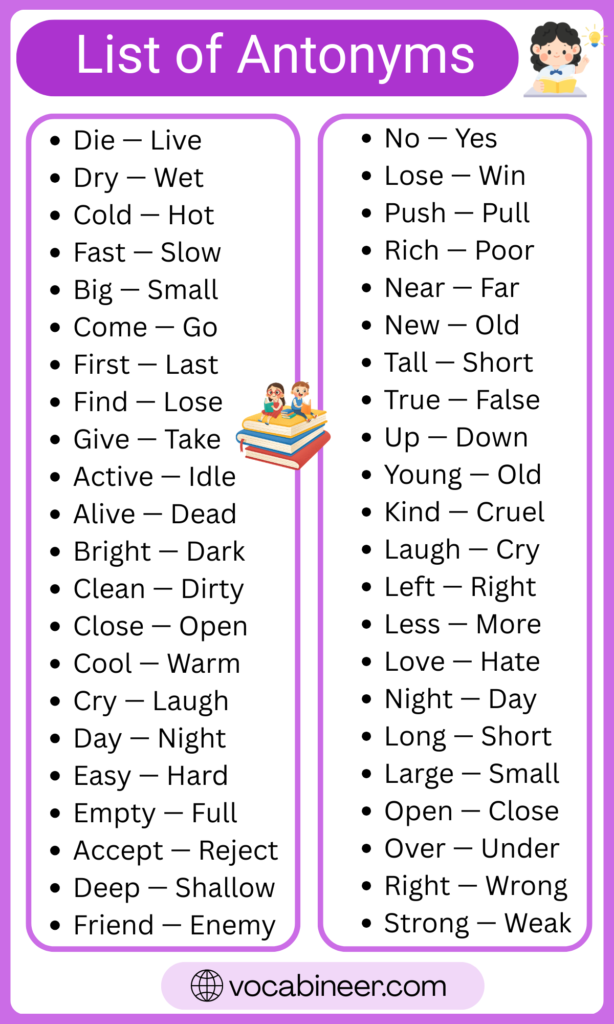
Everyday Antonym Pairs
Everyday antonym pairs are used in daily conversation and simple sentences to express contrast in actions, choices, and basic situations.
- Come – Go
- Buy – Sell
- Give – Take
- Sit – Stand
- Laugh – Cry
- Win – Lose
- Push – Pull
- Begin – End
- Arrive – Leave
- Ask – Answer
- Wake – Sleep
- Open – Close
- Enter – Exit
- Speak – Listen
- Work – Rest
- Remember – Forget
- Build – Destroy
- Catch – Miss
- Love – Hate
- Find – Lose
- Pay – Receive
- Send – Receive
- Start – Stop
- Move – Stay
- Lead – Follow
- Agree – Disagree
- Accept – Refuse
- Smile – Frown
- Teach – Learn
- Save – Spend
- Borrow – Lend
- Dress – Undress
- Rise – Fall
- Buy – Return
- Ask – Reply
- Call – Ignore
- Help – Hinder
- Wait – Hurry
- Share – Keep
- Speak – Remain silent
- Eat – Fast
- Drink – Abstain
- Knock – Enter
- Close – Open
- Stop – Continue
- Travel – Stay
- Order – Cancel
- Join – Leave
- Begin – Finish
- Try – Quit
- Choose – Reject
- Enter – Depart
- Wake – Doze
- Read – Write
- Watch – Ignore
- Listen – Talk
- Buy – Rent
- Meet – Separate
- Plan – Cancel
- Give – Withhold
- Ask – Tell
- Follow – Lead
- Speak – Whisper
- Smile – Cry
- Help – Refuse
- Work – Relax
- Hurry – Delay
- Spend – Save
- Build – Tear down
- Catch – Drop
- Start – Pause
- Walk – Run
- Stay – Leave
- Push – Resist
- Accept – Decline
- Teach – Study
- Remember – Ignore
- Try – Avoid
- Gain – Lose
- Come – Depart
- Speak – Stay quiet
- Give – Receive
- Ask – Demand
- Wait – Rush
- Eat – Skip
- Join – Separate
- Buy – Exchange
- Open – Lock
- Sit – Rise
- Move – Freeze
- Laugh – Weep
- Begin – Pause
- Help – Block
- Answer – Question
- Work – Quit
- Lead – Obey
- Speak – Mute
- Try – Fail
- Gather – Scatter
- Follow – Ignore
- Dress – Change
- Wake – Rest
- Ask – Command
- Smile – Scowl
- Build – Remove
- Give – Take back
- Plan – Improvise
- Start – End
- Speak – Hold back
- Act – Hesitate
- Meet – Avoid
- Push – Yield
- Enter – Stay out
- Buy – Boycott
- Help – Harm
- Save – Waste
- Travel – Return
- Lead – Submit
- Ask – Answer back
- Come – Stay away
Antonyms for Describing People
These antonyms describe opposite personal qualities, behaviors, or traits, helping show contrast in character, attitude, and personality.
- Brave – Cowardly
- Kind – Cruel
- Honest – Dishonest
- Polite – Rude
- Friendly – Hostile
- Patient – Impatient
- Generous – Stingy
- Humble – Proud
- Calm – Aggressive
- Confident – Insecure
- Careful – Careless
- Cheerful – Gloomy
- Loyal – Disloyal
- Active – Lazy
- Serious – Playful
- Fair – Unfair
- Gentle – Rough
- Helpful – Useless
- Respectful – Disrespectful
- Responsible – Irresponsible
- Wise – Foolish
- Mature – Immature
- Social – Shy
- Optimistic – Pessimistic
- Honest – Deceptive
- Friendly – Unfriendly
- Confident – Doubtful
- Patient – Restless
- Bold – Timid
- Calm – Nervous
- Caring – Heartless
- Curious – Indifferent
- Talkative – Quiet
- Reliable – Unreliable
- Cheerful – Miserable
- Polite – Impolite
- Hardworking – Lazy
- Thoughtful – Thoughtless
- Brave – Fearful
- Gentle – Harsh
- Kindhearted – Mean
- Sincere – Insincere
- Cooperative – Uncooperative
- Honest – Corrupt
- Respectful – Rude
- Friendly – Cold
- Patient – Irritable
- Humble – Arrogant
- Open-minded – Narrow-minded
- Responsible – Careless
- Outgoing – Reserved
- Serious – Lighthearted
- Loyal – Unfaithful
- Calm – Tense
- Helpful – Obstructive
- Positive – Negative
- Confident – Hesitant
- Caring – Neglectful
- Polite – Abrupt
- Brave – Timorous
- Considerate – Selfish
- Cheerful – Sad
- Honest – Lying
- Friendly – Distant
- Patient – Hasty
- Reliable – Inconsistent
- Kind – Unkind
- Calm – Upset
- Humorous – Serious
- Gentle – Forceful
- Supportive – Critical
- Trustworthy – Untrustworthy
- Confident – Timid
- Friendly – Aloof
- Mature – Childish
- Polite – Offensive
- Warm – Cold
- Calm – Agitated
- Helpful – Hindering
- Brave – Weak
- Loyal – Treacherous
- Honest – Fraudulent
- Friendly – Mean
- Patient – Short-tempered
- Generous – Selfish
- Calm – Furious
- Confident – Unsure
- Gentle – Violent
- Respectful – Disrespectful
- Caring – Cruel
- Cheerful – Somber
- Social – Withdrawn
- Humble – Boastful
- Reliable – Unstable
- Thoughtful – Careless
- Friendly – Hostile
- Calm – Anxious
- Honest – Sneaky
- Brave – Afraid
- Polite – Harsh
- Kind – Heartless
- Patient – Impulsive
- Supportive – Unsupportive
- Confident – Fearful
- Gentle – Abrasive
- Friendly – Cold-hearted
- Calm – Irritated
- Respectful – Offensive
- Helpful – Harmful
- Brave – Spineless
- Honest – Crooked
- Friendly – Rude
- Loyal – Disloyal
- Patient – Demanding
- Calm – Panicked
- Kind – Malicious
- Confident – Self-doubting
- Polite – Vulgar
- Caring – Indifferent
- Brave – Timid
Antonyms for Actions
Action-based antonyms show contrast between what is done and what is stopped, reversed, or avoided in everyday activities.
- Accept – Reject
- Add – Subtract
- Advance – Retreat
- Agree – Disagree
- Allow – Forbid
- Answer – Ask
- Arrive – Depart
- Attack – Defend
- Begin – End
- Build – Destroy
- Buy – Sell
- Catch – Miss
- Close – Open
- Come – Go
- Continue – Stop
- Create – Destroy
- Decide – Hesitate
- Decrease – Increase
- Defeat – Surrender
- Deliver – Collect
- Enter – Exit
- Expand – Contract
- Fail – Succeed
- Finish – Start
- Follow – Lead
- Forget – Remember
- Gather – Scatter
- Give – Take
- Grow – Shrink
- Help – Hinder
- Improve – Worsen
- Include – Exclude
- Join – Separate
- Laugh – Cry
- Learn – Teach
- Lend – Borrow
- Lift – Drop
- Lose – Win
- Lower – Raise
- Move – Stay
- Open – Shut
- Order – Cancel
- Pass – Fail
- Pay – Receive
- Plan – Cancel
- Pull – Push
- Quit – Continue
- Reach – Miss
- Receive – Give
- Reduce – Increase
- Remember – Forget
- Remove – Replace
- Rise – Fall
- Save – Spend
- Search – Find
- Sell – Buy
- Send – Receive
- Show – Hide
- Speak – Listen
- Spend – Save
- Start – Stop
- Strengthen – Weaken
- Succeed – Fail
- Take – Give
- Teach – Learn
- Throw – Catch
- Try – Avoid
- Unite – Divide
- Use – Waste
- Walk – Run
- Win – Lose
- Withdraw – Deposit
- Work – Rest
- Write – Erase
- Yield – Resist
- Approve – Oppose
- Ask – Reply
- Borrow – Lend
- Break – Fix
- Carry – Drop
- Charge – Release
- Choose – Reject
- Clean – Dirty
- Climb – Descend
- Collect – Distribute
- Copy – Create
- Cover – Expose
- Damage – Repair
- Delay – Hurry
- Destroy – Build
- Dress – Undress
- Drop – Lift
- Encourage – Discourage
- Enter – Leave
- Escape – Capture
- Examine – Ignore
- Fix – Break
- Guard – Attack
- Hurry – Wait
- Invite – Exclude
- Lead – Follow
- Lock – Unlock
- Mix – Separate
- Notice – Ignore
- Obey – Disobey
- Pack – Unpack
- Protect – Harm
- Push – Pull
- Reach – Avoid
- Remove – Attach
- Return – Keep
- Save – Waste
- Search – Hide
- Secure – Release
- Serve – Ignore
- Share – Keep
- Support – Oppose
- Take – Refuse
- Tie – Untie
- Use – Avoid
Antonyms for Objects and Conditions
These antonyms describe opposite physical states, features, or conditions of objects, materials, and surroundings.
- Hard – Soft
- Wet – Dry
- Clean – Dirty
- Full – Empty
- Open – Closed
- Heavy – Light
- Sharp – Dull
- Smooth – Rough
- Thick – Thin
- Wide – Narrow
- Bright – Dark
- Hot – Cold
- New – Old
- Strong – Weak
- Solid – Liquid
- Flexible – Rigid
- Clear – Cloudy
- Fresh – Stale
- Deep – Shallow
- Safe – Unsafe
- Loose – Tight
- Broken – Fixed
- Clean – Messy
- Dry – Damp
- Full – Hollow
- Flat – Curved
- Heavy – Weightless
- Sharp – Blunt
- Bright – Dim
- Smooth – Uneven
- Thick – Slim
- Wide – Slim
- Hard – Flexible
- Warm – Cool
- Polished – Rough
- Dirty – Spotless
- Secure – Loose
- Fixed – Movable
- Stable – Unstable
- Quiet – Noisy
- Strong – Fragile
- Clear – Blurry
- Rough – Soft
- Solid – Fragile
- Warm – Chilly
- Clean – Polluted
- Sharp – Rounded
- Heavy – Airy
- Hard – Gentle
- Bright – Pale
- Thick – Thin
- Smooth – Coarse
- Dry – Soaked
- Clean – Stained
- Solid – Hollow
- Wide – Narrow
- Heavy – Featherlight
- Safe – Risky
- Secure – Unsafe
- Stable – Shaky
- Hard – Spongy
- Fresh – Rotten
- Smooth – Jagged
- Clear – Murky
- Warm – Icy
- Solid – Soft
- Clean – Filthy
- Dry – Wet
- Heavy – Light
- Thick – Paper-thin
- Bright – Dull
- Flat – Bumpy
- Safe – Dangerous
- Solid – Liquid
- Flexible – Stiff
- Clean – Contaminated
- Dry – Moist
- Heavy – Portable
- Stable – Fragile
- Smooth – Wrinkled
- Thick – Slim
- Warm – Freezing
- Clean – Untidy
- Hard – Mushy
- Bright – Shadowy
- Secure – Exposed
- Fresh – Spoiled
- Solid – Gaseous
- Rough – Polished
- Safe – Hazardous
- Clear – Obscure
- Heavy – Lightweight
- Dry – Flooded
- Thick – Narrow
- Warm – Cold
- Smooth – Grainy
- Clean – Grimy
- Solid – Brittle
- Stable – Wobbly
- Bright – Faded
- Hard – Cushioned
- Clean – Soiled
- Dry – Soggy
- Strong – Breakable
- Clear – Hazy
- Warm – Frosty
- Heavy – Handy
- Solid – Porous
- Rough – Smooth
- Safe – Unsafe
- Clean – Muddy
- Dry – Humid
- Thick – Thin
- Bright – Muted
- Hard – Pliable
- Smooth – Cracked
- Fresh – Aged
- Solid – Soft
- Heavy – Compact
- Safe – Perilous
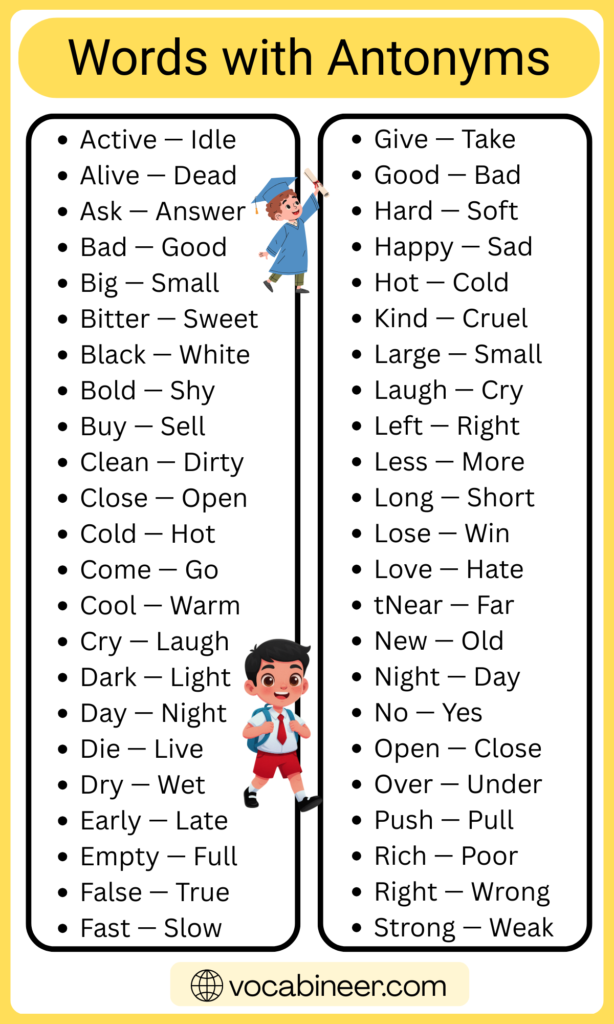
Antonyms for Feelings and Emotions
Emotion-related antonyms show contrast between different emotional states, reactions, and internal feelings expressed in language.
- Happy – Sad
- Calm – Anxious
- Excited – Bored
- Confident – Doubtful
- Proud – Ashamed
- Relaxed – Tense
- Cheerful – Gloomy
- Hopeful – Hopeless
- Brave – Afraid
- Content – Dissatisfied
- Angry – Calm
- Nervous – Relaxed
- Joyful – Miserable
- Peaceful – Troubled
- Loving – Hateful
- Secure – Insecure
- Friendly – Hostile
- Patient – Impatient
- Optimistic – Pessimistic
- Comfortable – Uncomfortable
- Fearful – Confident
- Cheerful – Sad
- Calm – Upset
- Excited – Uninterested
- Happy – Unhappy
- Relaxed – Stressed
- Proud – Humble
- Grateful – Ungrateful
- Kind – Cruel
- Confident – Hesitant
- Hopeful – Discouraged
- Calm – Irritated
- Loving – Cold
- Joyful – Depressed
- Secure – Unsafe
- Brave – Cowardly
- Content – Frustrated
- Calm – Panicked
- Happy – Miserable
- Relaxed – Worried
- Excited – Calm
- Cheerful – Melancholy
- Proud – Modest
- Hopeful – Doubtful
- Loving – Hostile
- Calm – Furious
- Confident – Insecure
- Peaceful – Aggressive
- Joyful – Sorrowful
- Comfortable – Uneasy
- Happy – Dejected
- Relaxed – Pressured
- Grateful – Thankless
- Brave – Timid
- Calm – Restless
- Hopeful – Despairing
- Loving – Unkind
- Cheerful – Somber
- Confident – Fearful
- Content – Unhappy
- Calm – Disturbed
- Excited – Indifferent
- Proud – Embarrassed
- Happy – Downcast
- Secure – Vulnerable
- Loving – Cruel
- Relaxed – Strained
- Cheerful – Grim
- Confident – Uncertain
- Calm – Agitated
- Hopeful – Cynical
- Joyful – Bleak
- Proud – Self-conscious
- Calm – Nervous
- Happy – Upset
- Relaxed – Taut
- Confident – Self-doubting
- Cheerful – Low
- Loving – Distant
- Content – Bitter
- Calm – Troubled
- Excited – Flat
- Happy – Displeased
- Relaxed – On edge
- Confident – Unsure
- Cheerful – Dreary
- Proud – Regretful
- Loving – Resentful
- Calm – Alarmed
- Content – Dissatisfied
Antonym Examples for Time and Order
These antonyms relate to opposite positions in time, sequence, or order, often used to explain when events happen or change.
- Early – Late
- Before – After
- Start – Finish
- Begin – End
- First – Last
- Past – Present
- Present – Absent
- Temporary – Permanent
- Quick – Slow
- Immediate – Delayed
- Short – Long
- New – Old
- Modern – Ancient
- Current – Outdated
- Initial – Final
- Prompt – Late
- Early – Delayed
- On time – Late
- Regular – Irregular
- Daily – Occasional
- Constant – Occasional
- Fast – Gradual
- Sudden – Gradual
- Instant – Slow
- Rapid – Steady
- Timely – Untimely
- Brief – Lengthy
- Now – Later
- Soon – Eventually
- Immediate – Eventual
- Early – Belated
- Prior – Subsequent
- Former – Latter
- Precede – Follow
- Begin – Conclude
- Start – Pause
- Order – Chaos
- Sequence – Disorder
- Regular – Random
- Continuous – Interrupted
- Short-term – Long-term
- Quick – Prolonged
- Instant – Delayed
- Early – Postponed
- First – Next
- Previous – Following
- Initial – Subsequent
- Temporary – Lasting
- Start – Completion
- Begin – Halt
- Early – Tardy
- Current – Past
- Modern – Traditional
- Immediate – Future
- Early – Deferred
- Short-lived – Enduring
- Prompt – Delayed
- Beginning – Ending
- First – Final
- Start – Terminate
- Present – Past
- Early – Slow
- Quick – Lingering
- Short – Extended
- Timely – Late
- Immediate – Postponed
- Sudden – Planned
- Fast – Drawn-out
- Beginning – Finish
- Start – Close
- Early – Overdue
- Prompt – Belated
- First – Following
- Initial – Ultimate
- Present – Future
- Now – Then
- Early – Late-arriving
- Swift – Leisurely
- Quick – Lengthy
- Early – Delayed
- Regular – Sporadic
- Timely – Missed
- Immediate – Deferred
- Start – Wrap up
- Early – Final
- Short – Protracted
- First – Endmost
- Early – Prolonged
- Prompt – Slow
- Beginning – Conclusion
Antonyms for Quantity and Degree
Quantity and degree antonyms express contrast in amount, size, level, or intensity within descriptions and comparisons.
- Many – Few
- Much – Little
- More – Less
- Most – Least
- All – None
- Full – Empty
- Plenty – Scarcity
- Heavy – Light
- Large – Small
- Big – Tiny
- High – Low
- Maximum – Minimum
- Wide – Narrow
- Thick – Thin
- Strong – Weak
- Rich – Poor
- Dense – Sparse
- Major – Minor
- Abundant – Scarce
- Excessive – Moderate
- Enough – Insufficient
- Total – Partial
- Complete – Incomplete
- Whole – Fragmented
- Intense – Mild
- Extreme – Moderate
- Powerful – Weak
- Heavy – Light
- Substantial – Slight
- Great – Small
- Plenty – Lack
- High-level – Basic
- Broad – Limited
- Massive – Tiny
- Extensive – Limited
- Strong – Faint
- Thick – Slender
- Heavy – Lightweight
- Deep – Shallow
- Large-scale – Small-scale
- High – Modest
- Maximum – Least
- Overflowing – Empty
- Vast – Narrow
- Huge – Minute
- Major – Trivial
- Considerable – Minor
- Great – Little
- Overfilled – Sparse
- Dense – Thin
- Plenty – None
- Abundant – Meager
- Heavy – Slight
- Massive – Compact
- Large – Petite
- Substantial – Minimal
- High – Minimal
- Loaded – Light
- Thick – Delicate
- Big – Compact
- Countless – Few
- Excess – Shortage
- Maximum – Minimal
- Full-scale – Limited
- Great – Modest
- Large – Narrow
- Extreme – Slight
- Big – Minor
- Plenty – Insufficient
- Massive – Slim
- Heavy – Trivial
- Rich – Meager
- Large – Minor
- Thick – Light
- High – Shallow
- Vast – Small
- Extensive – Brief
- Significant – Insignificant
- Major – Negligible
- Large – Tiny
- Heavy – Minor
- High – Low-level
- Substantial – Thin
- Big – Slim
- Dense – Light
- Plenty – Bare
- Massive – Petite
- Great – Tiny
- Abundant – Limited
- Huge – Small
Antonyms for Direction and Position
These antonyms describe opposite locations, movement, or orientation, helping explain position and spatial relationships.
- Up – Down
- In – Out
- Left – Right
- Above – Below
- Front – Back
- Inside – Outside
- Near – Far
- Here – There
- Forward – Backward
- Top – Bottom
- North – South
- East – West
- Over – Under
- Before – Behind
- On – Off
- Into – Out of
- Across – Along
- Toward – Away
- High – Low
- Upper – Lower
- Ahead – Behind
- Near – Distant
- Inside – Beyond
- Above – Beneath
- Upward – Downward
- Central – Peripheral
- Vertical – Horizontal
- Straight – Curved
- Direct – Indirect
- Close – Distant
- Overhead – Underfoot
- Fore – Aft
- Nearside – Farside
- Inward – Outward
- Aboveground – Underground
- Uppermost – Lowermost
- Central – Outer
- Frontward – Rearward
- Onward – Backward
- Ascend – Descend
- Entering – Exiting
- Approaching – Recedj – moving away
- Close by – Far off
- Upright – Inverted
- Near end – Far end
- Upper – Bottom
- Topside – Underside
- Within – Beyond
- In front – Behind
- Upstream – Downstream
- Leading – Trailing
- Incoming – Outgoing
- Forward-facing – Rear-facing
- Inward-bound – Outward-bound
- Centralized – Scattered
- Toward – Away from
- Atop – Beneath
- Ground level – Elevated
- Onstage – Backstage
- Near position – Distant position
- Frontline – Rear
- Overhead – Below
- Near side – Far side
- Above water – Underwater
- Leftward – Rightward
- In place – Out of place
- High ground – Low ground
- Front end – Back end
- Inward-facing – Outward-facing
- Close range – Long range
- Upper level – Lower level
- Near field – Far field
- Inside edge – Outside edge
- Front row – Back row
- On top – Underneath
- Ahead of – Behind
- Inner – Outer
- Vertical position – Horizontal position
- Upper side – Lower side
- In line – Out of line
- Center – Edge
- Foremost – Hindmost
- Near point – Far point
- Above surface – Below surface
- Head – Tail
- Upper part – Lower part
- Forward motion – Backward motion
- In bounds – Out of bounds
- Upper section – Lower section
- Top position – Bottom position
Commonly Confused Antonyms
These antonym pairs are often confused because of similar usage or meaning, even though they express clear opposite ideas.
- Borrow – Lend
- Bring – Take
- Buy – Sell
- Accept – Reject
- Teach – Learn
- Raise – Lower
- Win – Lose
- Lose – Miss
- Hard – Difficult
- Say – Tell
- Early – Soon
- Big – Large
- Calm – Quiet
- Few – Little
- Old – Former
- Lay – Lie
- Come – Go
- Open – Unlock
- Close – Shut
- Speak – Talk
- Watch – See
- Hear – Listen
- Look – See
- Start – Begin
- Finish – End
- Empty – Vacant
- Bring – Fetch
- Farther – Further
- Fast – Quick
- Right – Correct
- Safe – Secure
- Hard – Harsh
- Alone – Lonely
- Calm – Still
- Big – Huge
- Say – Speak
- Lend – Give
- Near – Close
- Stop – Pause
- Before – Prior
How to Remember Antonyms
Remember antonyms by noticing common negative prefixes like un, in, im, ir, and dis, which often reverse meaning. Learning words in meaning groups also helps, such as direction pairs like up and down or time pairs like before and after.
Practice antonyms in short sentence pairs to see contrast clearly. Be aware that some words have more than one opposite depending on context. Review small sets regularly, using sentences when a pair feels confusing.
FAQs About Antonyms
In most everyday learning, they point to the same idea: words with opposite meanings. In grammar, antonyms is the formal term, while opposite words is the more common phrase used by learners.
No. Many words do not have a clear opposite. Some words describe specific things or ideas that do not naturally form an opposite pair, so forcing an antonym can create incorrect matches.
Yes. Context can change the best opposite. Old can pair with new for objects and young for people. Light can contrast with dark for brightness and heavy for weight.
Not always. Some antonyms are absolute, like alive and dead. Others are on a scale, like hot and cold, where middle meanings exist, such as warm or cool.
Keep antonyms in meaning groups and use short sentence pairs for practice. Also, watch for pairs that look similar but do different jobs, such as borrow and lend, or bring and take. These are often confused because they depend on direction and viewpoint.
Conclusion
Antonyms help you understand contrast by showing how meaning changes from one side to the other. When you learn them in groups, notice common prefix patterns, and practice them in short sentence pairs, the opposites become easier to recall and use accurately. Over time, regular review and context-based learning make antonym pairs feel natural instead of memorized.
Read More
