

Learning the antonyms for sharp helps readers understand how objects, sounds, actions, and ideas change when they lose edge, strength, or intensity. Sharp often connects to pointed shapes, strong sensations, quick thinking, or sudden sounds, while its opposites point to dullness, softness, slowness, or gentleness. These contrasts appear frequently in reading passages, classroom explanations, and daily descriptions where precision or intensity matters.
This article explains how antonyms for sharp work in different situations involving objects, senses, thinking, and expression. Knowing these opposite words helps learners talk about blunt tools, soft sounds, slow reactions, and gentle actions in school and everyday communication.
In This Page
What Does Sharp Mean in English?
The word sharp is used in English to describe something having a pointed edge, strong effect, or quick quality. It can refer to a sharp knife, sharp pain, sharp sound, or sharp mind. A sharp object can cut easily, sharp pain feels sudden and intense, sharp sounds are piercing, and a sharp person thinks quickly. Because the meaning of sharp changes by context, its opposite words also change depending on use.
Common Antonyms for Sharp With Meanings
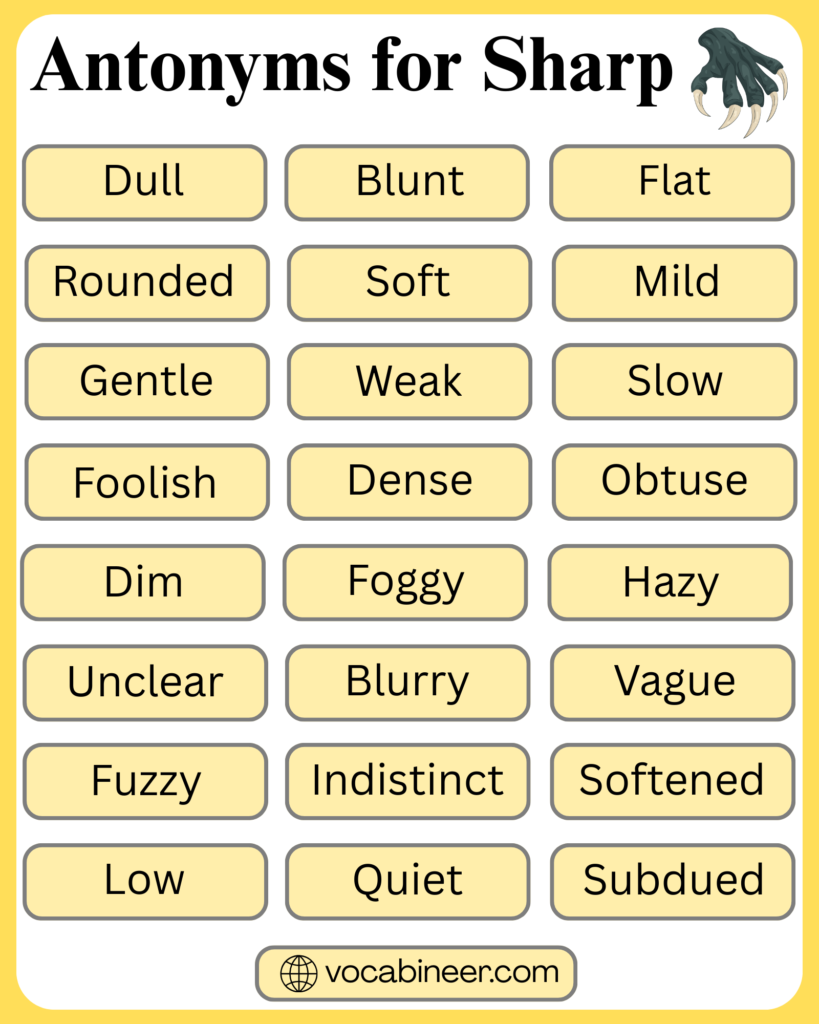
Understanding opposites of sharp helps readers describe objects, sounds, actions, and ideas that lack edge, intensity, or quickness. These words are often used in school texts and daily descriptions where something feels less cutting, less sudden, or less precise.
- Dull: Not sharp in edge, sound, or effect.
- Blunt: Having a rounded edge and unable to cut easily.
- Soft: Not hard, piercing, or intense in feel or sound.
- Mild: Gentle and not strong or sharp.
- Flat: Lacking sharpness in edge, sound, or expression.
- Rounded: Smooth and not pointed at the edges.
- Gentle: Not harsh or sharp in action or tone.
- Faint: Weak and barely noticeable in sound or feeling.
- Smooth: Free from sharp edges or sudden changes.
- Thick: Not thin or sharply edged.
- Muted: Softened and not sharp in sound.
- Calm: Free from sharp emotion or reaction.
- Slow: Not quick or sharp in response or movement.
- Vague: Not sharp or clear in meaning.
- Blurry: Not sharp in appearance or detail.
Antonyms for Sharp by Context
The opposite of sharp can change depending on what kind of sharpness you’re talking about, such as edge, sound, sensation, thinking, or expression. Choosing the right antonym helps your meaning stay clear and accurate.
Objects and Edges
When sharp refers to cutting edges or points, antonyms describe lack of edge.
- Dull – unable to cut well
- Blunt – rounded and thick
- Rounded – smooth at the edge
- Flat – without a cutting edge
- Thick – not narrow or sharp
Sound and Sensation
When sharp refers to sound or feeling, antonyms focus on softness or weakness.
- Soft – gentle to hear or feel
- Mild – not intense
- Faint – barely noticeable
- Muted – reduced in strength
- Gentle – not piercing
Thinking and Awareness
When sharp describes thinking or awareness, antonyms show slowness or lack of clarity.
- Slow – not quick to respond
- Dull – lacking mental sharpness
- Vague – unclear in thought
- Confused – not mentally sharp
- Unaware – not alert
Expression and Behavior
When sharp refers to words or actions, antonyms describe gentleness or calmness.
- Gentle – kind in tone
- Calm – not sharp in reaction
- Soft-spoken – not cutting or harsh
- Mild-mannered – gentle in behavior
- Polite – not sharp or rude
Sharp vs Similar Words
Understanding sharp vs similar words helps readers choose the correct term based on edge, intensity, sound, or thinking. Some words focus on physical points, while others describe strong effects, quick thinking, or piercing sounds. The table below explains how these words differ in meaning and use.
| Word | Meaning & Usage |
|---|---|
| Sharp | Having a cutting edge, strong effect, or quick quality. |
| Pointed | Having a narrow or tapered end. |
| Keen | Sharp in mind, senses, or interest. |
| Piercing | Very sharp or intense, especially in sound or pain. |
| Acute | Sudden and sharp in effect or feeling. |
| Cutting | Sharp enough to cut or hurt physically or emotionally. |
| Crisp | Sharp and clear, often used for sound or taste. |
| Intense | Very strong or extreme in effect, not always edged. |
| Severe | Harsh or sharp in impact, rules, or conditions. |
| Edgy | Slightly sharp, tense, or irritating in tone or feeling. |
How to Choose the Right Antonym for Sharp
Choosing the right antonym for sharp depends on what you are describing. For tools or objects, words like dull, blunt, or rounded fit best. When talking about sound or pain, soft, mild, or faint are more accurate. If sharp describes thinking or awareness, slow, vague, or confused works better. For speech or behavior, gentle, calm, or polite clearly express the opposite.
Conclusion
Understanding antonyms for sharp helps you describe objects, sounds, thoughts, and actions that lack edge, intensity, or quickness. Whether you are talking about a dull knife, soft sound, slow response, or gentle tone, knowing the right opposite words makes communication clearer and more precise in everyday learning and communication.
Read More
