

Learning the antonyms for freedom helps readers understand how independence, choice, and movement change when limits or control are present. Freedom often connects to liberty, rights, and personal choice; however, its opposites point to restriction, control, or lack of independence. As a result, these contrasts appear frequently in reading passages, civics lessons, and everyday situations where rules, authority, or limits shape behavior.
In this article, antonyms for freedom are explained across different situations involving rights, movement, decision-making, and control. By learning these opposites, learners can better talk about rules, boundaries, authority, and limited choices both in school and in daily communication.
In This Page
What Does Freedom Mean in English?
The word freedom is used in English to describe the state of being able to act, speak, or think without control or restriction. It can refer to personal freedom, political freedom, freedom of movement, or freedom of choice. When freedom exists, people act independently. When it is limited, control or rules take over. Because the meaning of freedom changes by context, its opposite words also change depending on use.
Common Antonyms for Freedom With Meanings
Understanding opposites of freedom helps readers describe situations where choice, movement, or independence is limited. These words are commonly used in school texts and everyday communication to explain control, rules, or lack of liberty.
- Restriction: A rule or limit that reduces choice or action.
- Control: Power used to direct or limit behavior.
- Captivity: Being held or kept under guard.
- Imprisonment: Being confined in prison or custody.
- Confinement: Restriction to a limited space or condition.
- Slavery: Complete loss of personal freedom and choice.
- Oppression: Unfair or harsh control over people.
- Restraint: Something that holds back free action.
- Limitation: A boundary that reduces independence.
- Bondage: State of being bound or controlled.
- Subjugation: Being forced under control or authority.
- Domination: Control exercised by power or force.
- Authority: Power to command and enforce rules.
- Tyranny: Cruel or oppressive rule.
- Constraint: A condition that restricts movement or choice.
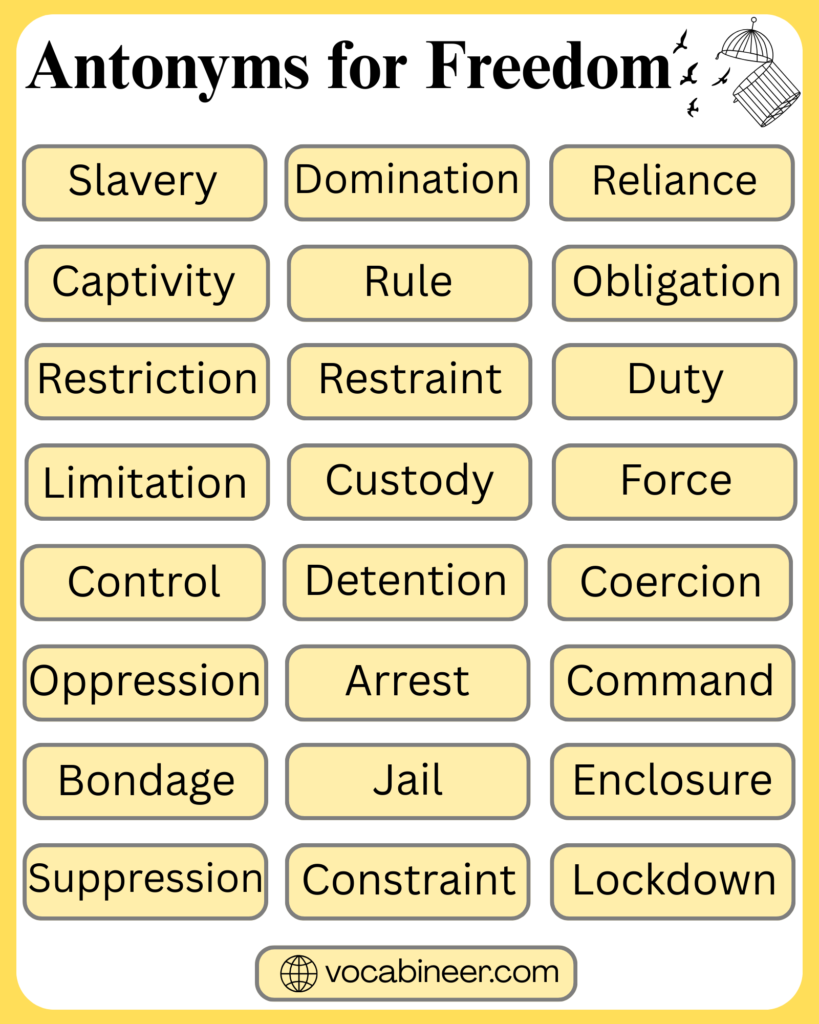
Antonyms for Freedom by Context
The opposite of freedom can change depending on what kind of freedom you’re talking about, such as personal, physical, political, or emotional. Choosing the right antonym helps your meaning stay clear and accurate.
Personal Choice and Action
When freedom refers to personal choice, antonyms describe limits and control.
- Restriction – limited choices
- Control – directed actions
- Restraint – held back from acting
- Limitation – reduced options
- Constraint – forced boundaries
Physical Movement
When freedom refers to movement, antonyms focus on confinement.
- Captivity – held against will
- Imprisonment – locked in custody
- Confinement – limited to one space
- Detention – temporary holding
- Bondage – lack of physical freedom
Political and Social Rights
When freedom refers to rights, antonyms describe unfair control.
- Oppression – harsh control
- Subjugation – forced obedience
- Domination – power over others
- Tyranny – cruel rule
- Authoritarianism – strict control
Emotional and Mental State
When freedom refers to inner choice, antonyms describe pressure or control.
- Pressure – forced influence
- Fear – mental restriction
- Obligation – forced duty
- Dependence – lack of independence
- Burden – limiting responsibility
Freedom vs Similar Words
Understanding freedom vs similar words helps readers choose the most accurate term when talking about independence, rights, or choice. Some words focus on legal rights, while others describe personal control or release from limits. The table below explains how these words differ in meaning and use.
| Word | Meaning & Usage |
|---|---|
| Freedom | Ability to act, speak, or choose without restriction. |
| Liberty | Legal or political freedom protected by law. |
| Independence | Freedom from control or influence by others. |
| Autonomy | Ability to govern or control oneself. |
| Choice | Power to decide between options freely. |
| Rights | Legal freedoms given by law or authority. |
| Privilege | Special freedom or benefit granted, not equal for all. |
| Release | Act of being set free from control or confinement. |
| Emancipation | Freedom from slavery, control, or restraint. |
| Self-rule | Ability to govern oneself or one’s own affairs. |
How to Choose the Right Antonym for Freedom
Choosing the right antonym for freedom depends on context. For personal choice, restriction or control fits best. When talking about movement, captivity or confinement is more accurate. For political freedom, oppression or tyranny works naturally. Thinking about what kind of freedom is missing helps select the correct opposite.
Conclusion
Understanding antonyms for freedom helps you describe situations where independence, choice, or movement is limited. Whether you are talking about rules, confinement, authority, or control, knowing the right opposite words makes communication clearer and more precise in everyday learning and communication.
Read More
