

Learning antonyms for protect helps readers understand how English expresses exposure, harm, neglect, risk, or endangerment instead of safety and care. When protection is removed or absent, language shifts to show vulnerability, danger, damage, or loss of security. These opposite words appear often in stories, school texts, conversations, news reports, and descriptive writing, shaping how actions, situations, and emotional responses are clearly communicated.
This article explains antonyms for protect using meanings, natural examples, and contextual explanations. Understanding these opposites helps describe emotional states, physical situations, social behavior, and real-life outcomes more accurately.
In This Page
Meaning of Protect in English
Protect means to keep someone or something safe from harm, danger, damage, or loss. It involves guarding, shielding, defending, or caring for someone or something to prevent injury, risk, or threat. Protection can be physical, emotional, social, or even legal.
The word protect is common in daily conversation, education, safety instructions, storytelling, and professional writing. When protection is removed or reversed, English uses different words to express harm, danger, neglect, or exposure.
Common Antonyms for Protect With Meanings
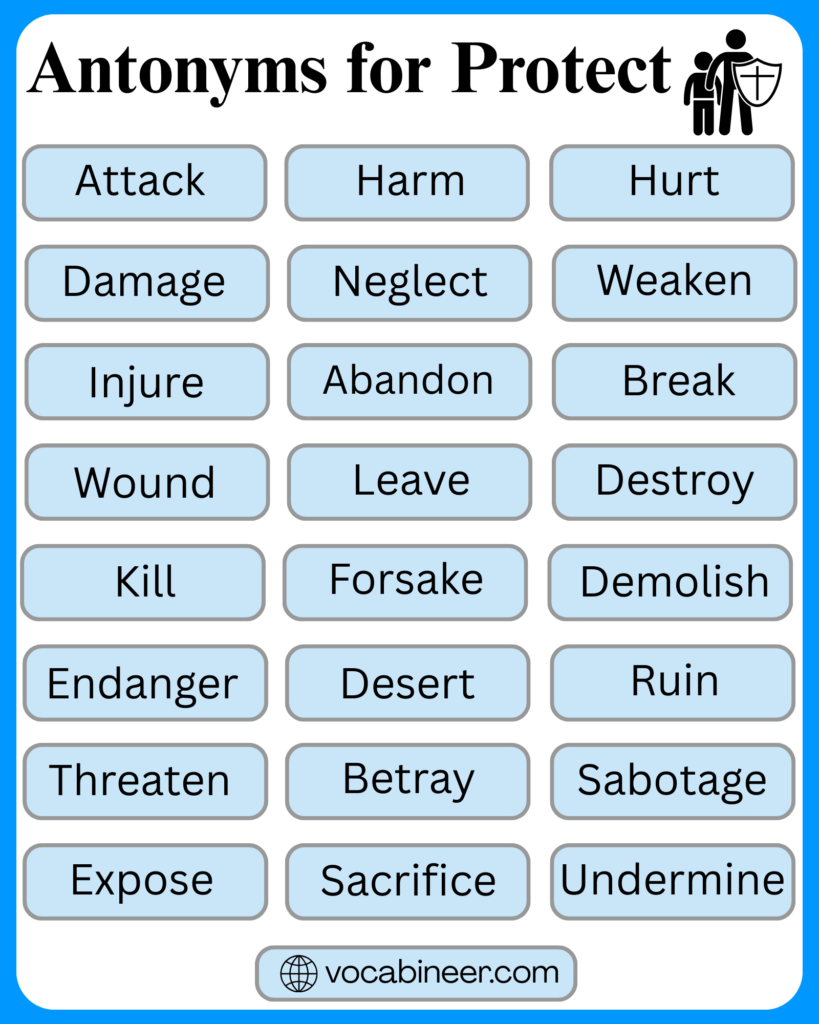
Some words clearly express the opposite of protect by showing exposure, harm, neglect, or danger instead of safety and care. These antonyms appear often in school texts, conversations, instructions, and descriptive writing.
- Endanger: To place someone or something in danger.
- Expose: To leave uncovered, unguarded, or without protection.
- Harm: To cause physical or emotional injury.
- Damage: To reduce strength, quality, or value.
- Injure: To cause physical pain or wounds.
- Neglect: To fail to provide proper care or attention.
- Abandon: To leave someone or something without support or safety.
- Threaten: To create fear, risk, or danger.
- Risk: To expose someone or something to possible harm.
- Jeopardize: To put at serious risk of damage or loss.
- Undermine: To weaken gradually or secretly.
- Attack: To act violently or aggressively toward someone or something.
- Destroy: To damage beyond repair.
- Compromise: To weaken safety, strength, or security.
- Sabotage: To deliberately damage success or safety.
Antonyms for Protect Related to Exposure
Some antonyms focus on leaving someone or something open to danger.
- Expose: Leaving uncovered or unguarded.
- Uncover: Removing protection or cover.
- Reveal: Making something known that should stay hidden.
- Disclose: Sharing private or sensitive information.
- Leave unguarded: Failing to provide protection.
Antonyms for Protect Related to Harm and Damage
Some antonyms emphasize injury, destruction, or emotional pain.
- Harm: Causing physical or emotional damage.
- Damage: Reducing quality or strength.
- Injure: Causing bodily pain.
- Wound: Inflicting physical or emotional hurt.
- Destroy: Breaking completely.
- Ruin: Causing lasting damage.
Antonyms for Protect Related to Neglect and Abandonment
Some antonyms describe failing to care or provide safety.
- Neglect: Failing to look after properly.
- Ignore: Choosing not to act.
- Abandon: Leaving without protection.
- Forsake: Turning away from responsibility.
- Desert: Leaving someone helpless.
Antonyms for Protect Related to Risk and Threat
Some antonyms focus on creating danger or fear.
- Endanger: Putting in danger.
- Threaten: Creating fear or harm.
- Risk: Exposing to danger.
- Jeopardize: Placing at serious risk.
- Compromise: Weakening safety or strength.
Words Related to Danger and Vulnerability
Some related words add depth to situations involving lack of protection.
- Vulnerability: State of being exposed to harm.
- Risk: Chance of danger.
- Threat: Possible harm.
- Exposure: Lack of cover or safety.
- Weakness: Reduced ability to defend.
Protect vs Similar Words
Below is a comparison showing how protect differs from related words in meaning and use.
| Word | Difference from Protect |
|---|---|
| Protect | Means to keep safe from harm or danger. |
| Defend | Focuses on active resistance against attack. |
| Guard | Means watching carefully to prevent harm. |
| Shield | Focuses on blocking physical or emotional harm. |
| Secure | Means making safe through systems or locks. |
| Preserve | Focuses on keeping in original condition. |
| Save | Means rescuing from danger. |
| Cover | Focuses on physical protection. |
Antonyms for Protect in Sentences
Seeing antonyms used in sentences helps learners understand natural usage.
- Leaving the gate open exposed the house to danger.
- His careless actions endangered everyone.
- Harsh words can harm emotional health.
- The broken wall compromised safety.
- She felt abandoned in difficult times.
- Ignoring warnings can risk serious injury.
- The storm damaged many homes.
How to Choose the Right Antonym for Protect
Choosing the right antonym for protect depends on the situation and the type of meaning you want to express. If the focus is on creating danger or risk, words like endanger, risk, or jeopardize fit best. When the meaning involves causing damage or injury, harm, injure, or damage is more suitable. For situations showing lack of care or responsibility, neglect, ignore, or abandon clearly express the absence of protection.
Conclusion
Understanding antonyms for protect helps readers recognize how English expresses exposure, harm, neglect, or danger instead of safety and care. These words appear across stories, school texts, conversations, instructions, and descriptive writing, shaping how actions, emotions, and outcomes are described. Learning them through explanation and natural examples builds clearer expression and deeper understanding of protection and vulnerability in English.
Read More
