

Learning the antonyms for simple helps readers understand how ideas, tasks, and explanations change when they become more detailed, demanding, or difficult. Simple often connects to ease, clarity, or lack of complexity, while its opposites point to complication, depth, or effort. These contrasts appear frequently in reading passages, classroom instructions, and learning activities where describing understanding or difficulty matters.
This article explains how antonyms for simple work in different situations involving tasks, ideas, language, and structure. Knowing these opposite words helps learners talk about complex topics, difficult work, detailed explanations, and demanding situations in school and daily communication.
In This Page
What Does Simple Mean in English?
The word simple is used in English to describe something easy, clear, or not complicated. It can refer to a simple task, a simple idea, simple language, or a simple design. A simple task is easy to complete, a simple explanation is easy to understand, and a simple rule has few steps. Because the meaning of simple changes depending on context, its opposite words also change.
Common Antonyms for Simple With Meanings
Understanding opposites of simple helps readers see how ease and clarity change when ideas, tasks, or structures become more demanding. These words are often used in school texts, instructions, and explanations where something is not easy, clear, or straightforward.
- Complex: Made of many connected parts or ideas.
- Complicated: Having many steps or details that are hard to follow.
- Difficult: Hard to do or understand.
- Hard: Requiring effort, skill, or thought.
- Confusing: Not clear in meaning or understanding.
- Detailed: Containing many small parts or facts.
- Involved: Needing careful attention and thinking.
- Advanced: Beyond the basic or beginner level.
- Challenging: Demanding skill, effort, or ability.
- Technical: Using special knowledge, terms, or methods.
- Elaborate: Carefully planned with many added details.
- Dense: Packed with information and difficult to follow.
- Sophisticated: Highly developed and complex.
- Demanding: Requiring a lot of effort or focus.
- Intricate: Having many small, closely connected parts.
- Lengthy: Long and full of details.
- Abstract: Not concrete or easy to picture.
- Rigorous: Strict and demanding in effort or rules.
- Thorough: Covering every detail carefully.
- Multifaceted: Having many sides or aspects.
- Layered: Built in levels with added complexity.
- Knotty: Hard to solve or understand.
- Cumbersome: Difficult to handle because of complexity.
- Overcomplicated: Made more complex than necessary.
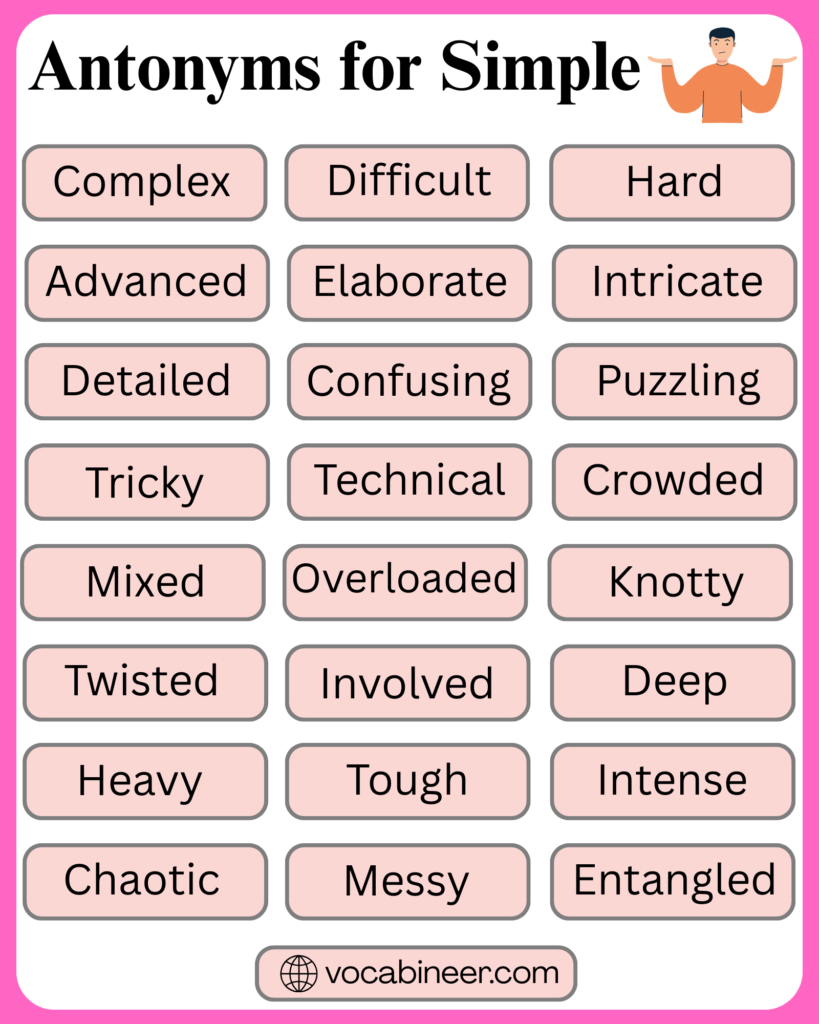
Antonyms for Simple by Context
The opposite of simple can change depending on what kind of simplicity you are talking about, such as tasks, ideas, language, or structure. Choosing the right antonym helps your meaning stay clear and accurate.
Tasks and Activities
When simple refers to ease of action, its antonyms describe difficulty or effort.
- Difficult – hard to complete
- Challenging – needs skill or effort
- Demanding – requires focus and work
- Hard – not easy to do
- Rigorous – strict and demanding
Ideas and Explanations
When simple describes clarity of ideas, antonyms focus on complexity.
- Complex – many connected ideas
- Complicated – not straightforward
- Confusing – unclear meaning
- Abstract – not easy to picture
- Dense – full of information
Language and Content
When simple refers to language or content level, antonyms describe depth or advancement.
- Advanced – beyond basic level
- Technical – uses special terms
- Sophisticated – developed and complex
- In-depth – very detailed
- Elaborate – carefully expanded
Rules, Systems, and Structure
When simple refers to structure or rules, antonyms suggest involvement or complexity.
- Involved – needs careful attention
- Multifaceted – many parts or sides
- Layered – built in levels
- Intricate – detailed and connected
- Compounded – increased in complexity
Simple vs Similar Words
Understanding simple vs similar words helps readers choose the right term based on ease, clarity, or structure. Some words suggest low effort, while others focus on plain style or beginner level. The table below shows how these words differ in meaning and use.
| Word | Meaning & Usage |
|---|---|
| Simple | Easy, clear, or not complex in idea, task, or structure. |
| Easy | Requires little effort to do or understand. |
| Plain | Lacks decoration or extra detail; focuses on appearance. |
| Basic | At an introductory or starting level. |
| Straightforward | Easy to follow without confusion or extra steps. |
| Clear | Easy to understand or see without difficulty. |
| Minimal | Very limited in detail or amount. |
| Elementary | Suitable for beginners or early learning stages. |
| Effortless | Needs very little work or energy. |
| Uncomplicated | Not complex and free from extra difficulty. |
How to Choose the Right Antonym for Simple
Choosing the right antonym for simple depends on context. For tasks, words like difficult or demanding fit best. For ideas or explanations, complex or confusing may be accurate. When describing language or systems, advanced, technical, or intricate works better. Thinking about what feels less easy or clear helps select the correct opposite.
Conclusion
Understanding antonyms for simple helps you describe ideas, tasks, language, and systems that are not easy or straightforward. Whether you are talking about a complex idea, a difficult task, or an advanced explanation, knowing the right opposite words makes communication clearer and more precise in everyday learning and communication.
Read More
