

Learning the antonyms for smooth helps readers understand how surfaces, actions, and processes change when they become rough, uneven, or difficult. Smooth often connects to even texture, easy movement, or calm progress, while its opposites point to roughness, bumps, resistance, or interruption. These contrasts appear frequently in reading passages, classroom explanations, and everyday descriptions where texture or ease matters.
This article explains how antonyms for smooth work in different situations involving surfaces, movement, speech, and processes. Knowing these opposite words helps learners talk about rough textures, uneven paths, difficult progress, and disrupted actions in school and daily communication.
In This Page
What Does Smooth Mean in English?
The word smooth is used in English to describe something even, flat, or free from bumps. It can refer to a smooth surface, smooth movement, smooth speech, or a smooth process. A smooth surface feels even, smooth motion happens without stops, and smooth progress occurs without problems. Because the meaning of smooth changes by context, its opposite words also change depending on use.
Common Antonyms for Smooth With Meanings
Understanding opposites of smooth helps readers describe surfaces, movement, sound, and processes that are not even, easy, or flowing. These words are often used in school texts and everyday descriptions where texture, motion, or progress feels difficult or uneven.
- Rough: Not even to touch and covered with bumps or ridges.
- Uneven: Not level or smooth across a surface.
- Bumpy: Full of small raised areas that disrupt smoothness.
- Coarse: Rough in texture and not fine or smooth.
- Jagged: Sharp and uneven at the edges.
- Grainy: Having a rough, sandy feel.
- Harsh: Rough or unpleasant in feel, sound, or tone.
- Rugged: Naturally rough and uneven in surface.
- Choppy: Not smooth in movement or flow.
- Scratchy: Causing irritation because of roughness.
- Irregular: Not smooth or consistent in shape or pattern.
- Rocky: Full of stones or uneven areas.
- Knotted: Full of hard or uneven spots.
- Jerky: Sudden and uneven in movement.
- Grating: Harsh and unpleasant to hear.
- Uneven-textured: Lacking a smooth surface.
- Ruffled: No longer smooth or flat.
- Broken: Not continuous or smooth in flow.
- Strained: Forced and not smooth in action or sound.
- Troubled: Not smooth due to problems or difficulty.
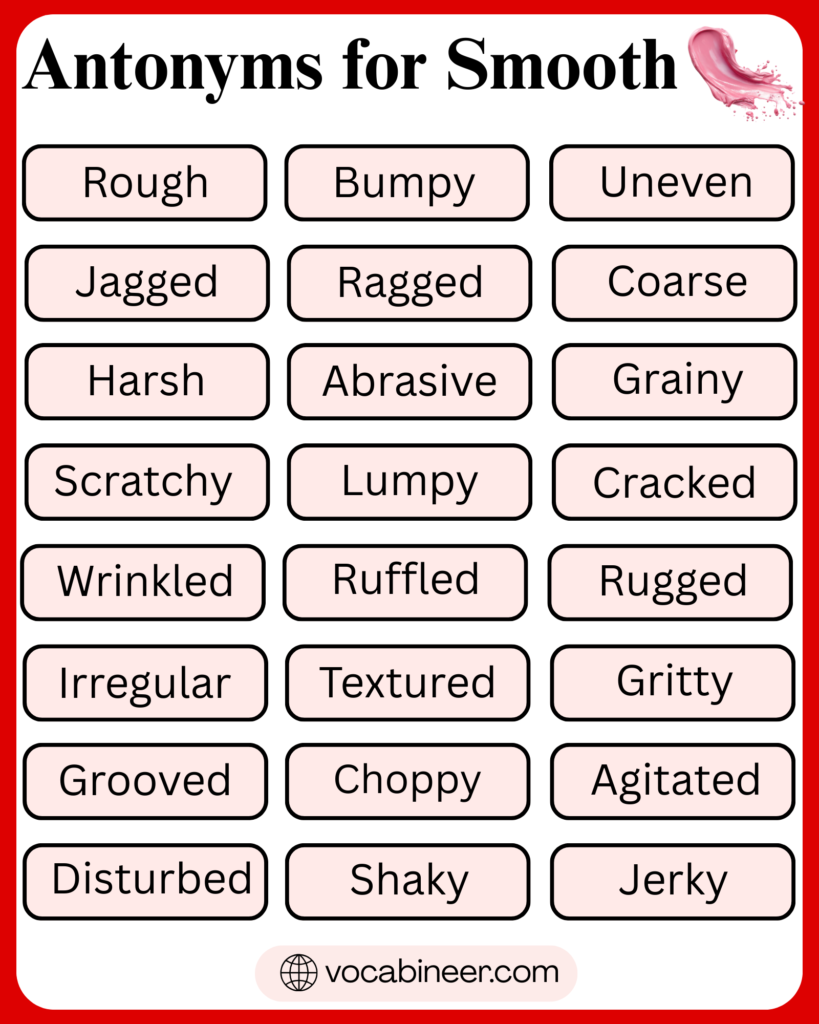
Antonyms for Smooth by Context
The opposite of smooth can change depending on what kind of smoothness you’re talking about, such as texture, movement, sound, or progress. Choosing the right antonym helps your meaning stay clear and accurate.
Surface and Texture
When smooth refers to physical surfaces, antonyms describe roughness or unevenness.
- Rough – not even to touch
- Uneven – not level
- Coarse – harsh in texture
- Grainy – sandy or gritty
- Jagged – sharp and irregular
Movement and Motion
When smooth refers to motion, antonyms describe interruption or difficulty.
- Bumpy – full of jolts
- Jerky – sudden and uneven
- Choppy – broken or uneven
- Rough – not flowing well
- Unsteady – lacking balance
Speech and Sound
When smooth refers to speech or sound, antonyms focus on harshness or breaks.
- Harsh – unpleasant to hear
- Rough – lacking ease or flow
- Grating – irritating to hear
- Broken – not continuous
- Strained – forced or tense
Process and Progress
When smooth refers to how something proceeds, antonyms describe problems or resistance.
- Difficult – not easy to continue
- Rocky – full of problems
- Troubled – affected by issues
- Disrupted – interrupted unexpectedly
- Uneven – inconsistent progress
Smooth vs Similar Words
Understanding smooth vs similar words helps readers choose the right term based on texture, movement, sound, or progress. Some words focus on surface feel, while others describe flow, finish, or ease. The table below shows how these words differ in meaning and use.
| Word | Meaning & Usage |
|---|---|
| Smooth | Even, easy, or flowing without bumps or interruptions. |
| Soft | Gentle to touch, but not always even or flat. |
| Flat | Level across a surface, though it may not feel smooth. |
| Polished | Made smooth and shiny through treatment or effort. |
| Sleek | Smooth and glossy in appearance, often stylish. |
| Even | Level or consistent, not necessarily smooth to touch. |
| Silky | Very smooth and soft, like silk. |
| Fluid | Smooth in movement or flow, without stops. |
| Calm | Smooth in mood or behavior, not physical texture. |
| Effortless | Smooth in action or process, needing little effort. |
How to Choose the Right Antonym for Smooth
Choosing the right antonym for smooth depends on what you are describing. For surfaces or textures, words like rough, uneven, or coarse fit best. When talking about movement or motion, bumpy, jerky, or choppy work naturally. For sound or speech, harsh, grating, or strained are more accurate. When smooth refers to progress or processes, rocky, troubled, or disrupted clearly express the opposite.
Conclusion
Understanding antonyms for smooth helps you describe surfaces, movements, speech, and processes that are not even or easy. Whether you are talking about a rough surface, a bumpy ride, harsh speech, or difficult progress, knowing the right opposite words makes communication clearer and more precise in everyday learning and communication.
Read More
