
Learning antonyms for win helps readers understand how English expresses loss, failure, defeat, or lack of success instead of victory or achievement. When winning does not occur, language shifts to reflect losing, surrender, disappointment, or setback, making changes in outcome easier to recognize. These opposite words appear often in stories, school texts, conversations, sports commentary, and descriptive writing, shaping how results, emotions, and consequences are clearly communicated and understood.
In This Page
What Does Win Mean in English?
Win means to achieve victory, succeed in a competition, gain a prize, or accomplish a desired result. It can describe success in games, sports, elections, exams, arguments, or personal goals. Win often suggests effort, skill, strategy, or luck that leads to a positive outcome.
The word win is common in school activities, sports, workplace achievements, storytelling, and daily conversation. When winning is absent, English uses different words to express loss, defeat, or failure.
Common Antonyms for Win
Some words clearly express the opposite of win by showing loss, defeat, failure, or giving up instead of success or victory. These antonyms appear often in school texts, sports commentary, conversations, and descriptive writing.
- Lose: To fail to win a game, contest, or competition.
- Fail: To not succeed in achieving a goal or result.
- Concede: To admit defeat or accept loss.
- Forfeit: To lose because of rule breaking or withdrawal.
- Surrender: To give up control or stop fighting.
- Fall short: To not reach the required level of success.
- Miss: To fail to achieve a target or opportunity.
- Collapse: To fail suddenly under pressure.
- Flop: To be completely unsuccessful.
- Stumble: To make mistakes that lead to failure.
- Drop out: To quit before finishing a competition or task.
- Withdraw: To remove oneself from a contest or effort.
- Yield: To give way or submit to defeat.
- Abandon: To give up completely.
- Relinquish: To give up a claim, position, or effort.
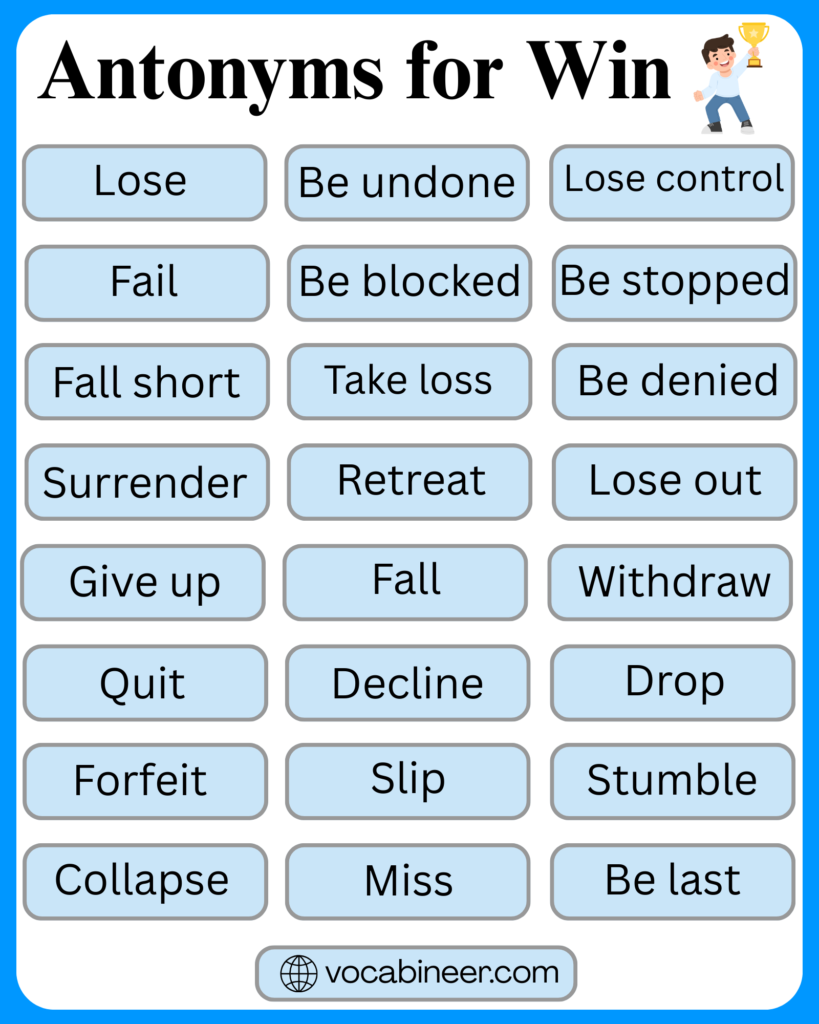
Antonyms for Win Related to Defeat
Some antonyms focus directly on losing a competition or struggle.
- Lose: Being defeated by another.
- Concede: Accepting defeat.
- Forfeit: Losing because of breaking rules.
- Surrender: Giving up control.
- Yield: Giving way to an opponent.
Antonyms for Win Related to Failure
Some antonyms emphasize unsuccessful effort rather than direct defeat.
- Fail: Not achieving the desired result.
- Miss: Not hitting a goal or target.
- Fall short: Not reaching expectations.
- Flop: Complete failure.
- Misfire: Attempt that fails.
Antonyms for Win Related to Giving Up
Some antonyms express stopping effort or withdrawing from struggle.
- Quit: Stopping before completion.
- Withdraw: Pulling out of competition.
- Drop out: Leaving an activity early.
- Abandon: Giving up completely.
- Relinquish: Letting go of effort or claim.
Words Related to Loss and Defeat
Some words support the idea of not winning without directly replacing the word.
- Defeat: State of losing.
- Loss: Absence of victory.
- Failure: Lack of success.
- Setback: Temporary defeat.
- Downfall: Major failure.
Win vs Similar Words
Below is a comparison showing how win differs from related words in meaning and use.
| Word | Difference from Win |
|---|---|
| Win | Means to achieve victory or success in a competition, contest, or effort. |
| Beat | Focuses on defeating an opponent directly, rather than overall success. |
| Succeed | Emphasizes reaching a goal, not necessarily through competition. |
| Triumph | Suggests a powerful or emotional victory after struggle. |
| Conquer | Highlights overcoming strong resistance or difficulty. |
| Prevail | Focuses on lasting success after conflict or challenge. |
| Achieve | Means reaching a result through effort, not always involving competition. |
| Gain | Refers to obtaining something beneficial, not necessarily winning. |
Antonyms for Win in Sentences
Seeing antonyms used in sentences helps learners understand natural usage.
- The team lost the final match.
- She failed the entrance exam.
- He conceded defeat gracefully.
- The runner collapsed near the finish line.
- They withdrew from the tournament.
- The project fell short of expectations.
How to Choose the Right Antonym for Win
Choosing the correct antonym depends on context. If the focus is competition, lose, concede, or forfeit works best. If the focus is effort or goals, fail, miss, or fall short fits better. When effort stops, quit, withdraw, or abandon is more accurate.
Understanding whether the situation involves defeat, failure, or surrender helps select the most natural antonym.
Why Learning Antonyms for Win Matters
Understanding antonyms for win helps readers recognize contrast between success and failure. These words explain how victory becomes defeat and how achievement turns into loss. They help describe emotional reactions, effort, competition, and consequences clearly.
Learning these opposites improves reading comprehension, writing clarity, and emotional expression.
Conclusion
Understanding antonyms for win helps readers recognize how English expresses loss, failure, defeat, or surrender instead of victory and success. These words appear across stories, school texts, sports commentary, and conversations, shaping how outcomes and emotions are described. Learning them through explanation and sentence use builds clearer expression and deeper understanding of success and failure in English.
Read More