

Blond vs Blonde often confuses writers because both words refer to light-colored hair. However, the difference depends on gender and regional usage rather than meaning.
Understanding Blond vs Blonde helps you write accurately in descriptive writing, journalism, and everyday communication. Therefore, this guide explains their definitions, grammar roles, usage patterns, and regional preferences so you can choose the correct form confidently.
In This Page
Blond vs Blonde: Quick Definition
Blond refers to a person or hair with light yellow or golden color.
Blonde also refers to a person or hair with light yellow or golden color.
In simple terms, both words describe light-colored hair.
Blond vs Blonde Difference in One Sentence
Blond is typically used for males.
Blonde is typically used for females.
Why Blond and Blonde Are Often Confused?
Blond and Blonde are often confused because they look almost identical and share the same meaning. In addition, pronunciation does not clearly distinguish them in everyday speech. As a result, many writers assume the difference is optional or purely stylistic.
However, the distinction originally comes from French grammar. In French, adjectives change form depending on gender. Therefore, Blond traditionally refers to males, while Blonde refers to females. Although modern English does not require gendered adjectives, this spelling difference has remained in usage.
Regional variation also affects confusion. American English sometimes uses Blond for both genders, especially when describing hair color. Meanwhile, British English more often maintains the traditional distinction. Thus, misunderstanding usually arises from differences in gender rules and regional preference.
Word Origin and Etymology
Blond and Blonde come from the Old French word blond, meaning light-colored or fair. In French, the masculine form is blond, and the feminine form is blonde. English borrowed both spellings and kept the gender distinction in many contexts.
Over time, English simplified many gender-based spellings. However, Blonde is still commonly used for women and girls, especially when referring to a person. Meanwhile, Blond is typically used for men or as a general adjective describing hair color. Therefore, the spelling difference reflects historical influence rather than a change in meaning.
Meaning of Blond
Blond refers to light yellow or golden hair color. It is traditionally used to describe males or to describe hair in general. Therefore, you often see Blond used when referring to a man or when the word functions purely as an adjective.
In addition, Blond can function as both an adjective and a noun.
Definition of Blond
Blond means having light-colored hair, typically yellow or golden.
In simple terms, it describes a fair hair color.
Blond as Part of Speech
Blond functions as an adjective and sometimes as a noun.
As an adjective:
- He has blond hair.
- The blond actor won the award.
- A tall blond man entered the room.
- The child has blond curls.
- The blond boy smiled.
- He dyed his hair blond.
- A blond surfer walked by.
- The blond athlete waved.
- He noticed the blond student.
- A blond puppy ran across the yard.
As a noun (less common, usually for males):
- The blond sat quietly.
- He was the only blond in the group.
Common Uses and Collocations of Blond
Common patterns include:
- Blond hair
- Blond boy
- Blond man
- Blond actor
- Dyed blond
- Natural blond
- Light blond
- Dirty blond
These combinations show that Blond is typically used for males or for describing hair color in general, especially in American English.
Meaning of Blonde
Blonde refers to light yellow or golden hair color, traditionally used for females. Therefore, it commonly describes women and girls with fair hair. In addition, Blonde can function as both an adjective and a noun.
Definition of Blonde
Blonde means having light-colored hair, typically yellow or golden, especially when referring to females.
In simple terms, it describes a woman or girl with fair hair.
Blonde as Part of Speech
Blonde functions as an adjective and as a noun.
As an adjective:
- She has blonde hair.
- The blonde actress smiled.
- A young blonde woman entered the room.
- The blonde singer performed.
- She dyed her hair blonde.
- A blonde student asked a question.
- The blonde model posed for photos.
- A confident blonde athlete won the race.
- The blonde teacher explained the lesson.
- The blonde girl laughed.
As a noun:
- The blonde walked into the café.
- She was the only blonde in the class.
- The blonde answered the question.
- Everyone noticed the tall blonde.
- The blonde introduced herself.
Common Uses and Collocations of Blonde
Common patterns include:
- Blonde hair
- Blonde woman
- Blonde actress
- Blonde girl
- Natural blonde
- Dyed blonde
- Platinum blonde
- Blonde highlights
These patterns show that Blonde is traditionally used when referring to females, especially in descriptive writing.
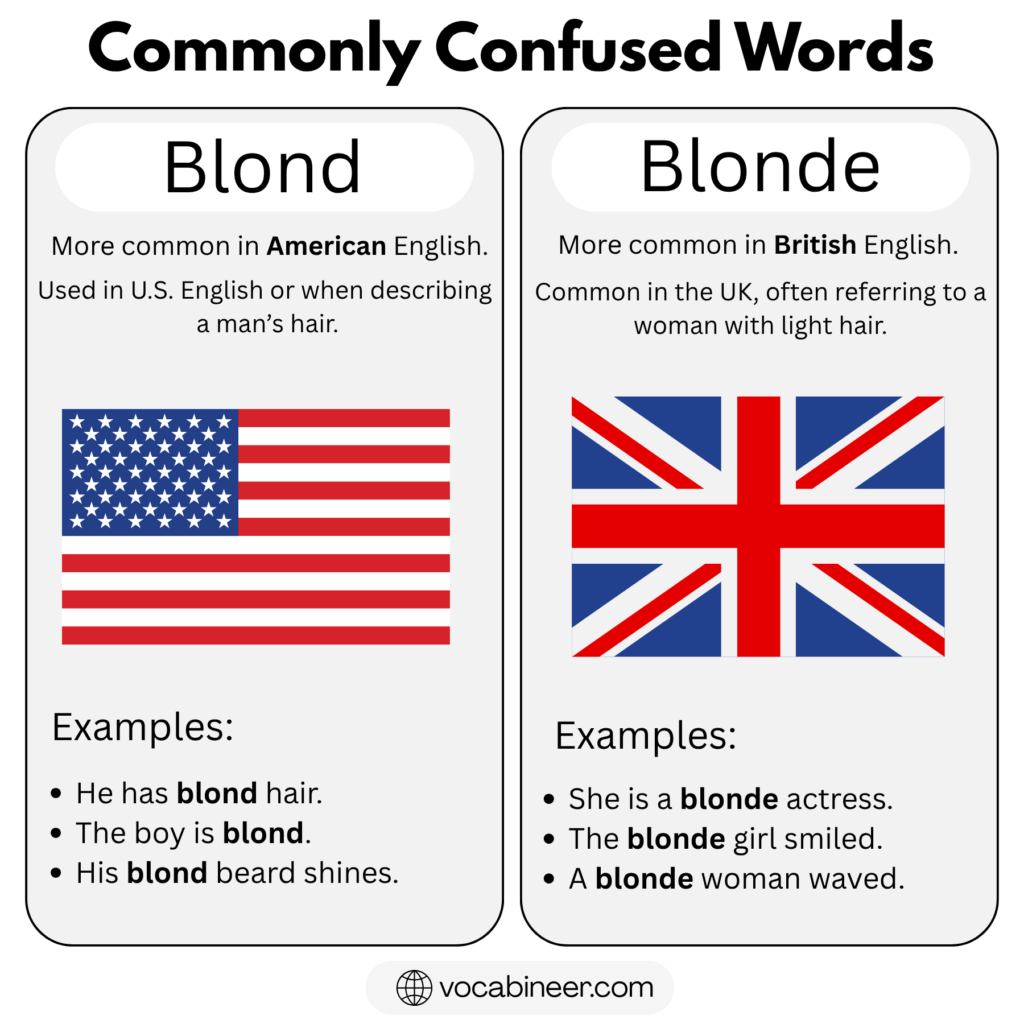
Blond vs Blonde: Key Difference Explained
Although Blond and Blonde describe the same light hair color, their difference lies in gender usage and regional preference. Traditionally, Blond is used for males and as a general adjective, while Blonde is used for females.
The distinction comes from French grammar, where adjectives change form based on gender. English borrowed both forms and kept this difference in many contexts. However, in modern American English, Blond is sometimes used for both genders, especially when describing hair color rather than a person. In short, the meaning remains the same, but spelling may change depending on gender and region.
Blond vs Blonde: Difference in One Look
| Feature | Blond | Blonde |
|---|---|---|
| Meaning | Light yellow hair color | Light yellow hair color |
| Part of Speech | Adjective / Noun | Adjective / Noun |
| Traditional Use | Males / General hair description | Females |
| Origin | French masculine form | French feminine form |
| Regional Variation | Common in American English | More common in British English for females |
| Interchangeable in Meaning? | Yes (with stylistic differences) | Yes (with stylistic differences) |
This comparison shows that the difference is based mainly on gender tradition and style rather than meaning.
Blond vs Blonde: Side by Side Sentence Contrast
Since both words describe the same hair color, the difference appears mainly in gender reference. Therefore, comparing similar sentences helps clarify usage.
- He is a blond actor.
- She is a blonde actress.
- The blond boy smiled.
- The blonde girl smiled.
- A tall blond man entered the room.
- A tall blonde woman entered the room.
- He dyed his hair blond.
- She dyed her hair blonde.
In each pair, the meaning stays the same. The spelling changes based on the person’s gender.
Blond vs Blonde: Sentence Structure Comparison
Because both words function as adjectives and nouns, their grammatical structure is similar.
Common patterns:
- Blond/Blonde hair
- A blond/blonde person
- Natural blond/blonde
- Dyed blond/blonde
- Platinum blonde
Therefore, both forms appear before nouns as adjectives or stand alone as nouns. The only difference lies in traditional gender usage and stylistic preference.
When to Use Blond and Blonde
Choosing between Blond and Blonde depends mainly on gender and regional style. Traditionally, Blond is used for males or as a general adjective describing hair color. Therefore, it often appears when referring to a man or to hair without emphasizing gender.
However, Blonde is traditionally used for females. It commonly describes women and girls with light-colored hair. Thus, when referring specifically to a female person, Blonde is usually preferred.
In modern American English, some writers use Blond for both genders when describing hair color. Nevertheless, many publications still follow the traditional distinction. Therefore, consider your audience and style guide before choosing.
Context Based Usage Guide
When referring to a male person, use Blond:
- A blond man walked in.
- The blond actor won an award.
- He has blond hair.
- The blond athlete smiled.
- A blond boy answered the question.
For a female person, use Blonde:
- A blonde woman entered the room.
- The blonde actress waved.
- She has blonde hair.
- The blonde singer performed.
- A confident blonde student spoke up.
When describing hair color in general, especially in American English, Blond may apply to both genders. Even so, maintain consistency throughout your writing.
Grammar Difference Between Blond and Blonde
Although Blond and Blonde share the same meaning, their grammatical usage differs slightly based on gender reference. Both words can function as adjectives and nouns. However, traditional English keeps the masculine form Blond and the feminine form Blonde when referring to people.
| Grammar Feature | Blond | Blonde |
|---|---|---|
| Part of Speech | Adjective / Noun | Adjective / Noun |
| Traditional Gender Use | Male / General | Female |
| Used Before Nouns | Blond man | Blonde woman |
| Used as Noun | A blond | A blonde |
| Used for Hair (General) | Blond hair | Blonde hair (for females) |
| Regional Variation | Often neutral in American English | Maintained for females in British English |
| Interchangeable? | Sometimes (hair description) | Sometimes (hair description) |
This table shows that the difference is based on traditional gender usage rather than grammar structure.
Pronunciation Difference Between Blond and Blonde
Blond and Blonde are pronounced the same in standard English. Therefore, pronunciation does not help distinguish between them. The difference appears only in spelling and writing.
As a result, correct usage depends on context, gender reference, and regional style rather than sound.
Common Mistakes With Blond and Blonde
Blond vs Blonde mistakes usually happen when writers ignore gender distinction or mix spelling inconsistently. Although both words mean the same hair color, traditional usage still matters in many contexts.
- Incorrect: The blonde man smiled.
Correct: The blond man smiled. - Incorrect: The blond woman entered the room (in formal writing).
Correct: The blonde woman entered the room. - Incorrect: She has blond hair and is a natural blonde (mixed without reason).
Better: Keep usage consistent depending on style. - Incorrect: A tall blonde man waved.
Correct: A tall blond man waved. - Incorrect: Mixing Blond and Blonde randomly in the same article.
Correct: Follow gender-based distinction or a consistent style guide.
Therefore, always check whether the word refers to a male, a female, or hair in general, and maintain consistent spelling throughout your writing.
FAQs
Blond vs Blonde often raises questions about gender usage and modern writing style. Although both words describe the same hair color, their spelling traditionally depends on gender. Below are the five most common questions.
Both are correct. Blond traditionally refers to males, while Blonde refers to females when describing a person.
Blond is traditionally used for males and sometimes for general hair description.
Blonde is traditionally used for females, especially when referring to a woman or girl.
Yes, especially in American English, Blond may describe hair for both males and females.
It depends on your style guide. Many formal publications still follow traditional gender-based spelling for clarity and consistency.
Final Summary
Blond and Blonde describe the same light hair color. The difference lies in traditional gender usage. Blond is typically used for males, while Blonde is used for females. However, modern American English sometimes uses Blond more broadly. Therefore, choose based on gender reference and maintain consistency throughout your writing.
Read More
- Confusing Words in English
- American vs British Words
- Ageing vs Aging in English
- Among vs Amongst in English
