

Breath vs Breathe often causes confusion because the words look nearly identical but function differently in grammar. Although both relate to respiration, one names the air taken in or released, while the other describes the action of inhaling and exhaling.
Understanding Breath vs Breathe helps you choose the correct form in structured writing and daily communication. This article explains their meaning, grammar roles, pronunciation difference, and usage patterns so you can apply them accurately.
In This Page
Breath vs Breathe: Quick Definition
Breath is a noun that means the air you take in or let out.
Breathe is a verb that means to take air into and out of the lungs.
The key difference in Breath vs Breathe is noun versus verb.
Breath vs Breathe Difference in One Sentence
Breath is the air itself.
Breathe is the act of taking in or releasing that air.
Why Breath and Breathe Are Often Confused?
Breath and Breathe are often confused because they differ by only one letter. In addition, they relate to the same physical process of respiration. Therefore, writers sometimes mix them up in sentences.
However, their grammar roles are different. Breath is a noun, while Breathe is a verb. As a result, confusion usually happens when writers ignore sentence structure and focus only on meaning.
Word Origin and Etymology
The history of Breath vs Breathe shows that both words come from Old English roots connected to air and respiration. Breath developed as the noun form referring to air taken in or out. Breathe developed as the verb form describing the action of inhaling and exhaling.
Over time, English separated the noun and verb by adding the final “e” to mark the verb form. Therefore, the spelling difference signals the grammar difference.
What Does Breath Mean?
Breath refers to the air that is inhaled or exhaled from the lungs. In this word pair, Breath always names the air itself.
Definition of Breath
Breath means the air taken into or released from the lungs.
It functions as a noun.
Breath as a Noun
Because Breath is a noun, it does not show action. It names the air or a single act of inhaling or exhaling.
Examples using Breath:
- Take a deep breath.
- She held her breath.
- I could feel his warm breath.
- He was out of breath after running.
- Her breath was steady.
- The cold air took my breath away.
- He caught his breath.
- She released a long breath.
- His breath smelled fresh.
- The swimmer took one last breath.
- I lost my breath while climbing.
- The baby’s breath was calm.
- She drew a slow breath.
- He paused for breath.
- The doctor checked his breath.
- His quick breath showed anxiety.
- I could see my breath in the cold.
- She gasped for breath.
- The singer took a steady breath.
- His breath formed a cloud in winter.
Notice that Breath names the air itself, not the action.
Common Uses and Collocations of Breath
- Take a breath
- Catch your breath
- Hold your breath
- Out of breath
- Short of breath
- Lose your breath
- Deep breath
- Fresh breath
- Last breath
- Warm breath
- Cold breath
- Quick breath
- Slow breath
- Steady breath
- Heavy breath
- Labored breath
- Calm breath
- Visible breath
- Single breath
- Final breath
What Does Breathe Mean?
Breathe describes the action of taking air into the lungs and releasing it. In the Breath vs Breathe contrast, Breathe always shows the physical act of inhaling and exhaling.
Unlike Breath, which names the air itself, Breathe expresses what someone does with that air.
Definition of Breathe
Breathe means to inhale and exhale air.
It functions as a verb.
Breathe as a Verb
Because Breathe is a verb, it connects to a subject that performs the action. It can change tense and appear with modal verbs.
Examples using Breathe:
- I can breathe easily now.
- She breathes slowly.
- He breathed deeply.
- We must breathe calmly.
- The patient struggled to breathe.
- She breathed in the fresh air.
- He breathes through his nose.
- They paused to breathe.
- I could hardly breathe.
- She breathed out slowly.
- The child breathes quietly.
- He breathed a sigh of relief.
- We should breathe deeply during exercise.
- She breathes carefully after surgery.
- He breathed rapidly.
- I will breathe more slowly.
- She has breathed steadily all night.
- They tried to breathe normally.
- He breathes with difficulty.
- She breathed softly.
Notice the pattern. Breathe changes form depending on tense and subject because it is a verb.
Common Uses and Collocations of Breathe
- Breathe deeply
- Breathe slowly
- Breathe in
- Breathe out
- Breathe calmly
- Breathe easily
- Breathe normally
- Breathe freely
- Breathe steadily
- Breathe heavily
- Breathe rapidly
- Breathe quietly
- Breathe softly
- Breathe carefully
- Breathe through
- Breathe hard
- Breathe comfortably
- Breathe again
- Breathe properly
- Breathe deeply and slowly
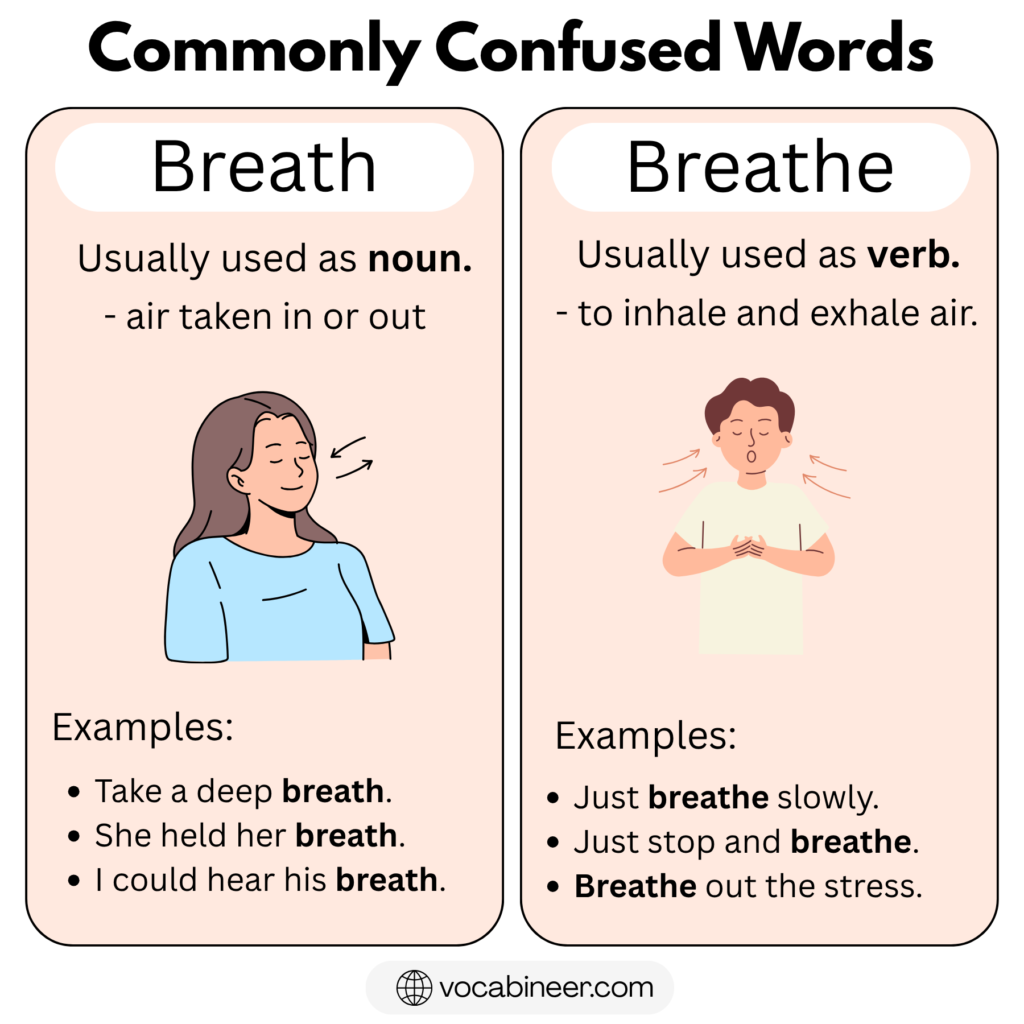
Breath vs Breathe: Key Difference Explained
The main difference in Breath vs Breathe depends on grammar role. Breath is a noun. Breathe is a verb. One names the air taken in or released, while the other shows the action of taking in that air.
If the sentence needs a thing, use Breath.
If the sentence needs an action, use Breathe.
Here is the difference in one sentence:
Breath is the air itself.
Breathe is the act of inhaling or exhaling.
Breath vs Breathe: Difference in One Look
| Feature | Breath | Breathe |
|---|---|---|
| Part of Speech | Noun | Verb |
| Meaning | Air taken in or out | To inhale and exhale |
| Shows Action | No | Yes |
| Changes Form | No | Yes, breathes, breathed |
| Replace With | Air | Inhale |
Notice something important. Because Breathe is a verb, it changes tense. Breath does not change form.
Breath vs Breathe: Side by Side Sentence Contrast
- Take a deep breath.
- Please breathe deeply.
- He held his breath.
- He struggled to breathe.
- I lost my breath while running.
- I could not breathe properly.
In each pair, Breath names the air. Breathe shows the action of using that air.
Breath vs Breathe: Sentence Structure Comparison
Understanding sentence structure makes the difference clearer.
| Structure Type | Breath Pattern | Breathe Pattern |
|---|---|---|
| Basic Pattern | Take a breath | Breathe deeply |
| With Verb | Catch your breath | She breathed slowly |
| With Modal | Need a breath | Must breathe calmly |
| Negative Form | No breath left | Could not breathe |
| Tense Change | Does not change | Breathes, breathed |
If the word needs tense change or follows a subject performing an action, it is usually Breathe. If it names the air itself, it is usually Breath.
When to Use Breath and Breathe
Choosing between Breath vs Breathe becomes simple when you check whether the sentence needs a noun or a verb. Ask yourself whether the word names the air or describes the action of inhaling and exhaling.
Use Breath when the sentence refers to:
- Air from the lungs
- A single inhalation
- A pause for air
- Physical breathing state
Examples:
- Take a deep breath.
- He was out of breath after running.
- She held her breath.
- I could see my breath in the cold.
- He caught his breath quickly.
- The singer took one steady breath.
- She gasped for breath.
- His warm breath fogged the glass.
- He paused for breath.
- The doctor listened to his breath.
Use Breathe when the sentence refers to:
- Inhaling air
- Exhaling air
- The physical act of respiration
- Regaining calmness
Examples:
- Please breathe slowly.
- She breathed deeply before speaking.
- He struggled to breathe.
- We must breathe calmly during exercise.
- I can finally breathe easily.
- She breathes through her nose.
- He breathed in the fresh air.
- Try to breathe steadily.
- The patient could not breathe properly.
- She has breathed calmly all night.
If the word names the air, choose Breath. If the word shows the action of inhaling or exhaling, choose Breathe.
Context Based Usage Guide
Context often signals the correct choice in Breath vs Breathe.
Breath commonly appears:
- After verbs like take, catch, hold, lose
- With adjectives like deep, short, steady
- In phrases about physical state
Examples:
- Take a deep breath.
- Catch your breath.
- He was short of breath.
- She released a slow breath.
Breathe commonly appears:
- After modal verbs like can, must, should
- Before adverbs like slowly, deeply, easily
- In action-based sentences
Examples:
- You must breathe slowly.
- She can breathe clearly now.
- He breathed softly.
- Try to breathe deeply.
You may notice a helpful clue. If the word can change tense to breathed or breathes, it must be Breathe, not Breath.
Grammar Difference Between Breath and Breathe
The grammar difference between Breath vs Breathe is direct.
Breath is a noun.
Breathe is a verb.
Breath does not change form:
- His breath was steady.
- She lost her breath.
Breathe changes tense:
- She breathes slowly.
- She breathed deeply.
- She will breathe calmly.
If the sentence needs a verb that shows action, use Breathe. If it needs a noun that names the air itself, use Breath.
Pronunciation Difference Between Breath and Breathe
Although Breath vs Breathe look almost the same, their pronunciation clearly separates them. The difference appears in the final sound.
Breath ends with a soft “th” sound, like in the word thin.
Breathe ends with a voiced “th” sound, like in the word this.
Below is a quick pronunciation comparison:
| Feature | Breath | Breathe |
|---|---|---|
| Part of Speech | Noun | Verb |
| Final Sound | Soft “th” sound | Voiced “th” sound |
| Changes Form | No | Yes |
| Example Form | Breath | Breathes, breathed |
Say them slowly:
Breath
Breathe
The small sound difference helps signal noun versus verb in this word pair.
Common Mistakes With Breath and Breathe
Most mistakes in Breath vs Breathe happen when writers use the noun instead of the verb or the verb instead of the noun. Since the words differ by only one letter, the error often goes unnoticed.
Below are common mistakes with corrections.
- Incorrect: I need to breath deeply.
Correct: I need to breathe deeply. - Incorrect: Take a deep breathe.
Correct: Take a deep breath. - Incorrect: He could not breath properly.
Correct: He could not breathe properly. - Incorrect: She took a long breathe.
Correct: She took a long breath. - Incorrect: I cannot breath in the smoke.
Correct: I cannot breathe in the smoke. - Incorrect: Catch your breathe.
Correct: Catch your breath. - Incorrect: He held his breathe.
Correct: He held his breath. - Incorrect: Try to breath slowly.
Correct: Try to breathe slowly. - Incorrect: She lost her breathe while running.
Correct: She lost her breath while running. - Incorrect: He stopped to catch his breathe.
Correct: He stopped to catch his breath.
Notice the pattern. When the sentence needs an action word, use Breathe. When it needs the noun referring to air, use Breath.
FAQs
The difference in Breath vs Breathe is grammar role. Breath is a noun that refers to the air taken in or released from the lungs. Breathe is a verb that means to inhale and exhale air.
No. Breath is not a verb. It is a noun that names the air itself. For example, Take a deep breath uses Breath as a thing, not an action.
No. Breathe is a verb. It describes the action of inhaling and exhaling. For example, Please breathe slowly shows the action being performed.
The extra “e” at the end of Breathe signals the verb form. If the word needs tense change like breathed or breathes, it must be Breathe, not Breath.
No. The correct form is breathe deeply because the sentence requires a verb showing action. Breath cannot be used as a verb in standard English.
Final Summary
Breath vs Breathe may look nearly identical, but their grammar roles are clearly different. Breath is a noun that names the air taken in or released. Breathe is a verb that describes the action of inhaling and exhaling. If the sentence shows action, choose Breathe. If it names the air itself, choose Breath. Understanding this noun versus verb contrast prevents common writing mistakes and strengthens sentence accuracy.
Read More
