

Capital vs Capitol often creates confusion because the words look almost identical but refer to very different things. One usually relates to cities, money, or importance, while the other refers specifically to a government building. Their spelling difference reflects a broader meaning versus a specific place.
Understanding Capital vs Capitol helps you choose the correct word in structured writing, academic contexts, and formal communication. This article explains their meaning, grammar roles, usage patterns, sentence structure, and common mistakes so you can apply them accurately.
In This Page
Capital vs Capitol: Quick Definition
Capital refers to a city, money, or something important.
Capitol refers to a building where lawmakers meet.
The key difference in Capital vs Capitol is general meaning versus specific government building.
Capital vs Capitol Difference in One Sentence
Capital can mean a city or financial resources.
Capitol is the building where a legislature meets.
Why Capital and Capitol Are Often Confused?
Capital and Capitol are often confused because they differ by only one letter. In addition, both words are connected to government and public institutions. Therefore, writers sometimes use them interchangeably.
However, their meanings are not the same. Capital has several meanings, including city and money, while Capitol refers only to a legislative building. As a result, confusion usually happens when writers focus on sound rather than meaning.
Word Origin and Etymology
The history of Capital vs Capitol shows that both words come from the Latin root caput, meaning head. Capital developed to describe something important, chief, or central, such as a capital city. Capitol developed from the name of the Capitoline Hill in ancient Rome, where important government buildings stood.
Over time, English separated the broader meaning of Capital from the specific building meaning of Capitol. Therefore, even though the words share a root related to importance, their modern meanings differ clearly.
What Does Capital Mean?
Capital has multiple meanings depending on context. It can refer to a city, financial assets, uppercase letters, or something of major importance.
Definition of Capital
Capital means a city that serves as the seat of government, financial resources, or something chief or important.
It functions as a noun or adjective.
Capital as a Noun
Because Capital can function as a noun, it often names a city or financial resources.
Examples using Capital as a city:
- Paris is the capital of France.
- Tokyo is the capital of Japan.
- Islamabad is the capital of Pakistan.
- Ottawa is the capital of Canada.
- Rome is the capital of Italy.
- Madrid is the capital of Spain.
- Berlin is the capital of Germany.
- Cairo is the capital of Egypt.
- Canberra is the capital of Australia.
- Beijing is the capital of China.
Examples using Capital as money:
- The company raised more capital.
- Investors provided financial capital.
- The business needs working capital.
- They invested private capital.
- Lack of capital slowed growth.
- Venture capital supported the startup.
- The firm secured additional capital.
- The bank increased its capital reserves.
- The project required large capital.
- He invested personal capital.
Notice that Capital has multiple meanings depending on context.
Common Uses and Collocations of Capital
- Capital city
- Capital gains
- Capital investment
- Capital punishment
- Capital letter
- Capital market
- Capital growth
- Capital expenditure
- Human capital
- Social capital
- Working capital
- Financial capital
- Venture capital
- Political capital
- Capital offense
- Capital improvement
- Capital fund
- Capital reserve
- Capital stock
- Capital assets
What Does Capitol Mean?
Capitol refers specifically to a building where a legislature meets. In the Capital vs Capitol contrast, Capitol does not refer to a city, money, or importance. Instead, it names the physical structure where lawmakers gather to create laws.
Unlike Capital, which has several meanings, Capitol has one primary meaning tied to government buildings.
Definition of Capitol
Capitol means the building in which a state or national legislature meets.
It functions as a noun.
Capitol as a Noun
Because Capitol is a noun, it names a specific place. It does not change form or act as a verb.
Examples using Capitol:
- The governor spoke at the state capitol.
- Lawmakers met inside the capitol.
- The protest took place near the capitol.
- The tour included a visit to the capitol.
- The new bill was debated at the capitol.
- Visitors gathered outside the capitol.
- The state capitol stands downtown.
- Security increased around the capitol.
- The ceremony was held at the capitol.
- Officials worked late at the capitol.
- The historic capitol building attracts tourists.
- The meeting was scheduled at the capitol.
- Reporters waited outside the capitol.
- The governor entered the capitol early.
- The capitol dome is visible from afar.
- The debate continued inside the capitol.
- Students toured the capitol building.
- The event was hosted at the capitol.
- The mayor visited the capitol.
- The bill was signed at the capitol.
Notice something important. Capitol always refers to a government building, not a city.
Common Uses and Collocations of Capitol
- State capitol
- National capitol
- Capitol building
- Capitol dome
- Capitol steps
- Capitol complex
- Capitol tour
- Capitol grounds
- Capitol chamber
- Capitol office
- Capitol hearing
- Capitol protest
- Capitol security
- Capitol event
- Capitol meeting
Each phrase refers to the physical legislative building.
Capital vs Capitol: Key Difference Explained
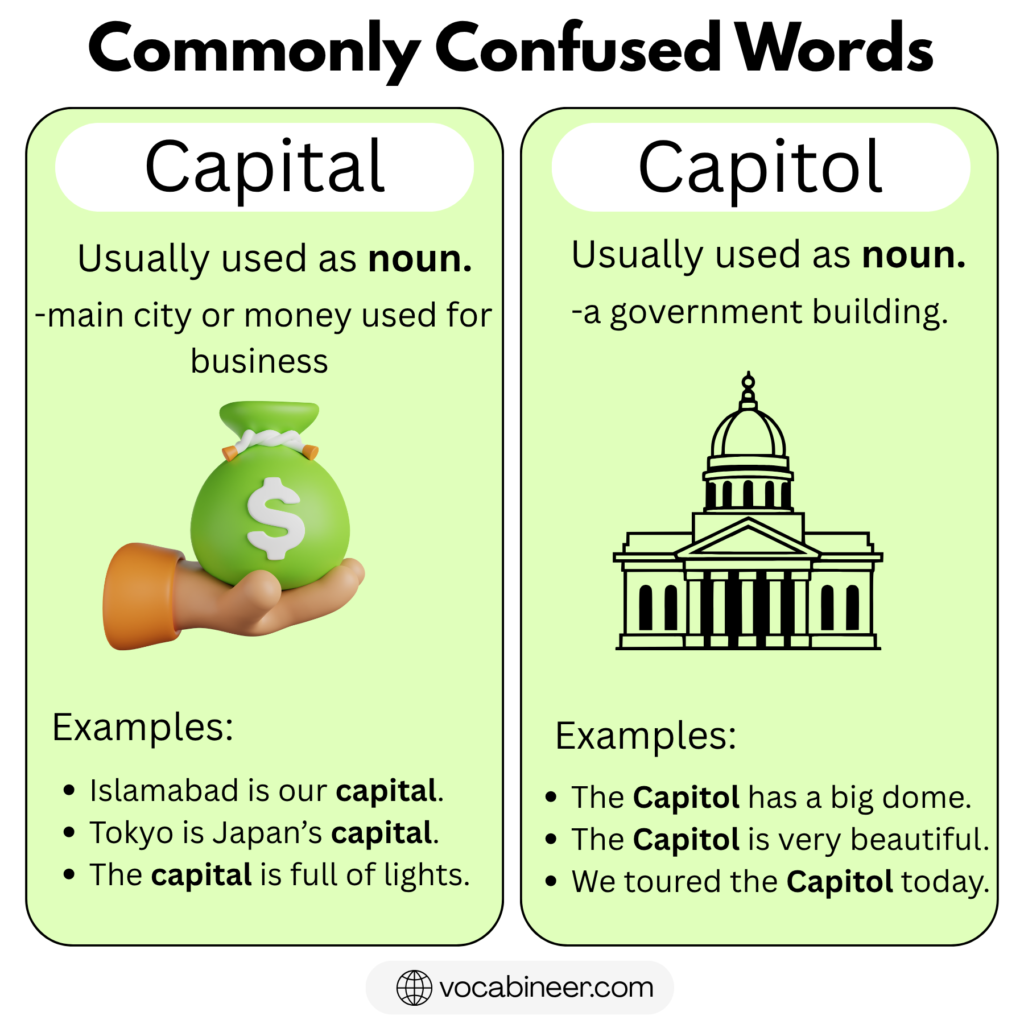
The main difference in Capital vs Capitol depends on meaning scope. Capital has several meanings, including city, money, or something important. Capitol refers only to a government building where lawmakers meet.
If the sentence refers to a city or financial resources, use Capital.
If the sentence refers to a legislative building, use Capitol.
Here is the difference in one sentence:
Capital can mean a city or financial resources.
Capitol is the building where a legislature meets.
Capital vs Capitol: Difference in One Look
| Feature | Capital | Capitol |
|---|---|---|
| Part of Speech | Noun or adjective | Noun |
| Meaning | City, money, or chief importance | Legislative building |
| Scope | Broad meanings | Specific building |
| Replace With | City, funds | Government building |
| Common Context | Finance, geography, grammar | Government, legislature |
Notice something important. Capital can function in multiple contexts, while Capitol has one specific meaning.
Capital vs Capitol: Side by Side Sentence Contrast
- Islamabad is the capital of Pakistan.
- Lawmakers met at the state capitol.
- The company raised more capital this year.
- The protest took place near the capitol.
- She wrote her name in capital letters.
- The governor delivered a speech at the capitol.
In each pair, Capital refers to city, money, or importance. Capitol refers to the building where government officials meet.
Capital vs Capitol: Sentence Structure Comparison
Understanding sentence structure helps prevent confusion.
| Structure Type | Capital Pattern | Capitol Pattern |
|---|---|---|
| City Context | Paris is the capital of France | The meeting was held at the capitol |
| Finance Context | The firm needs more capital | Officials gathered at the capitol |
| Grammar Context | Use a capital letter | The tour included the capitol |
| Adjective Form | Capital investment | State capitol building |
If the sentence discusses geography, finance, or importance, use Capital. If it names the legislative building, use Capitol.
When to Use Capital and When to Use Capitol
Choosing between Capital vs Capitol becomes simple when you focus on meaning. Ask yourself whether the sentence refers to a city, money, importance, or a specific government building.
Use Capital when the sentence refers to:
- A city where government leaders work
- Financial resources or investment funds
- Uppercase letters
- Something chief or important
Examples:
- Rome is the capital of Italy.
- The company raised new capital.
- Write your name with a capital letter.
- The firm secured venture capital.
- Islamabad is the capital of Pakistan.
- The startup needs more working capital.
- He used a capital C in his name.
- The business invested additional capital.
- Tokyo serves as the capital of Japan.
- The project required large financial capital.
Use Capitol when the sentence refers to:
- The building where lawmakers meet
- A state legislative building
- The national legislative building
- A government structure
Examples:
- The governor spoke at the state capitol.
- Lawmakers gathered inside the capitol.
- The protest occurred near the capitol.
- Tourists visited the historic capitol.
- The ceremony was held at the capitol.
- Officials debated the bill in the capitol.
- Students toured the capitol building.
- The governor entered the capitol early.
- Security increased around the capitol.
- The dome of the capitol is visible downtown.
If the word refers to a city, money, or importance, choose Capital. If it refers to the government building, choose Capitol.
Context Based Usage Guide
Context often gives strong clues in Capital vs Capitol decisions.
Capital frequently appears:
- With country or state names
- With words like investment, funds, market
- With grammar terms like letter
- With finance terms
Examples:
- Berlin is the capital of Germany.
- The firm invested venture capital.
- Use a capital letter at the start.
- The bank increased its financial capital.
Capitol frequently appears:
- After state or national references
- With words like building, dome, steps
- In government or legislative contexts
Examples:
- The state capitol building is downtown.
- The protest gathered near the capitol steps.
- The governor signed the bill at the capitol.
- Lawmakers met inside the capitol chamber.
You may notice a helpful clue. If the word refers to a physical building related to government, it must be Capitol, not Capital.
Grammar Difference Between Capital and Capitol
The grammar difference between Capital vs Capitol is based on usage range.
Capital can function as:
- A noun
- An adjective
Examples:
- Paris is the capital of France.
- They invested additional capital.
- Use a capital letter.
Capitol functions only as:
- A noun
Examples:
- The governor visited the capitol.
- The ceremony took place at the capitol.
If the word modifies another noun like investment or letter, it is usually Capital. If it names the legislative building, it is always Capitol.
Pronunciation Difference Between Capital and Capitol
Although Capital vs Capitol look similar, their pronunciation is nearly identical in everyday speech. Both words are commonly pronounced the same way, which increases confusion in writing.
Below is a quick comparison:
| Feature | Capital | Capitol |
|---|---|---|
| Part of Speech | Noun or adjective | Noun |
| Pronunciation | KAP-i-tuhl | KAP-i-tuhl |
| Meaning Scope | Broad meanings | Specific building |
| Changes Form | Yes, as adjective | No |
Because the pronunciation is almost the same, spelling becomes the only clear signal of meaning difference. Therefore, writers must rely on context rather than sound.
Common Mistakes With Capital and Capitol
Most mistakes in Capital vs Capitol happen when writers confuse the city meaning with the government building meaning. Since the words sound the same, spelling errors are common.
Below are frequent mistakes with corrections.
- Incorrect: Islamabad is the capitol of Pakistan.
Correct: Islamabad is the capital of Pakistan. - Incorrect: The governor spoke at the state capital building.
Correct: The governor spoke at the state capitol building. - Incorrect: The protest took place at the capital.
Correct: The protest took place at the capitol. - Incorrect: The company raised more capitol.
Correct: The company raised more capital. - Incorrect: Use a capitol letter at the start.
Correct: Use a capital letter at the start. - Incorrect: The ceremony was held in the capital building.
Correct: The ceremony was held in the capitol building. - Incorrect: The firm secured venture capitol.
Correct: The firm secured venture capital. - Incorrect: Lawmakers met inside the capital.
Correct: Lawmakers met inside the capitol. - Incorrect: She invested private capitol.
Correct: She invested private capital. - Incorrect: The dome of the capital is famous.
Correct: The dome of the capitol is famous.
Notice the pattern. If the word refers to a city, money, or importance, use Capital. If it refers to the legislative building, use Capitol.
FAQs
Capital usually refers to a city, money, or something important. Capitol refers specifically to a government building where lawmakers meet.
No. The city is spelled capital with an “a”. Capitol with an “o” refers only to the legislative building.
No. Capitol does not refer to financial resources. That meaning belongs to capital.
Think of Capitol with an “o” as the building with a dome. Both words contain an “o” shape in memory association.
Both words sound the same and relate to government contexts. Therefore, writers often mix them up based on sound rather than meaning.
Final Summary
Capital vs Capitol may look and sound alike, but their meanings are clearly different. Capital refers to a city, financial resources, uppercase letters, or something of chief importance. Capitol refers only to the government building where lawmakers meet. If the sentence discusses geography, money, or importance, choose Capital. If it names the legislative building, choose Capitol. Understanding this distinction prevents common spelling mistakes and improves sentence accuracy.
Read More
- Confusing Words in English
- Breath vs Breathe in English
- Accept vs Except in English
- Your vs You’re in English
